
A1 Interface and O-RAN Architecture Explained: Key Roles of SMO, RICs, and E2 Nodes
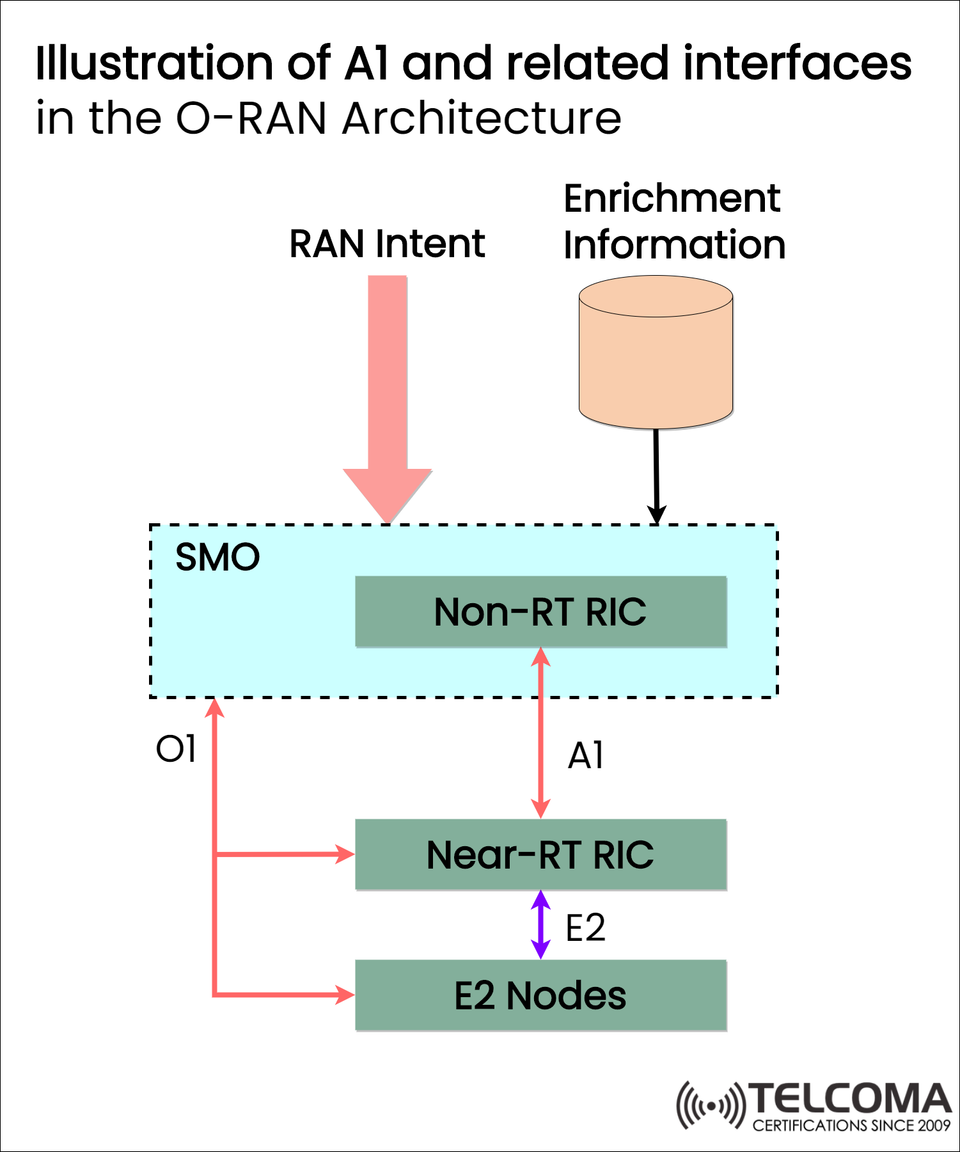

Enabled by O-RAN, the transformation to open and intelligent radio access networks is happening through a new framework that introduces disaggregation, interoperability, and new intelligence to the RAN ecosystem. A foundational component of the O-RAN architecture is the A1 interface, which marries high-level policy-driven controls to real-time responsive Network Elements.
The O-RAN Architecture Components
The diagram below shows a simplified O-RAN reference model and is emphasized against the flow of control and intelligence around the network which is central to the architecture. This is a brief overview of the roles each component plays.
- SMO (Service Management and Orchestration)
The management layer that manages the configuration, fault, and performance of the RAN.
Holds the Non-RT RIC and interfaces with the other components using the O1 interface.
Receives RAN Intent and Enrichment Information to enhance RAN Operation with additional domains which support intelligent optimization conditions in the network.
- Non-RT RIC (Non-Real-Time RAN Intelligent Controller)
Looks above 1 second latency which is best suited for policy management and training AI models.
Generates RAN control policies based on specific user cases, reports them to a Near-RT RIC over the A1 interface.
A1, O1 and E2 Interfaces: Overview
Interface Purpose Source Target
A1 Sends policies, ML models from Non-RT to Near-RT RIC Non-RT RIC Near-RT RIC
O1 FCAPS operations, lifecycle management SMO Near-RT RIC, E2 Nodes
E2 Real-time data/control plane interaction Near-RT RIC E2 Nodes
Why the A1 Interface is Important in O-RAN
As a base enabler for intelligent, intent-based control within the RAN, the A1 interface supports the detaching of strategic from tactical functions, promoting - RANs that are:
More responsive to changing user demands, priority, and network state
Industry-neutral due to standardizes interconnects
AI-literate for offline training of machine learning models to be applied in near-real-time
Conclusion
The A1 interface is significant in O-RAN architecture, supporting the co-existence of policy-based, long-term intelligence and fast. real-time control of RAN functions. With the interconnection of the Non-RT RIC and the Near-RT RIC, the A1 interface will enable an intelligent RAN to be managed by the SMO and resulting in adaptively shuffling processing between the non-RT and Near-RT RIC.
Integration of AI/ML into the O-RAN Architecture One of the characteristics that makes O-RAN truly different than other radio areas is the welcome for AI/ML applications. The architecture is built to accommodate intelligent decision making at multiple layers.
Where AI Fits In:
Component AI/ML Engagement
Non-RT RIC Trains models using historical data, determines policy goals.
A1 Interface Delivers trained models and policy objectives to Near-RT RIC.
Near-RT RIC Applies models for immediate inference and execution on RAN elements.
E2 Nodes Provide telemetry data to improve and test AI models.
The benefit of this modular structure is that you can use many different kinds of data sources to build your AI models, you can test them offline, and deploy them without disrupting real-time operating services.
Here is a practical example of how a policy propagates across interfaces:
Suppose a mobile network operator uses the O-RAN architecture to improve latency for gaming users during "busy hours."
The chain of events may look like this:
Defining RAN Intent: "Make gaming apps no lag / low latency from 5 PM to 9 PM."
SMO & Non-RT RIC:
• Look at historical traffic patterns.
• Train a policy model using ML.
• Set policy: "Apply latency control algorithm to traffic originating from IP ranges X,Y."
Future Roadmap and Industry Adoption
The O-RAN Alliance and industry players are at an accelerated pace with the evolution of these interfaces. Here are some things to anticipate from the A1 and its relevant interfaces:
Improved model lifecycle management via the A1, which will include capability for model versioning, rollback, and validation.
More granular control via A1 policies, from a slice specific granularity to UE specific.
Vendor interoperability testing and certifications to demonstrate cross-platform functions.
More enriched data sources, for example, social trends or weather, that will be required for predictive analytics.
Standardization of exchangeable formats for AI models that will be agreed by vendors and operators.
Operators like Rakuten Mobile, Deutsche Telekom, and AT&T are currently piloting and running these interactions as part of their next-gen RAN implementations.
Final Thoughts
The A1 and relevant interfaces within the O-RAN architecture creates a highly intelligent, open and flexible RAN ecosystem. The low latency interaction provided by A1 allows operators to seamlessly connect their high-level AI strategies to nearly real-time executions, providing an unprecedented level of optimization, automation, and innovation across mobile networks.
📌 Important Steps:
Understand O-RAN Specifications
Go on the O-RAN Alliance website and read the latest technical specifications, particularly:
A1 Interface Specification
O-RAN Architecture Description
Non-RT and Near-RT RIC functional specifications
Pick a Reference Implementation
Choose the implementation to prototype based on your preference for using open-source projects, vendor supported frameworks etc.:
OSC (O-RAN Software Community): Provides the basic RIC and SMO components.
ONAP: Will be helpful for integrating SMO capabilities.
SD-RAN - ONF: Testing xApps and running a Near-RT RIC.
FlexRIC: Lightweight framework for E2 interface implementations.
Get a Simulated or Lab Environment Running
Use network emulators to simulate:
srsRAN - to simulate the RAN nodes.
OpenAirInterface (OAI) - to simulate realistic CU/DU scenarios.
Docker/K8s - to simulate the SMO and RIC microservices.
Develop and Test A1 Policies
Create and start testing A1 policies therein.
Start with a simple use case such as traffic steering or QoS prioritization.
Specify the A1 policy objects in JSON/XML format following O-RAN specifications.
Observe the way your defined policies are implemented in the Near-RT RIC, and how they cause various E2 nodes to behave.
Typical challenges and best practices
🔧 Challenges:
Complexity of onboarding A1 policies with proprietary network elements
No standardized formats for exchange of AI models from various vendors
Latency between policy deployment and corresponding execution of actions
Limited access to enrichment data in test (i.e., sandbox) environments
✅ Best Practices:
Begin everybody's journey with high-level, simple policy objectives before delving into more complicated ML models.
Mock data for enrichment that simulates less than enriched decision-making.
Use containerized data and microservices to ensure modular and, therefore, scalable RIC and SMO deployments.