
AI and ML Enabled Knowledge Plane (KP) in Telecom: Architecture, Control Loops, and Decision Elements
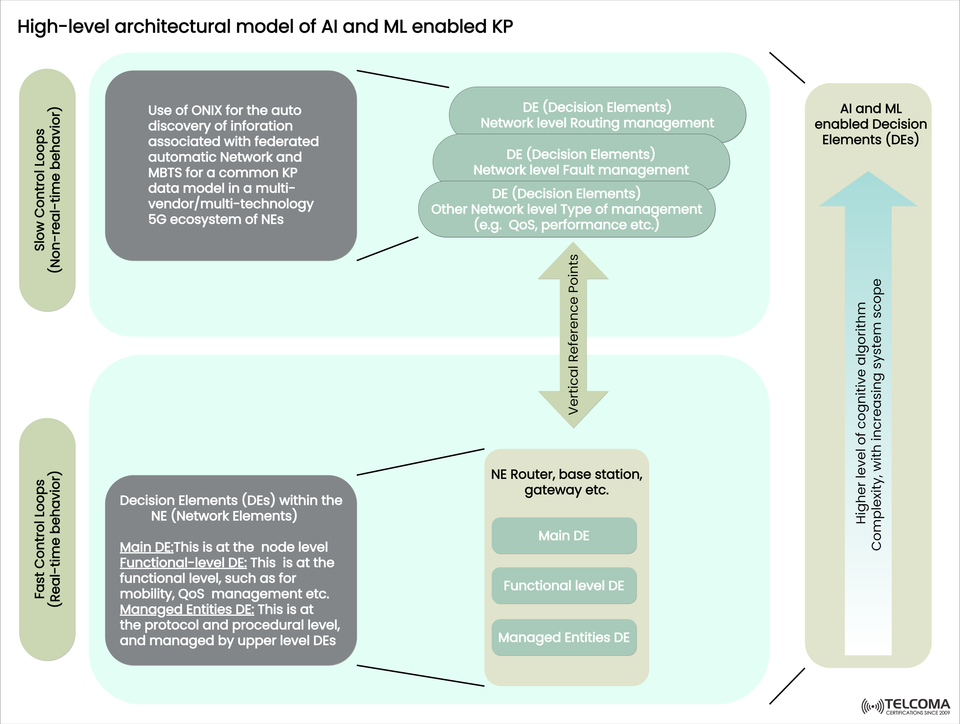

High-Level AI and ML-Enhanced Knowledge Plane Architectural Model in Telecom
The Knowledge Plane (KP) is an essential layer in network architecture as telecom networks transition into more autonomous and intelligent systems, leveraging AI and ML into the KP enables real-time decision making, self-optimization, and cognitive automation across the layers of telecom networks.
The diagram above illustrates a high-level architectural model of an AI and ML-enhanced KP, showing how Decision Elements (DEs) are responsible for managing the various physical and virtualized telecom network elements in a coordinated and intelligent manner act through fast and slow control actions.
What is a Knowledge Plane (KP) in Telecom?
The Knowledge Plane is a conceptual layer in telecom network architecture that sits at the center of the network and is responsible for systems intelligence throughout the entire network, using analytical tools, policies, and learned behaviours to make decisions.
By integrating AI/ML in the KP:
Service providers can immediately predict network behaviour.
Telecom networks become self-optimizing and self-adaptive.
Real-time and non-real-time decision-making is distributed, scalable and reliable.
🧠 AI and ML-Enhanced Decision Elements (DEs)
DEs are the computational and cognitive aspects of the network responsible for:
Routing
Fault management
QoS/performance optimization
Mobility and session control
There are different types of layers that work at different levels, including:
Main DE: Intelligence at the node-level (e.g., routers, base stations)
Functional-level DE: defines service-specific copious logic such as QoS, mobility
Managed Entities DE: defines at protocol/procedural levels with updates for higher levels
Control loop architecture - Fast vs. Slow Loops
Type Description Use case examples
Fast Control Loops in real-time where node in NEs are DEs rapidly directive to promote behaviour in network response with real-time constraints Hand over, avoiding latency, enforce QoS
Slow Control Loops non-real time action, which makes use of cognitive reasoning and analytics, and as such dictates behaviour through policy as examples Routing policy, adjustment of an SLA, optimization of energy
📌 Remember:
Fast loops to manage real time behaviours are advocated for critical functions.
Slow loops use ONIX and federated data in order to dictate policy level change in non-real-time through the application of PI to multi-function and multi-vendor environments.
These vertical reference points facilitate use of:
Fast local (DE nodes) decision making
Global higher-level decision making KPs
Fast loops and slow loops form a reflexive relationship in carrying out:
Context-aware propagation of decision-making
Feedback driven optimization
Scaled automation across distinct domains (RAN, core, transport)
This enables:
Sharing of knowledge in a consistent manner
Increased accuracy in actual decision making
Interoperability of intelligent DEs and management systems
Key Advantages of KP Architecture (with AI and ML Enabled)
✅ Smart-wide scalability across all layers of the network in every domain
✅ Automated fault and performance management
✅ Predictive and adaptive operations utilizing iterations of AI learning
✅ Vendor agnostic integration leveraging ONIX federation
✅ Real-time and non-real time optimizations-producing control loops
📶 5G Network Optimizations
Fast loops improve mobility and latency for URLLC use cases
Slow loops optimize energy consumption and improve long-term performance.
🛰️ 6G Vision Synergies
AI/ML enabled DEs will be responsible for cross domain orchestration
Intent based networking can become possible with cognitive KP
Summary: A Framework for Cognitive Automation Support in Telecom
Overall, what we described as high-level architecture (AI/ML-enabled Knowledge Plane) is fundamentally changing how telecom networks operate from reactive, manual to predictive and autonomous. Network operators will be able to implement decision elements at layers throughout their stack and utilize fast and slow control loops in order to:
Maximize service improvement for experiences,
To maximize operational efficiency
To turbo charge innovation in the future of mobility with 5G and beyond.
As AI matures, the Knowledge Plane can scale to be the command centre of self-driving networks. The telecoms infrastructure will begin to drive semantic, adaptive, resilient and ethically enabled Intelligent Networks.
Real-World Examples of AI/ML-enabled Knowledge Plane Architecture
- Dynamic QoS Control
AI/ML-enabled DEs in the functional layer can: - Identify increased latency or jitter and act in real-time.
- Trigger fast loop actions to change routing or modify bandwidth allocation. Coordinate with slow loop De’s, which support higher-layer decisions, on routing policy changes with an impact on robustness in the long-term.
- Self-Healing Networks
With a large 5G RAN deployment, your local DEs (Main and Managed Entities DE) can detect anomalies occurring at the base station. At the same time, fault management DEs of the slow control loop are viewing logs across all sites. As soon as some action is identified based on real-time data-sharing capability that ONIX enables across all vendors, AI can trigger the automated process to reconfigure without human intervention. - Energy Efficiency Optimization
AI in the slow loop will find underutilized network elements. Decision Elements can take some resources (e.g., RAN cells, links) into low-power mode in off-peak hours. It allows to preserve utility while lowering the power consumption of parts of your network, which represents a key use case for green networking.
Getting Carriers Started on the Implementation Plan
Although acquisition of an AI/ML-enabled Knowledge Plane involves changing the architecture, operations and culture of your client, there are some simple things a telecom operator can do to start:
🛠️ Step-by-Step Plan
Optimize your Network
Establish where your Decision Elements exist today (manual or automated).
List the analytics platforms and data sources that currently exist.
Deploy Local DE’s (Fast Loop)
Start from the NE level, using AI for real-time mobility, QoS, or fault detection.
Deploy Federated Data Management through ONIX
Consolidate multi-vendor, multi-domain data into a common model.
Develop AI Models for Global DE's (Slow Loop)
Concentrate on upper-layer optimizations: routing, policy control, SLA management.
Develop Vertical Reference Points
Create an interaction based on APIs between real-time DE's and the knowledge DE.
Integrate Assurance and Closed-Loop Automation
Integrate with orchestration systems to take automated correction/predictive actions.
Training and Certification Path for Practitioners
Practitioners wishing to work on this architecture should grow competencies in the following areas:
Skill Area Recommended Learning
AI/ML in Telecom PyTorch/TensorFlow, ML Ops in Telco
Network Automation & Analytics ETSI ENI, TM Forum AI Ops
Closed Loop Architecture ETSI ZSM, ONAP Policy Framework
ONIX and Federation of Data IETF ONIX, Kafka/ONAP DataLake
Telecom cloud platforms Kubernetes, CNFs, OpenStack
Consider obtaining certifications:
Linux Foundation AI for Edge and Telecom
ETSI Certified AI/ML Network Specialist
TM Forum AI-Enabled Operations Badge
Future Perspective: Building The Autonomous Network