
AI and ML in 5G: Enhancing E2E Wireless Networks from Edge to Cloud

🌐 Introduction: AI and ML in the 5G Era
5G wireless networks are not only influenced by speed and latency, this era is about intelligence at every level. AI (Artificial Intelligence) and ML (Machine Learning) has provided the critical capabilities expected for End-to-End (E2E) system optimization from user equipment on the edge through cloud-based services.
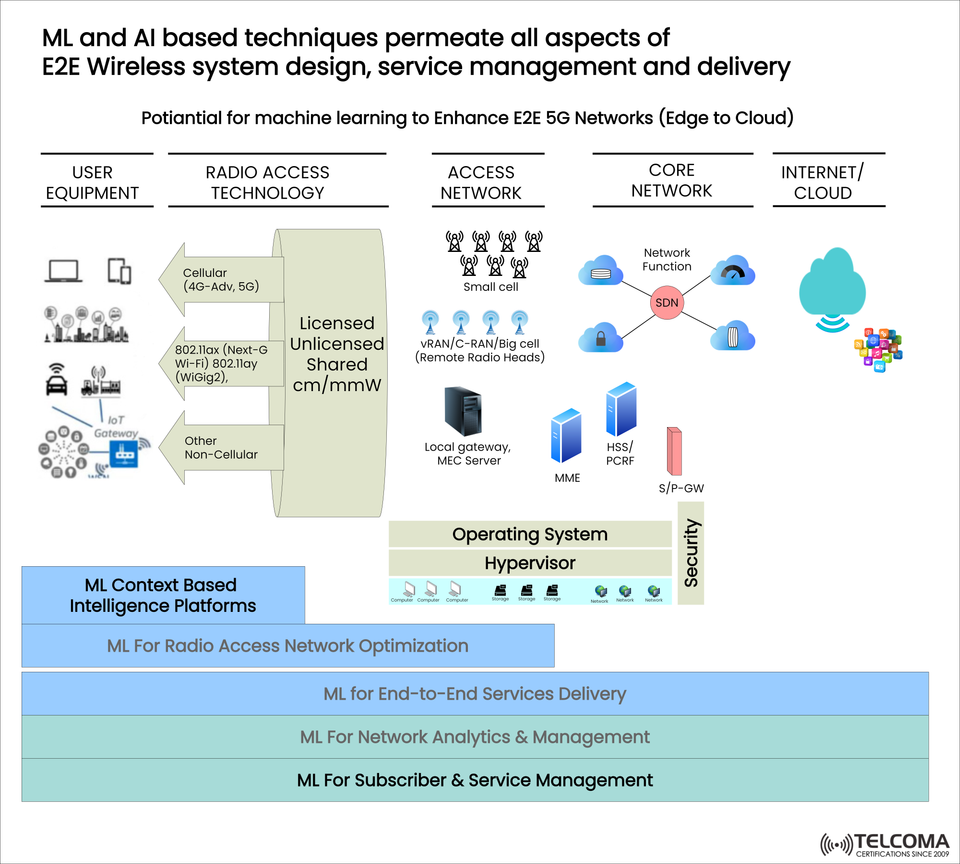
As drawn in the image above, AI/ML exists in every domain of E2E wireless networks working towards the same goal; to deliver smarter, faster, and more resilient 5G services.
🧠 AI/ML Across the E2E Wireless Network: Significant Domains
- User Equipment (UE) and IoT Edge Intelligence
AI algorithms exist in:
Smartphones for power optimization, beam selection
IoT gateways for device identification and data prioritization
Wearables and sensors for predicting or detecting an abnormality in usage - Radio Access Technology (RAT)
Includes:
Cellular (4G Advance, 5G NR)
Wi-Fi 6/6E/7 (802.11ax/ay)
Non-cellular (LoRa, Zigbee)
AI/ML optimizes:
Spectrum (licensed, unlicensed, shared)
Channel prediction & interference management
Mobility decisions (handovers, access point selection)
- Access Network
Evolves as established:
vRAN / C-RAN with Remote Radio Heads
Small cells and macro cells
Multi-access Edge Computing (MEC) platforms activated
AI/ML applications include:
Real-time RAN optimization
Cell clustering and loading
- Core Network
Software-Defined Networking (SDN) and NFV-based Architecture supports:
- Intelligent traffic routeing
- Predictive fault management
- Network slicing automation
Network functions involved:
- MME
- HSS / PCRF
- S-GW / P-GW
- Internet / Cloud Integration
AI enables:
- Dynamic scaling of cloud-native functions
- Secure, low latency service delivery
- Personalization of content delivery and CDN optimization
🧰 Core AI/ML Use Case Across Stack
AI/ML Focus Area Function
Context-Based Intelligence User behavior modeling, real-time contextual decision-making
RAN Optimization Traffic shaping, beamforming, power control
End-to-End Service Delivery SLA assurance, estimating user QoE
Analytics & Management Fault prediction, anomaly detection, performance KPIs
Subscriber & Service Mgmt Churn prediction, CD & billing intelligence, AI enabled self-care
🧱 Foundational Infrastructure
Operating Systems and Hypervisors manage the virtualization layers.
Security frameworks determine and ensure data integrity and privacy and robustness throughout.
Cloud-native platforms host and orchestrate distributed AI/ML models.
🎯 Conclusion: Intelligence Will Be the New Backbone of 5G
AI and ML need no longer be optional components – they will form the cornerstones of scalable, adaptable, and efficient 5G systems. Any components of networks that enable RAN optimization through modelling of historic radio signals; intelligent monitoring and reporting of levered user behavior; or proactive skills that can predict user behavior in advance of them doing anything, redefines the impact that AI and ML is having on Telcos and Telco networks, and the ability to innovate across network functions.
The efficiency of machine learning distributed as templates, across every conceivable domain of a network stack; from Edge to Cloud enables operators to execute on constraints of exploding volumes of subscriber user sessions with low latency security guaranteed by supporting platforms, within availability of infinitely expandable network service and capabilities.
🔄 AI/ML Integration with Cloud-Native and Virtualization Architectures
With virtualization being the backbone of the modern 5G infrastructure—containers, VNFs, and hypervisors—flexible, distributed, and disaggregated networks are made possible. The cloud-native shift necessitates AI/ML platforms to think cloud-based as well.
Key Enablers:
Containerized ML models for microservices-based deployment
Kubernetes orchestration for scaling AI workloads in MEC nodes
Federated Learning (FL) to train the model in a decentralized manner without moving data
AI-as-a-Service (AIaaS) models to integrate with Open RAN and MEC platform
Real-time decisions referred to the AI inference engines embedded at the edge can support handovers, congestion avoidance, and content caching with very low latency enabling better overall user Quality of Experience (QoE).
📊 Business and Operational Benefits
📈 For Network Operators:
Reduced TCO via automation and predictive maintenance
Faster fault recovery time and SLA attainment
Better network efficiencies and spectral utilization
👥 For Subscribers:
Better connectivity with less service disruption
Ability to personalize services and content delivery
Better seamless mobility with latency reduction
🔒 For Security:
Threat detection driven by AI behavioral analytics
Detection and response to anomalies in real-time
Better privacy protection with AI-driven encryption strategies
🚀 Future Outlook: AI-Driven 6G and Beyond
Although 5G is having its traditional deployment phase, 6G research is already beginning to consider tighter integration with AI-native development patterns.
📣 Final Thoughts
ML and AI are no longer tools that stand alone. They are layers that span the wireless ecosystem from the UE to the cloud. Their role in E2E network design, management, and delivery will be foundational if we are to create intelligent, resilient, and scaled networks.
A few things to consider, based on your role:
Telecom operator – think about how you might build ML pipelines natively into your core orchestration system;
Solution architect – think about the implications of the platforms for RAN and for MEC, and how you will design for systems that are AI-ready;
Network or field engineer – think about your skills relating to AI tools that can aid diagnostics, real-time operations, and predictive management;
Product team – consider how you might build AI-enhanced features into your next-generation wireless products.
Embrace AI as the enabler for the next leap in wireless transformation.
✅ Suggested Reading or Activity
📘 [Whitepaper] AI-Driven RAN Optimization in 5G Networks
📊 [Case Study] AI Down-Time Reduction of 40% for Urban Deployment 5G outtages
🛠️ [Toolkits] Open Source ML frameworks designed for Telecom (ONAP, O-RAN ML Layer)
💬 [Webinar] “How Edge AI will enable real-time decisions in 5G MEC” – Register Here
🎯 Conclusion: Adopting Intelligent Connectivity
The advent of 5G has taken complexity to a new level that traditional strategies alone cannot manage. While telecom systems have always relied on operational expertise and experience, AI and ML provide the intelligence and flexibility needed to operate flawlessly, while ensuring resilience and performance. Adaptability will only become more essential in future systems so context-informed decision-making through real-time responsiveness and predictive awareness will be of strategic importance for medical decision-support, design, deployment, and evolution of next-generation wireless ecosystems, as the practice of AI/ML has come to represent.
As 6G approaches, AI/ML will take a more prominent role—emerging from functionalities that react to conditions to self-driving digital fabric that adapts continuously to emerging user and service demands.
🧭 Final CTA: Are you ready to be an AI-powered Wireless Leader?
Regardless of your role as a discipline engineer, network architect, product manager, CTO—embrace the power of AI/ML as part of your strategy! Think of AI as co-pilot on your journey to wireless transformation, not as a one-time tool!