
AI Integrating Module in 5G Networks: How Artificial Intelligence Transforms Network Management

AI Integrating Module in 5G Networks: Transforming Telecom with Intelligence
As 5G networks continue to develop, figuring out how to manage their increasing complexity is proving to be a major challenge for telecom companies. With new technologies like Network Slicing, NFV (Network Function Virtualization), SDN (Software Defined Networking), and MEC (Multi-access Edge Computing), relying on manual operations just doesn’t cut it anymore to keep things running smoothly.
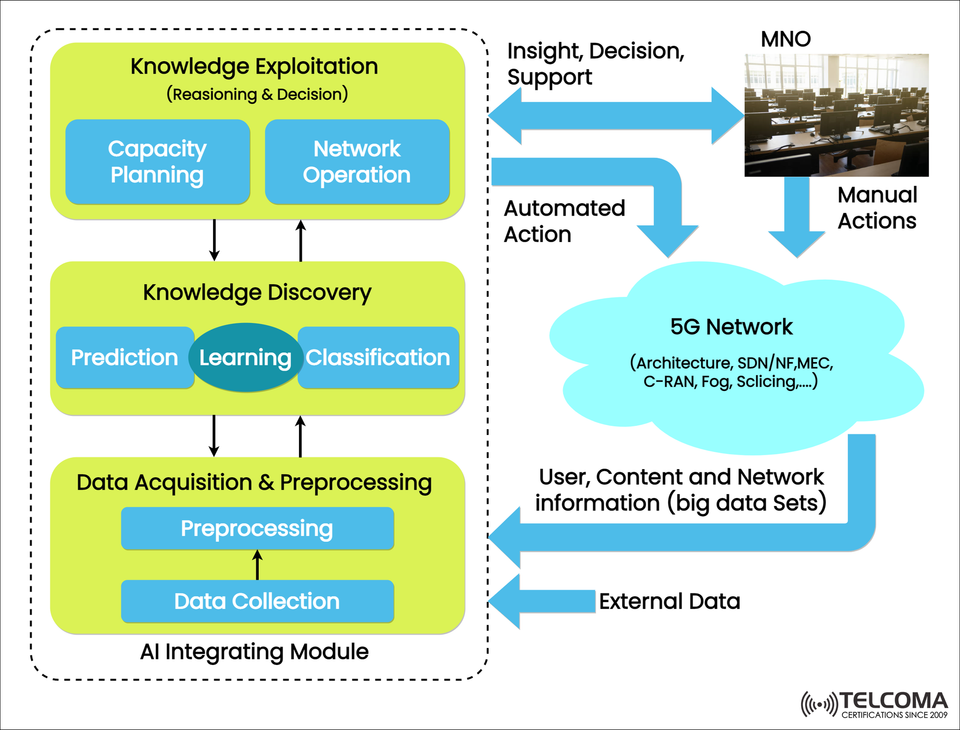
To tackle this issue, telecom networks are leaning more on Artificial Intelligence (AI) for automating processes, optimizing performance, and making predictive decisions. The image provided—labelled “AI Integrating Module”—shows how AI integrates with the 5G landscape, boosting efficiency at all operational levels.
Overview of the AI Integrating Module
The AI Integrating Module serves as the brain of the 5G network, collecting, analyzing, and interpreting massive sets of data to enable autonomous, adaptable decision-making.
Core Components (illustrated in the image):
Data Acquisition & Preprocessing – Gathers and cleans raw network information.
Knowledge Discovery – Uses AI methods like learning, prediction, and classification.
Knowledge Exploitation – Applies insights for planning capacity and making operational choices.
Together, these elements facilitate closed-loop automation, enabling networks to react in real time to user needs, traffic trends, and performance issues.
Data Acquisition and Preprocessing: The Foundation of AI in 5G
The AI process kicks off with collecting and preparing data from various sources. In the 5G context, data comes from different areas—user equipment (UE), base stations, core networks, and external systems.
a. Data Collection
Collects user behavior data, content consumption trends, and network performance metrics.
Sources include SDN controllers, RAN components, and IoT devices.
Data can be structured (like logs and KPIs) or unstructured (such as streaming telemetry).
b. Preprocessing
Cleans, filters, and normalizes data to eliminate noise and inconsistencies.
Aggregates data into big datasets for more thorough analysis.
Ensures adherence to data governance and privacy regulations.
This stage turns large volumes of raw data into meaningful, AI-compatible datasets ready for predictive modeling.
Knowledge Discovery: The AI Brain of the Network
Once the data's ready, the Knowledge Discovery layer carries out advanced analytics using machine learning and deep learning techniques.
Key Components:
a. Learning
AI models identify patterns from both historical and real-time network data.
Techniques used include supervised, unsupervised, and reinforcement learning.
Helps networks predict congestion, anticipate failures, and manage resources.
b. Prediction
Forecasts possible network bottlenecks, demand surges, or hardware breakdowns.
Supports proactive measures like adjusting network slices or reallocating spectrum.
c. Classification
Sorts network events, traffic types, and user behaviors.
Aids in prioritizing network reactions to maintain Quality of Service (QoS).
This phase essentially transforms raw data into actionable intelligence, forming the backbone of self-organizing and self-optimizing networks (SONs).
Knowledge Exploitation: From Insight to Intelligent Action
After AI models produce insights, the Knowledge Exploitation layer implements reasoning and decisions to boost network operation. It's responsible for turning knowledge into actions.
Key Processes:
a. Capacity Planning
Leverages AI insights to predict future network demand.
Allows operators to strategize infrastructure expansions, spectrum distribution, and load balancing.
Guarantees optimal Quality of Experience (QoE) for users, even during busy hours.
b. Network Operation
Automates routine management tasks like configuration, fault detection, and optimization.
Improves network resilience by enabling AI-driven self-healing.
Cuts operational costs by reducing the need for human involvement.
The results from this layer are conveyed to Mobile Network Operators (MNOs) as decision-support systems or executed through automated processes.
The Role of the 5G Network in AI Integration
The 5G network is central to this setup, acting as both a data source and a space where AI-driven actions take place.
AI and 5G Synergy:
Architecture: AI functions across distributed architectures, including C-RAN, Edge Clouds, and Core Networks.
Technologies: Works with SDN, NFV, MEC, and Network Slicing frameworks.
Automation: AI modules continually assess 5G KPIs and trigger automated actions when needed.
User Personalization: AI enables context-aware services, adjusting bandwidth or minimizing latency.
This partnership turns the 5G network into a self-managing, intelligent system that can adapt instantly.
Interaction Between MNOs and AI Systems
The uploaded image clearly depicts a two-way relationship between MNOs (Mobile Network Operators) and the AI Integrating Module.
How It Works:
Insight, Decision, Support: AI offers MNOs suggestions for network upgrades, capacity tweaks, and policy implementations.
Automated Actions: AI can make network changes directly, like rerouting traffic or scaling resources.
Manual Actions: MNOs can still step in to adjust or approve AI choices when needed.
This blend of automation and human input ensures that as networks move toward autonomy, human oversight stays crucial, preserving trust and control.
Role of External Data in AI Integration
AI models don’t just depend on internal network data; they also draw from external data sources like:
Weather data
Geographic and mobility trends
Social media insights
Application usage stats
Incorporating these external datasets allows for context-aware intelligence, helping the network adjust to real-world situations, such as ramping up capacity in high-traffic areas during events.
Benefits of AI Integration in 5G Networks
Category Benefits
Automation: Cuts down manual effort and reduces human errors in network management.
Efficiency: Optimizes resource use—bandwidth, energy, and hardware.
Predictive Maintenance: Spots and fixes issues before they disrupt services.
Customer Experience: Ensures steady QoS and tailored service delivery.
Operational Agility: Quickly adapts to changes in traffic and service demands.
Cost Reduction: Lowers operational expenses through autonomous decision-making.
By continually learning from the network landscape, AI propels systems that are self-optimizing, self-healing, and self-configuring in 5G.
Real-World Applications of AI in Telecom
AI integration modules are already making a difference in real-world telecom operations across several areas:
Intelligent Traffic Management: AI anticipates congestion and dynamically reroutes data.
Energy Efficiency: Smart algorithms enhance power usage at base stations.
Network Slicing Management: AI adjusts slices according to service requirements.
Customer Experience Management: Predictive models tailor network responses for individual users.
Fault Detection and Root Cause Analysis: Dramatically cuts down repair times.
These examples show how AI isn’t just an additional feature; it’s a key driver of next-gen networks.
Challenges in AI Integration
Even with its benefits, merging AI into telecom has its hurdles:
Data Privacy & Security: Handling sensitive customer data responsibly.
Model Accuracy: Making sure AI algorithms perform well in varying environments.
Interoperability: Ensuring AI systems work seamlessly with different vendors’ tech.
Scalability: Efficiently managing massive amounts of real-time data.
Telecom operators need to establish strong governance frameworks to navigate these challenges while sticking to global standards.
Conclusion
The AI Integrating Module is changing how telecom operators oversee, enhance, and grow 5G networks. By blending data acquisition, knowledge discovery, and knowledge exploitation, it creates an intelligent, automated, and self-adjusting ecosystem.
As we move towards 6G, AI’s role will only grow more significant, paving the way for fully cognitive networks capable of zero-touch management and real-time orchestration.