
AI Native Maturity Model Explained: Six Levels of AI Transformation for Enterprises

AI Native Maturity Model: Your Guide to Fully Intelligent Enterprises
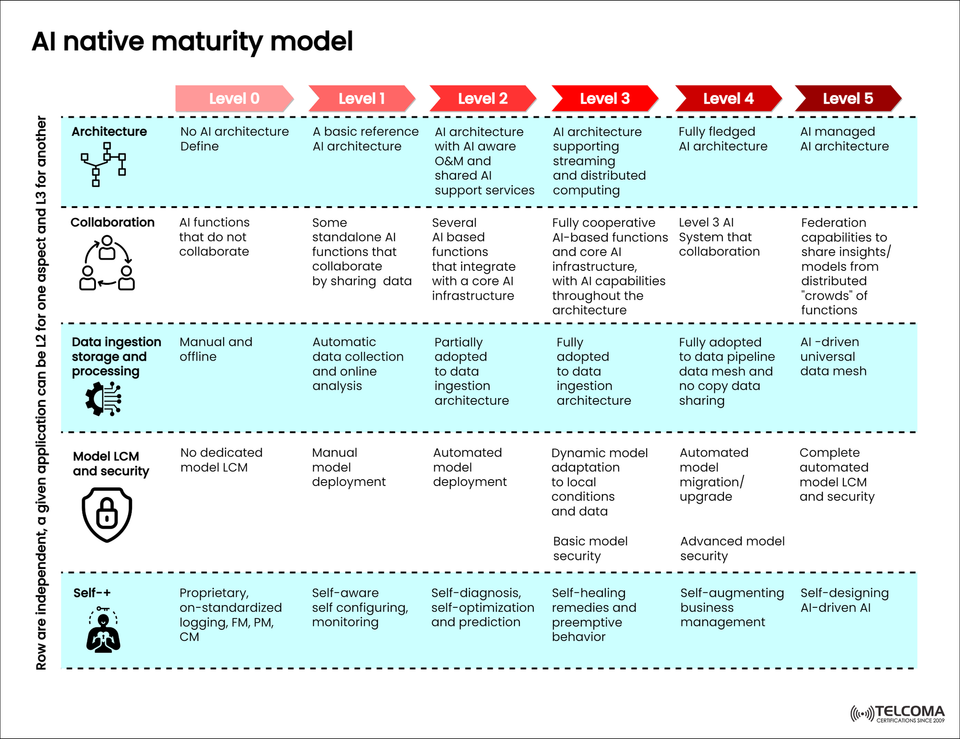
Artificial Intelligence (AI) is changing the game for how businesses operate, develop, and deliver value. But shifting to an “AI-native” organization isn't just a one-step process — it’s a maturity journey. The AI Native Maturity Model, illustrated in the image above, charts this path through six levels (0–5), evaluating how advanced an organization is in areas like AI architecture, collaboration, data processing, model lifecycle management (LCM), and self-management capabilities.
For those in telecom, getting a grip on this maturity model is essential since AI-driven automation plays a key role in 5G/6G operations, predictive maintenance, network optimization, and boosting customer experience.
Let’s take a closer look at each level to see how organizations progress from basic automation to fully autonomous AI systems.
What’s the AI Native Maturity Model?
The AI Native Maturity Model is a systematic framework that assesses how well an organization integrates AI into its operations and infrastructure.
It gauges AI capability across five dimensions:
Architecture
Collaboration
Data Ingestion, Storage, and Processing
Model Lifecycle Management (LCM) and Security
Self-Management (Self-+)
Each row in the model stands alone — so, an organization could be at Level 3 for data processing but only at Level 1 for AI collaboration. The aim is to gradually level up in every dimension for total AI-native maturity.
Level 0 – No AI Architecture Defined
At Level 0, there’s pretty much no AI integration happening.
Key Characteristics:
Architecture: No AI framework in place. Systems work in isolation.
Collaboration: Little to no teamwork across functions.
Data Ingestion: Everything’s done manually and offline.
Model LCM: No structured management for model lifecycles.
Self-+: Proprietary logging with no standardization, relying on manual fault and performance management.
Typical Scenario:
Outdated telecom systems that depend completely on manual setups, troubleshooting, and rule-based monitoring. Data gets scattered, with analysis happening only after events occur.
Challenges:
High costs of operation
Lack of predictive insights
Reacting to issues as they arise
At this stage, AI isn’t part of the organization’s digital makeup.
Level 1 – Basic Reference AI Architecture
By Level 1, organizations start to weave in some basic AI elements.
Key Characteristics:
Architecture: An initial AI reference framework is established.
Collaboration: Standalone AI tools that share some data.
Data Processing: Data is collected automatically, with simple online analysis.
Model LCM: Deployment of models is done manually.
Self-+: Systems have some awareness, monitoring, and configurations.
Example:
A telecom operator might set up AI-based fault detection tools or predictive analytics for one area, like network monitoring, but the integration across systems is still quite limited.
Benefits:
Basic AI capabilities are starting to take shape.
Early automation in data analytics is introduced.
However, issues with scalability and data consistency still pose significant challenges.
Level 2 – AI-Aware and Integrated Architecture
At Level 2, organizations begin to see real benefits from AI integration.
Key Characteristics:
Architecture: AI-aware infrastructure that includes Operations & Maintenance (O&M) and shared AI support services.
Collaboration: Several AI functions that connect with a core data infrastructure.
Data Handling: Some use of data ingestion frameworks and distributed analytics begins.
Model LCM: Automated model deployment starts to take effect.
Self-+: Systems begin to self-diagnose and optimize performance.
Example in Telecom:
An AI platform that connects network performance, customer analytics, and energy optimization through shared data pipelines.
Benefits:
Less need for human intervention.
Better fault prediction and automation in responses.
More consistent data flow across AI modules.
Organizations lay down a scalable AI foundation for further development at this point.
Level 3 – Streaming and Distributed AI Architecture
At Level 3, AI systems become deeply rooted across various infrastructure layers.
Key Characteristics:
Architecture: Supports streaming data and distributed computing.
Collaboration: Full teamwork among AI functions through a common infrastructure.
Data Processing: The organization fully embraces data ingestion architecture for continuous data flow.
Model LCM: Models adapt dynamically to real-time changes.
Self-+: Self-healing attributes and proactive behavior develop.
Example in Telecom:
An AI-enhanced network operations center (NOC) that uses streaming data to allocate network resources in real time, predict congestion, and apply self-corrective measures before any performance drops.
Benefits:
Decisions can be made in real time.
Downtime is minimized thanks to proactive corrections.
There’s full visibility across distributed systems.
Level 3 signifies a shift from AI-enabled to AI-embedded operations within enterprises.
Level 4 – Fully Fledged AI Architecture
At Level 4, organizations reach full AI maturity across most dimensions.
Key Characteristics:
Architecture: Robust, end-to-end AI architecture.
Collaboration: At this point, Level 3 AI systems interact smoothly across different areas.
Data Processing: A fully integrated data pipeline mesh means there are no redundant data copies.
Model LCM: There's automated migration and upgrading of models.
Self-+: Business management capabilities that self-augment are in place.
Example in Telecom:
An operator where AI agents autonomously manage service assurance, capacity planning, and customer experience, while continuously refining models based on real-time feedback.
Benefits:
AI systems collaborate across multiple domains (like network, IT, and customer service).
Adaptation to changes in workload and market conditions happens automatically.
Operational savings are significant thanks to process automation.
This level showcases enterprise-scale AI orchestration within a completely data-driven ecosystem.
Level 5 – AI-Managed and Self-Designing Architecture
Level 5 is the peak of AI-native maturity — where AI itself oversees the evolution of the enterprise.
Key Characteristics:
Architecture: A fully AI-managed and self-designing setup.
Collaboration: Various distributed AI models that share insights on a global scale.
Data Processing: A universal data mesh managed entirely by AI, requiring no manual intervention.
Model LCM: Lifecycle management is fully automated, covering deployment and security.
Self-+: Systems are self-designing and self-evolving, driven by AI.
Example:
An autonomous telecom network where AI designs, tests, and deploys optimized configurations without any human input, all while ensuring security compliance.
Benefits:
Constant innovation and adaptability.
Autonomous evolution of systems powered by reinforcement learning.
Maximum efficiency in operations with no human input needed.
At this level, AI isn’t just a tool — it’s the guiding intelligence of the enterprise.
Comparison Table: Summary of the AI Native Maturity Model
Dimension | Level 0 | Level 1 | Level 2 | Level 3 | Level 4 | Level 5
Architecture| No AI design | Basic AI reference | AI-aware with O&M | Streaming & distributed | Fully fledged AI | AI-managed architecture
Collaboration | Non-collaborative | Partial collaboration | Shared data functions | Cooperative core AI | AI system-level collaboration | Federation-based sharing
Data Processing | Manual/offline | Automatic collection | Partial ingestion | Fully adopted architecture | Data pipeline mesh | AI-driven universal mesh
Model LCM | No model LCM | Manual deployment | Automated deployment | Dynamic adaptation | Automated upgrade | Fully automated LCM
Self-+ | Manual ops | Self-monitoring | Self-optimization | Self-healing | Self-augmenting | Self-designing
Why This Model Matters for Telecom and Tech Enterprises
In the telecom and enterprise IT world, reaching AI-native maturity is a key competitive edge.
Less Downtime: AI-driven automation cuts down on manual troubleshooting.
Boosted Efficiency: Real-time analytics enhance network usage.
Improved Security: Automated model LCM keeps compliance on point.
Customer Experience: Predictive personalization thrives on integrated data mesh.
Scalability: Distributed AI allows for autonomous management of extensive networks.
With the growth of 5G/6G networks and cloud-native systems, telecom providers are pushing from Level 2 (AI-aware) up to Level 4 (fully fledged AI) maturity.
Conclusion: The Future of AI-Native Enterprises
The AI Native Maturity Model serves as a roadmap for organizations moving from manual, rule-based operations to autonomous, AI-managed ecosystems.
Achieving higher maturity levels requires more than just tech; it calls for strategic harmony among data, architecture, and operational processes. As AI continues to evolve, companies — particularly within telecom — will transition into self-learning, self-managing, and self-designing intelligent systems.
Becoming AI-native isn’t simply a destination — it’s an ongoing journey toward resilience, innovation, and autonomy in this digital age.