
Applications of 5G: Enhanced Mobile Broadband, IoT, and Low-Latency Use Cases
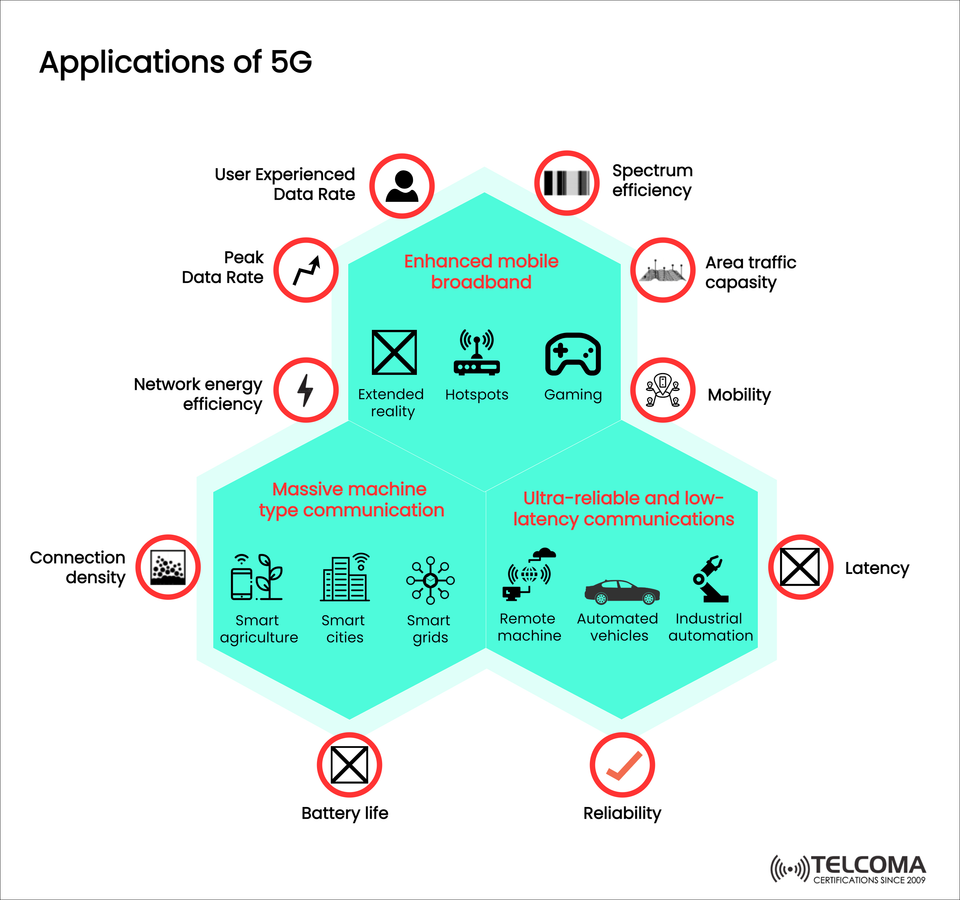

Moving from 4G/LTE to 5G is about way more than just a speed boost. 5G is built to kick off a new digital era, driving things like augmented reality, self-driving cars, smart cities, and automated industries. The way it's set up focuses on three main service categories identified by the International Telecommunication Union (ITU):
Enhanced Mobile Broadband (eMBB)
Massive Machine-Type Communication (mMTC)
Ultra-Reliable and Low-Latency Communications (URLLC)
The infographic we've included illustrates how these categories translate into real-world applications, backed by 5G’s goals for technical performance like high data speeds, minimal delay, efficient use of spectrum, reduced energy use, and the ability to connect a ton of devices at once.
The specifics of each application area.
Enhanced Mobile Broadband (eMBB)
Enhanced Mobile Broadband is all about delivering faster data rates, wider coverage, and smoother user experiences. This is what most consumers will notice first because it directly enhances their mobile connectivity.
Key Features of eMBB:
Peak data rates of up to 20 Gbps.
User-experienced data rates of at least 100 Mbps.
Better spectrum efficiency compared to 4G.
Support for traffic capacity in crowded areas.
Applications of eMBB:
Extended Reality (XR): * Covers AR (Augmented Reality), VR (Virtual Reality), and MR (Mixed Reality). * Opens the door for immersive gaming, training sessions, and remote teamwork.
Hotspots and Urban Connectivity: * Delivers smooth, high-speed internet in busy spots like stadiums, shopping centers, and transportation hubs.
Cloud Gaming and Streaming: * Makes high-definition streaming, multiplayer gaming, and on-the-fly content access possible without lag.
Why it matters:
eMBB guarantees that 5G users enjoy reliable, fast speeds on their devices, transforming how we consume entertainment, learn, and collaborate professionally.
Massive Machine-Type Communication (mMTC)
Massive Machine-Type Communication sets up scalable IoT (Internet of Things) ecosystems by allowing up to 1 million devices per square kilometer to connect.
Key Features of mMTC:
High connection density to foster IoT expansion.
Enhanced network energy efficiency for long-lasting IoT applications.
Longer battery life for devices that use little power.
Applications of mMTC:
Smart Agriculture: * Sensors check on soil moisture, crop health, and irrigation needs. * Helps manage resources better and promotes sustainable farming practices.
Smart Cities: * IoT solutions for traffic management, waste collection, and public safety. * Enhances efficiency and sustainability in urban settings.
Smart Grids: * Advanced meters and real-time monitoring of electricity usage. * Optimizes energy distribution and minimizes outages.
Why it matters:
mMTC is the backbone of IoT ecosystems, enabling modern industries, cities, and utilities that depend on millions of devices working together.
Ultra-Reliable and Low-Latency Communications (URLLC)
Ultra-Reliable and Low-Latency Communications focus on crucial use cases where high reliability and low latency are a must. 5G aims for 1 millisecond latency and 99.999% reliability.
Key Features of URLLC:
Latency as low as 1 ms.
High reliability for vital applications.
Mobility support for speeds up to 500 km/h.
Applications of URLLC:
Remote Control of Machines: * Allows for distant operation of heavy machinery in risky environments. * Keeps human workers safer in industries like mining or oil extraction.
Self-Driving Cars: * Guarantees real-time communication between vehicles (V2V) and infrastructure (V2X). * Aids safe and efficient autonomous driving.
Industrial Automation: * Supports robotic systems and automated production lines. * Boosts efficiency, accuracy, and safety in smart factories.
Why it matters:
URLLC is crucial for the Industry 4.0 revolution, enabling applications where any downtime or delays could lead to safety hazards or financial hits.
Technical Enablers for 5G Applications
5G’s ability to support these applications hinges on its technical advancements over 4G.
The infographic calls out these key enablers:
User Experienced Data Rate: Guarantees consistent speeds across different environments.
Peak Data Rate: Allows for quick downloads and smooth streaming.
Latency: Enables almost real-time responsiveness.
Mobility: Keeps connectivity for fast-moving trains and vehicles.
Connection Density: Facilitates the setup of dense IoT networks.
Network Energy Efficiency: Lowers costs and backs eco-friendly networking.
Spectrum Efficiency: Maximizes the use of limited spectrum resources.
Traffic Capacity: Handles high data needs during big events with lots of people.
Battery Life Improvements: Crucial for IoT sensors.
Reliability: Provides consistent service for critical operations.
These enablers make it possible for 5G to cater to consumer broadband, business networks, and industrial IoT ecosystems all at once.
Comparative Summary of 5G Application Categories
Category| Focus Area| Key Applications
Enhanced Mobile Broadband (eMBB)|High data rates & capacity| XR, cloud gaming, hotspots, ultra-HD streaming
Massive Machine-Type Communication (mMTC)|Massive device connectivity| Smart agriculture, smart cities, smart grids
Ultra-Reliable Low-Latency Communications (URLLC)|Reliability & ultra-low latency| Remote machine control, automated vehicles, industrial IoT
Real-World Examples of 5G Applications
Healthcare: Remote surgeries powered by low-latency URLLC.
Transportation: Self-driving cars using V2X communications.
Utilities: Smart grids fueled by mMTC IoT sensors.
Entertainment: Seamless VR/AR gaming thanks to eMBB high bandwidth.
Enterprise: Private 5G networks for factories, warehouses, and logistics.
Conclusion
The applications of 5G go far beyond just faster mobile internet. With Enhanced Mobile Broadband (eMBB), it changes the game for entertainment and communication. Thanks to Massive Machine-Type Communication (mMTC), it supports billions of IoT devices driving smart cities and industries. And with Ultra-Reliable Low-Latency Communications (URLLC), it facilitates mission-critical tasks like self-driving cars, industrial automation, and remote surgeries.
For professionals in telecom, being aware of these application areas is key for planning new deployments and building services. For tech fans, it reveals how 5G is shaping daily life and paving the way for the future of digital transformation.