
Applications of Free Space Optical (FSO) Communication Links in Modern Networks
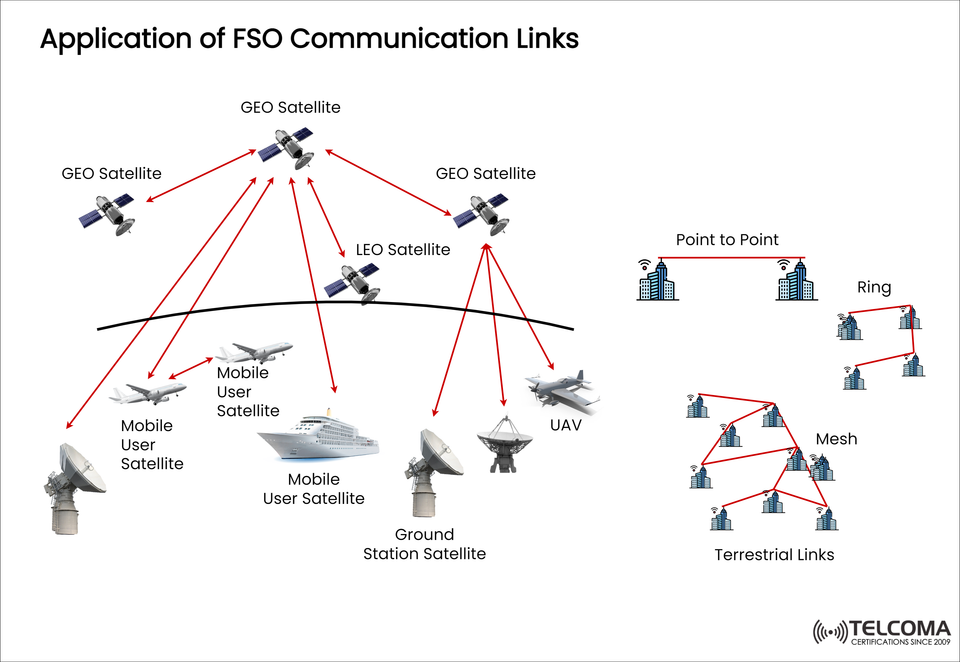

Applications of Free Space Optical (FSO) Communication Links
With global data demands rising rapidly, telecom networks are grappling with the need to provide ultra-high-speed, secure, and low-latency communication in a variety of settings—from the ground to outer space. That's where Free Space Optical (FSO) communication comes in, using light beams to transmit data instead of traditional radio frequencies.
The diagram we've uploaded, titled “Application of FSO Communication Links,” shows how FSO technology links satellites, UAVs, ground stations, and terrestrial networks into a cohesive optical communication system. In this article, we'll dive into the working principle, major uses, and deployment structures of FSO systems in today's communication networks.
Understanding Free Space Optical (FSO) Communication
Free Space Optics (FSO) is a wireless tech that sends data via laser beams through free space—whether that's the atmosphere, space, or even a vacuum. It functions a bit like fiber optic communication but skips the physical fiber cables, relying instead on light traveling between transmitters and receivers.
Key Features of FSO Communication:
Ultra-High Data Rates — achieving multi-Gbps speeds
Unlicensed Spectrum — no licensing fees involved
High Security — narrow laser beams reduce eavesdropping risks
Low Deployment Cost — no need for digging up ground for cables
Interference-Free — not impacted by RF congestion
It's worth noting that FSO communication links are widely used in various systems—terrestrial, aerial, and space—which is a significant boost for the evolution of 5G, 6G, and satellite internet.
Classification of FSO Communication Applications
The image provided breaks down FSO applications into two main areas:
Space-Based Applications — This covers communication between satellites, UAVs, and other mobile platforms.
Terrestrial Applications — These are ground-based point-to-point, ring, and mesh networks.
Let’s get into each one.
Space-Based Applications of FSO Links
When it comes to space communication, FSO links are stepping in for radio systems used between satellites, satellite-to-ground, and satellite-to-aerial communication. These links enable low-latency, high-capacity global data transfer and are crucial for LEO, MEO, and GEO satellite constellations.
a. GEO and LEO Satellite Links
GEO (Geostationary Earth Orbit) satellites hover about 35,786 km above the Earth, while LEO (Low Earth Orbit) satellites float between 500 and 2,000 km.
FSO links create Inter-Orbital (IOL) and Inter-Satellite Links (ISL) between these satellites.
GEO satellites can communicate with each other and LEO satellites to facilitate data relay and global coverage.
Benefits:
Less signal delay and latency
Efficient use of bandwidth
Smooth connectivity for Earth observation and broadband systems
Applications:
Starlink, OneWeb, and Telesat rely on laser-based ISLs for inter-satellite networking.
Earth observation constellations share high-resolution imaging data using FSO.
b. Mobile User Satellites (Aerial and Maritime Platforms)
The diagram depicts mobile user satellites on planes and ships that connect with orbiting satellites through FSO. These links deliver high-speed internet access in challenging and mobile environments.
Use Cases:
In-flight internet access for commercial and military aircraft
Maritime communication on ships and cruise liners
Disaster recovery communications through mobile aerial relays
Advantages:
Consistent connectivity while in motion
No interference from ground-based radio systems
Ideal for global coverage over oceans and isolated areas
c. UAV (Unmanned Aerial Vehicle) Communication
Drones, or UAVs, play an essential part in aerial data transmission, surveillance, and backhaul for 5G networks. FSO links facilitate secure, low-latency connections among UAVs, satellites, and ground control stations.
Applications:
Military tactical operations
Remote sensing and aerial mapping
High-altitude platform stations (HAPS) for internet extension
Technical Benefits:
Light optical terminals
Resistant to jamming and RF interference
Supports real-time HD video transfer
d. Ground Station Communication
Ground stations make up the earth-side part of FSO communication systems. They create laser-based links with satellites for data downloads, telemetry, and command uplinks.
FSO Ground Station Advantages:
High data throughput
Lower latency than RF systems
Smaller antenna sizes
Easier integration with existing fiber setups
Ground stations also fit into hybrid optical-RF designs, providing reliable communication even in bad weather.
Terrestrial Applications of FSO Communication
FSO links aren't just for space; they're also changing ground-based communication networks. The diagram shows that terrestrial FSO setups can include Point-to-Point, Ring, and Mesh configurations.
a. Point-to-Point Links
The simplest form of FSO, connecting two fixed locations directly with a laser beam.
Commonly used in enterprise networks, building-to-building connections, and for 5G backhaul.
Delivers fiber-like performance without the cables.
Advantages:
Quick and easy setup
High bandwidth (up to 10 Gbps or more)
Secure line-of-sight communication
Example:
Connecting two corporate buildings in a city using rooftop-mounted FSO transceivers.
b. Ring Topology
In a ring setup, multiple FSO nodes create a circular network.
Each node connects to its two neighbors, offering backup paths for reliability.
Applications:
Metropolitan Area Networks (MANs)
5G small cell ring networks
Campus and industrial networks
Benefits:
Greater reliability with loop protection
Ongoing service even if one link goes down
c. Mesh Topology
A mesh network connects several FSO nodes, forming multiple backup routes for data transmission.
Perfect for dense urban applications, disaster-resistant communication, and military uses.
Advantages:
Maximum reliability and redundancy
Adaptive routing for managing congestion
Scalable and self-healing network structure
Use Cases:
Smart city connections
Urban surveillance systems
Emergency response communications
Technical Advantages of FSO Communication Systems
Feature | FSO Advantage
Bandwidth | Multi-Gbps throughput that rivals fiber
Deployment | No digging or spectrum licensing needed
Security | Laser beams are difficult to intercept since they’re highly directional
Interference Immunity | Not impacted by RF congestion or electromagnetic interference
Cost Efficiency | Reduced capital and operational costs
Scalability | Easy to integrate with current infrastructure
Challenges in FSO Deployment
Despite its many benefits, FSO technology has some environmental and operational hurdles to overcome:
Weather Sensitivity: Fog, rain, and atmospheric conditions can weaken laser signals.
Line-of-Sight Dependency: Needs a clear view between the transmitter and receiver.
Distance Limitations: Typically practical range is a few kilometers under harsh weather.
Beam Divergence: Over longer distances, beams spread out, which can decrease power received.
The Future of FSO Communication
With ongoing improvements in optical components, AI-driven beam tracking, and quantum communication, FSO systems are set to change the game in connectivity across all sectors. New technologies will make FSO even more resilient, self-sufficient, and scalable, helping to close the digital gap.
Upcoming Trends:
Quantum FSO links aimed at ultra-secure communication
AI-enhanced network optimization for beam adjustments
Hybrid optical-RF systems for greater reliability
Deep-space optical networks facilitating interplanetary data transfer
Conclusion
The applications of FSO communication links span diverse areas—terrestrial, aerial, and space—forming a crucial part of the next-gen communication landscape. Whether it's linking satellites in orbit, providing in-flight internet, or supporting urban 5G backhaul, FSO brings fiber-like speeds with the added benefit of wireless flexibility.
As telecom networks continue to move toward 6G and beyond, FSO communication will be instrumental in building a globally connected, ultra-fast, and smart communication network.