
Applications of FSO Communication Links: Bridging Space, Air, and Ground Networks
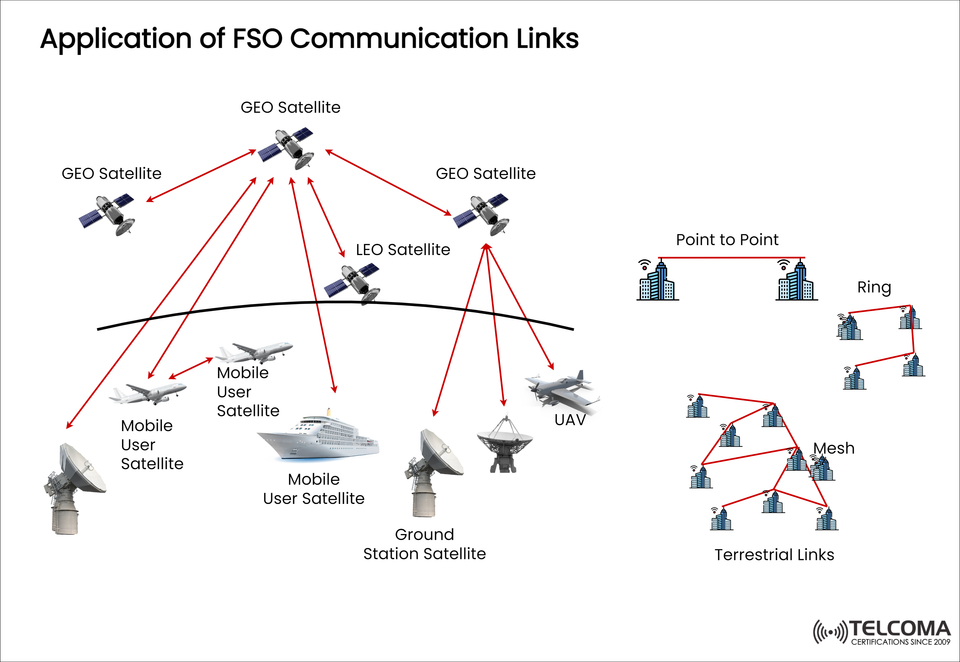

Applications of FSO Communication Links: Transforming Global Connectivity
In today’s world, where we’re seeing a huge demand for bandwidth and limited spectrum availability, Free Space Optical (FSO) communication is really making waves. By utilizing light to send data through open air, FSO provides super-fast data rates, low latency, and is immune to electromagnetic interference—perfect for advanced aerospace, defense, and telecom systems.
The image above shows the different uses of FSO links, covering everything from space (GEO/LEO satellites) to airborne systems (like UAVs and aircraft) and ground communication networks (whether point-to-point, ring, or mesh setups). Let’s dive into how these connections facilitate quick and seamless communication around the globe.
Understanding Free Space Optical (FSO) Communication
FSO communication relies on a line-of-sight (LOS) approach, transmitting data through optical beams (mostly lasers) across the atmosphere or in a vacuum, ditching the usual radio frequencies.
Key Features of FSO Technology:
High Data Rate: Comparable to fiber optics, reaching speeds up to 100 Gbps.
License-Free Spectrum: Works in optical wavelengths, steering clear of RF congestion.
Low Latency: Direct light transmission cuts down on delays.
Secure Transmission: The narrow beams are tough for anyone to intercept or jam.
Cost-Effective Deployment: No pricey digging or spectrum licenses needed.
Still, FSO systems come with challenges like atmospheric interference, fog, and alignment problems—issues that are being tackled with advanced tracking systems and hybrid RF/optical setups.
Space-Based FSO Links: GEO, LEO, and Inter-Satellite Communication
a. GEO (Geostationary Earth Orbit) Satellites
Situated about 35,786 km above, GEO satellites stay fixed in place relative to the Earth.
FSO Application: Links between GEO satellites and from GEO to the ground.
Use Case: Providing high-bandwidth backhaul and optical feeder links for internet access.
Advantages: * Handles massive data traffic for global relay. * Cuts down on RF interference and spectrum crowding. * Allows for optical inter-satellite links (OISLs) to ensure steady coverage.
b. LEO (Low Earth Orbit) Satellites
LEO satellites float at altitudes between 500–2,000 km and work in big constellations, like Star link and One Web.
FSO Application: Links between satellites and downlinks to ground stations.
Use Case: Offering broadband internet, real-time Earth monitoring, and space-based IoT connectivity.
Advantages: * Very low latency (20–40 ms). * Optical connections allow for fast data transfer between satellites. * Less reliance on ground infrastructure for relaying data.
c. GEO–LEO Interlink Communication
The image shows FSO beams linking GEO and LEO satellites, creating seamless data exchange in orbit.
Benefit: Ensures continuous global data routing without needing Earth-based relays.
Application: Space networking, deep-space communications, and secure military connections.
Airborne FSO Links: UAVs and Mobile User Satellites
a. UAV (Unmanned Aerial Vehicle) Communication
Drones fitted with optical transceivers can set up high-speed air-to-air or air-to-ground FSO links.
Applications: * Military surveillance and reconnaissance. * Disaster recovery networks. * Temporary backhaul in remote or conflict zones.
Advantages: * Quick setup without needing ground infrastructure. * Tight security due to narrow optical beams. * Low electromagnetic signature—great for defense scenarios.
b. Mobile User Satellites (Aircraft and Ships)
Airborne and maritime units can serve as mobile user terminals, connecting with satellites using FSO links.
Use Cases: * In-flight internet access for aircraft. * Ship-to-satellite links for broadband at sea. * Entertainment and navigation data for cruise ships.
Advantages: * Seamless high-speed internet for those on board. * Real-time tracking and telemetry. * No reliance on ground RF network.
Ground Segment: FSO for Ground Station and Terrestrial Networks
a. Ground Station Satellite Links
Ground stations that have optical terminals can receive data from GEO or LEO satellites via FSO beams.
Functions: * Downlink for Earth observation missions. * Uplink for command and control (C2) operations. * Secure data management for government and defense entities.
Advantages: * High-capacity optical downlinks replace traditional RF antennas. * Compact and lightweight terminal designs. * Lower costs and energy use for operations.
b. Terrestrial FSO Communication Links
On the ground, FSO links connect buildings or network nodes through line-of-sight optical transceivers, as shown on the right side of the image.
Common Topologies:
Topology Description Typical Use Case Point-to-Point Direct FSO link between two fixed nodes Building-to-building data links, metro networks Ring Several nodes connected in a loop for redundancy Enterprise or campus networks Mesh Nodes interconnected with multiple FSO paths Smart cities, resilient urban networks
Benefits of Terrestrial FSO:
Fiber-Like Speed: Up to 10 Gbps over short distances.
Rapid Deployment: Perfect for temporary or emergency networks.
Cost-Effective: Skips the costs of trenching for fiber setup.
Scalability: Can be easily expanded with more optical nodes.
Hybrid FSO–RF Systems: Tackling Atmospheric Challenges
FSO might come with great benefits, but its performance can dip during fog, heavy rain, or dust storms. To keep things running smoothly, hybrid FSO/RF systems are being put in place.
How It Works: When the optical signal weakens, RF links take over to ensure connectivity doesn’t drop.
Applications: * Cellular backhaul in varying weather. * Defense communications needing high reliability. * Smart city and IoT infrastructures.
This hybrid setup combines FSO's bandwidth with RF's durability, aiming for the best uptime and performance.
Real-World Use Cases and Industry Momentum
a. SpaceX Starlink and Telesat Lightspeed
Both are using optical inter-satellite links (OISLs) to connect their satellites worldwide without depending on ground stations.
b. Military and Defense
FSO links deliver secure, jam-resistant communication for airborne surveillance, satellite management, and tactical data sharing.
c. 5G and Beyond Backhaul
Telecom companies are incorporating FSO for last-mile and 5G backhaul, making for quick setups in crowded urban or rural areas.
d. Disaster Recovery and Emergency Networks
FSO terminals that can be quickly set up help restore connectivity when regular infrastructure goes down—like during quakes or floods.
Advantages of FSO Communication at a Glance
✅ Ultra-high data rates similar to fiber optics
✅ License-free optical spectrum
✅ Secure and interference-free transmission
✅ Quick and flexible setup
✅ Low operational and maintenance costs
✅ Great for space, aerial, and ground applications
Conclusion: FSO – The Future Backbone of Global Connectivity
The image of FSO communication link applications perfectly showcases how this tech links space, air, and ground communication systems into a unified, high-speed network.
From satellite constellations and UAV relays to ground mesh networks, FSO is changing how data travels around the world—and beyond. As hybrid FSO/RF systems advance and methods to combat atmospheric issues improve, Free Space Optics is set to be a cornerstone in 6G and space-based communications.
In the end, FSO technology fills in the gaps where traditional fiber can’t reach—bringing connectivity to the unconnected and fueling the next wave of global digital growth.