
Artificial Intelligence and Blockchain in Ultra-Dense Edge Computing: The I-UDEC Framework Explained
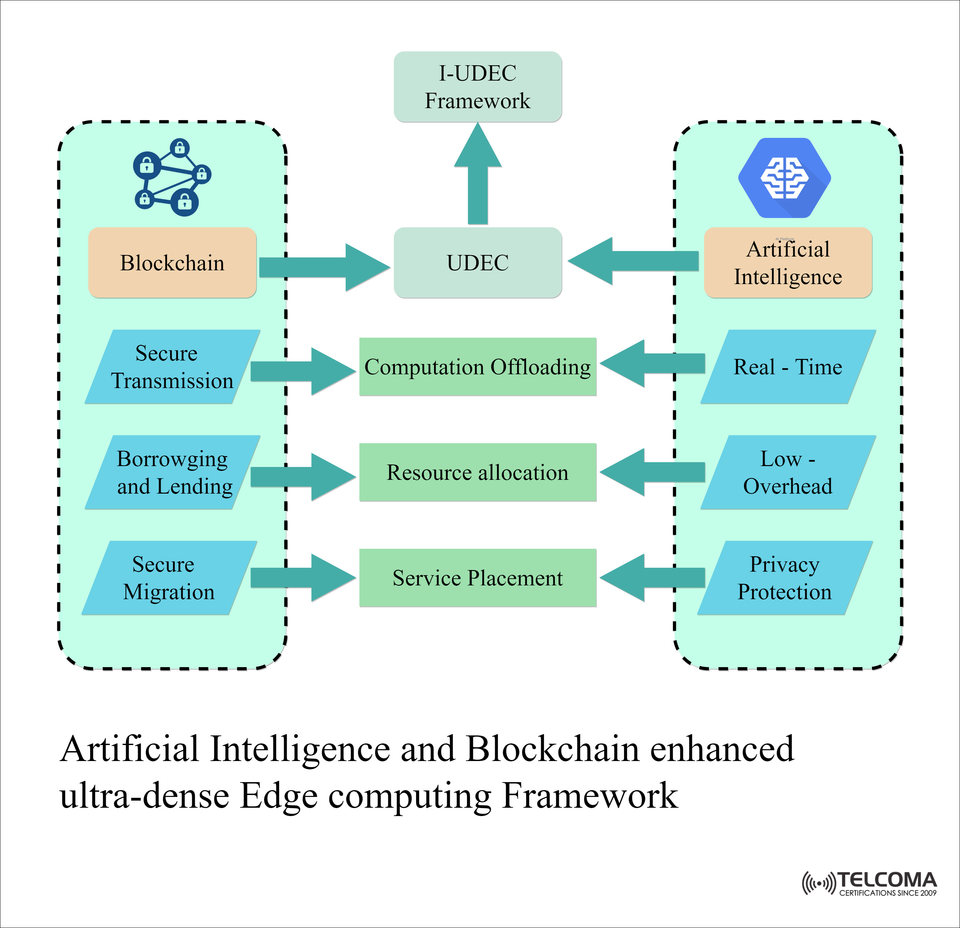

An Ultra-Dense Edge Computing Framework Enhanced by Blockchain and Artificial Intelligence
As edge computing rapidly evolves, so does the demand for ultra-fast and secured real-time processing, particularly in telecom networks, smart cities, and other IoT dense environments. In this context, the I-UDEC (Intelligent Ultra-Dense Edge Computing) Framework introduces an advanced architecture that applies Artificial Intelligence (AI) and Blockchain to augment the performance, security, and efficiency of ultra-dense edge computing.
This article will delve into how the I-UDEC framework combines the benefits of both AI and Blockchain to address the principal obstacles of operating edge networks specifically related to telecom applications.
The I-UDEC Framework Concept
Fundamentally, the I-UDEC framework is an extension of UDEC (Ultra-Dense Edge Computing) and involves two key enabling technologies:
Artificial Intelligence (AI): Enables intelligent decision-making for real-time optimization.
Blockchain: Secures the transactions enabled by operations across the edge network.
The figure above represents the relationships between these systems and demonstrates how they address key edge computing components such as computation offloading, resource allocation, and service placement.
🔗 Blockchain: Trust and Security
Blockchain technology is an important part of UDEC in the following ways:
Secure Transmission: Guarantees end-to-end data integrity and authenticity between edge nodes.
Borrowing and Lending Resources: Supports trusted and auditable resource-sharing between edge devices.
Secure Migration: Provides secure workload migration between nodes with immutable, usable audit trails.
🤖 AI: Optimization and Efficiency
AI introduces capabilities to UDEC in the following ways:
Real-Time Computation Offload: Instantaneously compute the best nodes for task execution.
Low-Overhead Resource Allocation: Dynamically assign resources with low-latencies, and computational overhead.
Protection of Privacy: Applies machine learning algorithms to protect the privacy of user data while maximizing resources in the system.
Functional Mapping of the I-UDEC Framework
Function Blockchain AI
Computation Offload Secure transmission Real-Time Decision-Making
Resource Allocation Trusted resource exchange Low-Overhead Algorithms
Service Placement Secure migration Privacy-Aware Placement
Why the I-UDEC Framework is Important in Telecom
As for the telecom sector, the I-UDEC framework introduces transformative capabilities offering:
Supports 5G and Beyond: Bringing distributed computing as close to the end user as possible - perfect for low-latency applications.
Scales Volume: Trustworthy infrastructure that intelligently accommodates dense, and growing, edge nodes.
Enhances SLA Assurance: Guarantees service delivery with auditable resource utilization.
Pros of AI + Blockchain in Edge Networks
✅ Decentralized Trust: No central authority is needed, with smart contracts establishing rules.
✅ Autonomous Optimization: AI can adjust resource allocation based on network learning.
✅ Regulatory Compliance: Data governance and privacy management using tamper-proof ledgers.
✅ Service Agility: Operators can quickly and safely deploy new services across edge devices.
Conclusion
The I-UDEC framework is the future of edge computing - intelligent, secure, and scalable. It allows telecom networks and edge-based infrastructures to support the next generation of connected services by combining the trust layer of Blockchain with the adaptive intelligence of AI. Whether it's real-time video analytics, smart grid operations or autonomous vehicles, the I-UDEC can support an efficient, think-through trustworthy layer in ultra-dense edge environments.
Applications of the I-UDEC Framework
The model of integration Artificial Intelligence and Blockchain to provide edge computing is not academic; it is already facilitating some extraordinary applications in numerous industries. The following are some of the we consider to be potential use cases in the real world where I-UDEC has the potential to be an impactful enabler:
🚗 Autonomous Vehicles
Low Latency Processing- Computation offloading helps ensure that vehicle decisions are made in milliseconds.
Trustworthy Data Exchange: Blockchain ensures that vehicle-to-vehicle (V2V) data and vehicle-to-infrastructure (V2I) data are verified, authentic, and not tampered with.
🏥 Healthcare
Edge AI for Diagnosis: Humans don't typically have symptoms of medical conditions until it's late in the meaning and may need real-time medical diagnostics at the edge (e.g., wearables) to offload computations from a centralized server.
Privacy and Compliance: As laws around patient data (HIPAA/GDPR) increase, blockchain appends patient data logs to the distributed ledgers and enforces compliance.
📡 Telecom Networks
Network Slicing Management: AI uses historical data to predict for a specific time and dynamically assign traffic to slices.
Roaming and Handoff: Blockchain allows for a seamless and secure handoff between base stations or service providers.
Technical Challenges & How I-UDEC Addresses These Challenges
Challenge How I-UDEC Solves It
Latency-sensitive computations AI ensures optimal node selection for offloading
Data privacy in distributed networks Blockchain’s encryption and logs provide compliance
Scarcity of resources and allocation Smart AI ensures balanced load across nodes
Untrustworthy edge devices Blockchain provides decentralized consensus
Migrate securely when changing tasks Blockchain logs are verified and encrypted transmission
How Telecom Professionals Can Take Advantage of I-UDEC
For telecom professionals interested in offering modernization to networks, the following are advantages of applying the I-UDEC framework:
🔍 Network Optimization
Leverage AI for predictive maintenance, traffic load balancing, and energy-efficient node management.
🔐 Advanced Security & Compliance
Use Blockchain for secure toroidal management of SLAs, secure roaming, and anti-fraud.
🔄 Future-Proofing
6G is coming, and I-UDEC will serve as a foundation for autonomous, intelligent, and network services operated with security, reliability, and scale.
Looking Ahead: I-UDEC and the Future of 6G
The ideas behind I-UDEC will be fundamental as we push toward 6G and beyond.
AI Networks: Networks where AI is no longer an assistant but the entity that independently operates from the route to service placement.
Blockchain as Infrastructure: Blockchain governance will not be an afterthought; it will be the necessary foundational layer for trust, access control, and identity.
Edge-first Structures: Centralized clouds will become obsolete with edge computing, as cutting-edge technology advances, particularly in latency-sensitive applications, such as virtual reality and augmented reality.
Self-organizing, self-optimizing Edge Networks, where devices are both users and providers, will emerge through facilitation from I-UDEC.
In Closing
The I-UDEC framework represents a strategic combination of intelligence and trust, and is well-suited to manage the complexity of next-generation edge computing. It is more than an architecture; it is an aspirational goal.