
Backhaul Capacity Requirements for 5G Sites: Spectrum, Cell Types, and Performance

Backhaul Capacity Needs for 5G Sites
Rolling out 5G networks isn’t just about putting in new radios and getting more spectrum; it’s also heavily reliant on the backhaul capacity that links cell sites to the core network. If there isn’t enough backhaul bandwidth, even the most cutting-edge 5G radio access network (RAN) won’t be able to deliver on its promises of speed, low latency, or reliability.
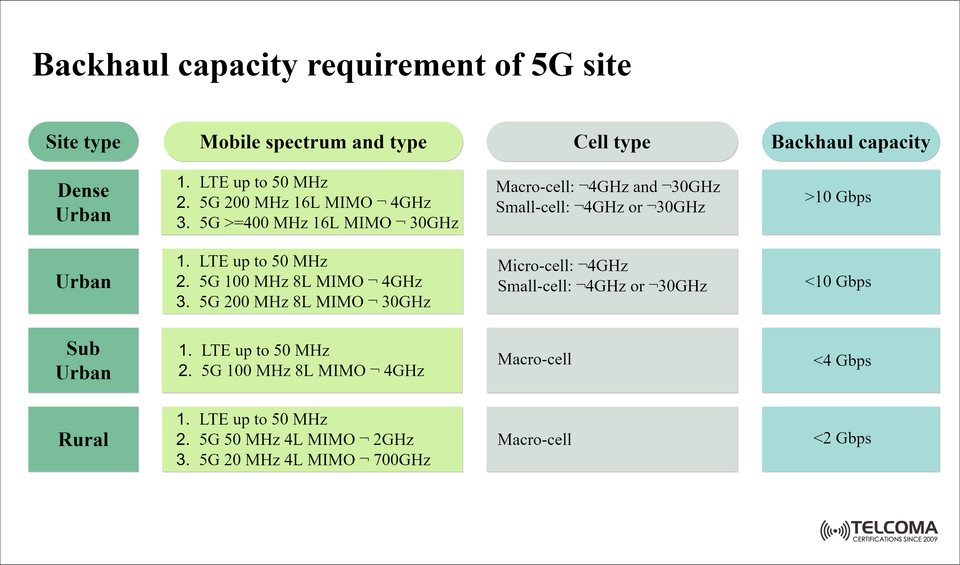
The image above details the backhaul capacity needs for various types of 5G sites—such as Dense Urban, Urban, Suburban, and Rural—along with their spectrum setups, MIMO configurations, types of cells, and throughput expectations.
Let’s dive into these requirements a bit more.
The Importance of Backhaul in 5G
Backhaul is the transport link that connects the base station (be it gNB or eNodeB in LTE) to the mobile core network. It can be set up using:
Fiber optics (the go-to for high capacity and low latency)
Microwave links (often found in rural or hard-to-reach locations)
Millimeter-wave wireless backhaul (for short-range, super high-capacity connections)
In 5G, the performance of backhaul has a direct impact on:
User experience, particularly regarding speed and responsiveness.
Efficiency of cell sites, especially when using high-capacity MIMO setups.
Scalability of the network for future traffic demands.
- Backhaul Needs by Site Type
The table in the image breaks it down clearly:
Site Type | Mobile Spectrum & MIMO Configuration | Cell Type | Backhaul Capacity
Dense Urban | 1. LTE up to 50 MHz
- 5G 200 MHz 16L MIMO @ ~4 GHz
- 5G ≥ 400 MHz 16L MIMO @ ~30 GHz | Macro-cell (~4 GHz & ~30 GHz), Small-cell (~4 GHz or ~30 GHz) | > 10 Gbps
Urban | 1. LTE up to 50 MHz
- 5G 100 MHz 8L MIMO @ ~4 GHz
- 5G 200 MHz 8L MIMO @ ~30 GHz | Micro-cell (~4 GHz), Small-cell (~4 GHz or ~30 GHz) | < 10 Gbps
Suburban | 1. LTE up to 50 MHz
- 5G 100 MHz 8L MIMO @ ~4 GHz | Macro-cell | < 4 Gbps
Rural | 1. LTE up to 50 MHz
- 5G 50 MHz 4L MIMO @ ~2 GHz
- 5G 20 MHz 4L MIMO @ ~700 MHz | Macro-cell | < 2 Gbps
- Dense Urban Sites
Key Features:
High user density: Hundreds of people using the network at the same time per cell.
Multiple frequency bands: Utilizing both Mid-band (~4 GHz) and mmWave (~30 GHz) to handle capacity.
Sophisticated MIMO setups: 16-layer MIMO for increased throughput.
Backhaul Requirement:
More than 10 Gbps needed to support peak 5G speeds and multi-gigabit user demands.
Fiber is the ideal backhaul medium, with millimeter-wave wireless backhaul as an option for smaller cells.
Challenges Involved:
Figuring out how to coordinate spectrum use among macro and small cells.
Dealing with interference in high-density setups.
Urban Sites
Key Features:
Moderate-to-high density: Plenty of users, but not as many as in dense urban settings.
Mixed cell types: Micro-cells and small cells are used for focused coverage.
Varied spectrum: Both mid-band (~4 GHz) and mmWave (~30 GHz) are deployed.
Backhaul Requirement:
Less than 10 Gbps, but enough to ensure smooth ultra-HD streaming, AR/VR, and enterprise-level connectivity.
Implementation Notes:
Operators might use fiber when it's feasible, turning to microwave backhaul for locations where digging for fiber is too expensive.
Suburban Sites
Key Features:
Lower population density compared to urban settings.
Mainly macro-cell architecture with broader coverage areas.
Limited to mid-band spectrum (~4 GHz) for better range and penetration.
Backhaul Requirement:
Under 4 Gbps—adequate for fewer simultaneous users and less heavy applications.
Common Backhaul Methods:
Fiber is usually found along major roads.
Microwave or high-capacity wireless backhaul could link more remote sites.
Rural Sites
Key Features:
Very low user density—usually only a handful of users per cell site.
Low-band spectrum (~700 MHz) for long-range coverage, alongside some mid-band (~2 GHz).
Limited MIMO configurations to 4 layers for effective coverage.
Backhaul Requirement:
Below 2 Gbps, since traffic levels are lower and applications generally don’t require much bandwidth.
Typical Backhaul Options:
Long-haul microwave or satellite backhaul is used when fiber is not an option.
Network operators tend to prioritize coverage over achieving top-capacity.
How Spectrum and MIMO Affect Backhaul Needs
The broader the spectrum and the more MIMO layers in play, the higher the peak data rate—and this drives the backhaul requirements.
Picking the Right Backhaul Technology
Fiber:
Best for low latency and future-ready capacity.
High CAPEX for setup in dense urban and rural areas.
Microwave Backhaul:
More flexible and quicker to deploy.
Capacity can drop at longer distances or in bad weather (especially for high frequencies).
Millimeter-Wave Wireless Backhaul:
Ideal for small cell connections in urban settings.
Can provide fiber-like capacity (>10 Gbps) over short distances.
Satellite Backhaul:
Used in hard-to-reach rural areas.
Has higher latency, but newer LEO constellations are improving performance.
Network Planning Factors
While planning backhaul for 5G sites, operators need to think about:
Traffic forecasting: Understanding peak vs average usage.
Number of sectors per site: More sectors mean a greater need for backhaul.
Shared backhaul links: Combining multiple small cells into one backhaul link.
Upgrade path: The capability to boost capacity as spectrum and MIMO configurations develop.
Quick Recap: Backhaul Overview
Environment | Typical Spectrum | MIMO | Cell Type | Capacity Needs | Preferred Backhaul
Dense Urban | 4 GHz & 30 GHz | 16L | Macro & Small | >10 Gbps | Fiber / mmWave
Urban | 4 GHz & 30 GHz | 8L | Micro & Small | <10 Gbps | Fiber / Microwave
Suburban | 4 GHz | 8L | Macro | <4 Gbps | Fiber / Microwave
Rural | 700 MHz & 2 GHz | 4L | Macro | <2 Gbps | Microwave / Satellite
How 5G Backhaul Differs from 4G Backhaul
LTE backhaul usually worked in the 1–3 Gbps range for most macro sites. But for 5G, especially in densely populated areas, backhaul demands can easily exceed 10 Gbps.
Here’s why:
Wider channel bandwidths: LTE typically used 20 MHz channels, while 5G can go all the way up to 400 MHz in mmWave bands.
Massive MIMO: LTE often stuck to 2x2 or 4x4 MIMO, but with 5G, it’s possible to scale up to 16x16 or even 64x64 MIMO in trials.
Ultra-low latency: 5G aims for <1 ms air interface latency, so backhaul links have to respond really quickly.
Multi-service convergence: 5G backhaul isn’t just for mobile broadband; it also needs to handle IoT, URLLC, and private network data.
This shows that the network transport architecture needs to evolve, becoming more capacity-rich and latency-sensitive than what we saw in the 4G days.
Backhaul Latency Considerations
Throughput isn’t everything—latency is super important for real-time 5G applications like autonomous driving, AR/VR, and industrial automation.
Typical latency targets are:
Dense Urban / Urban: <1–2 ms one-way.
Suburban: <5 ms one-way.
Rural: <10 ms one-way (this works for most consumer applications).
To hit these targets, operators prefer using fiber wherever they can, along with short-hop wireless links to keep delays low.
Traffic Growth and Backhaul Scalability
A common issue in network design is planning backhaul based on current demand without considering future growth.
Some major traffic drivers for 5G include:
4K/8K streaming video.
Cloud gaming.
Enterprise VPNs using 5G.
IoT and smart city sensors.
Edge computing integration (which increases east-west traffic between sites).
Recommendation: Size your backhaul for 1.5–2× the expected peak demand to sidestep frequent upgrades.
Fiber vs Wireless Backhaul Trade-offs
Fiber Advantages:
Very high capacity (>100 Gbps possible).
Low and consistent latency.
Long-term scalability.
Fiber Disadvantages:
High installation costs, especially in rural regions.
Delays in deployment due to permit issues and civil works.
Microwave/mmWave Wireless Advantages:
Quick to deploy.
Lower initial CAPEX.
Great for filling last-mile gaps to fiber.
Wireless Disadvantages:
Limited capacity over longer distances.
Vulnerable to weather impacts at high frequencies.
Small Cells and Backhaul Challenges
In crowded urban areas, small cells are vital for offloading capacity, especially at mmWave frequencies where coverage can be tricky.
Here are some challenges with small cell backhaul:
Site availability: rooftops, lampposts, bus stops.
Backhaul link density: each small cell might need multi-gigabit links.
Power supply: remote spots may not have reliable power.
Solutions include:
Utilizing mmWave point-to-multipoint backhaul to link multiple small cells to a central hub.
Deploying integrated access backhaul (IAB), where part of the spectrum is used for backhaul.
- The Role of Network Slicing in Backhaul Planning
5G’s network slicing allows various types of traffic (like eMBB, URLLC, and mMTC) to share the same infrastructure while offering separate performance guarantees.
This impacts backhaul by:
Requiring QoS-aware transport with careful bandwidth allocation.
Latency-sensitive slices (like URLLC) might need dedicated low-latency paths.
Slicing also supports private enterprise networks, which can have their own specific backhaul KPIs.
Case Study: Dense Urban Deployment
Scenario: A telecom operator gears up for a Dense Urban 5G rollout in a city center.
Spectrum plan: 200 MHz @ 3.5 GHz (mid-band) and 400 MHz @ 28 GHz (mmWave).
MIMO configuration: 16-layer MIMO for both bands.
Site type: Macros plus integrated small cells.
Estimated peak throughput per site: around 15–20 Gbps aggregate.
Backhaul design:
Dual 10 Gbps fiber connections for each site (active-active).
mmWave wireless backhaul for small cells (links under 500 m).
QoS-enabled IP/MPLS transport to the core network.
Result:
Supports gigabit-level user speeds.
Set for future 5G-Advanced upgrades without major backhaul overhauls.
Future Trends in 5G Backhaul
Looking ahead, several trends are set to change 5G transport networks:
Terabit backhaul for super-dense 6G-ready networks.
AI-driven traffic optimization to flexibly allocate backhaul capacity.
Open RAN integration, requiring more adaptable and disaggregated transport.
Satellite-terrestrial backhaul hybridization for global coverage.
Operators today planning backhaul should ensure their infrastructure is ready to evolve with these trends.
Key takeaways for telecom professionals include:
Always think ahead for future traffic growth, not just current levels.
Align backhaul tech with the site type: fiber for capacity, microwave for flexibility, mmWave for short-range gigabit links.
Keep latency in mind as a performance metric alongside throughput.
Build with redundancy and scalability in mind to meet evolving 5G needs and the eventual shift to 5G-Advanced and 6G.
A well-designed backhaul network will enable operators to deliver the full potential of high-speed, ultra-reliable 5G connectivity to consumers, businesses, and mission-critical applications.
Conclusion
The backhaul capacity requirements of 5G sites are shaped by factors like site location, spectrum allocation, MIMO settings, and cell type. In crowded urban areas, you’ll need fiber-level throughput over 10 Gbps, while rural areas can manage effectively with links under 2 Gbps.
Telecom professionals need to consider future traffic increases, 5G spectrum growth, and the shift towards 5G-Advanced in their backhaul designs. Finding the right balance between fiber, microwave, and mmWave wireless will ensure networks can adapt to the needs of ultra-fast, ultra-reliable 5G services.
The backhaul capacity requirement for a 5G site is crucial for realizing the promised performance of next-gen networks. It varies greatly, from over 10 Gbps in dense urban areas to sub-2 Gbps in rural zones, depending on population density, spectrum use, and MIMO setup.