
Beamforming Explained: How Antenna Arrays Shape Wireless Communication in 5G and Beyond

Beamforming: The Smart Antenna Tech Changing Wireless Communication
As wireless technology develops from 4G to 5G and beyond, one standout innovation making a big difference in performance, coverage, and efficiency is beamforming.
Beamforming helps base stations and access points to zero in on radio signals in specific directions, rather than letting them spread out everywhere. This focus allows networks to give stronger signals, faster data rates, and less interference, even when there are a lot of users around.
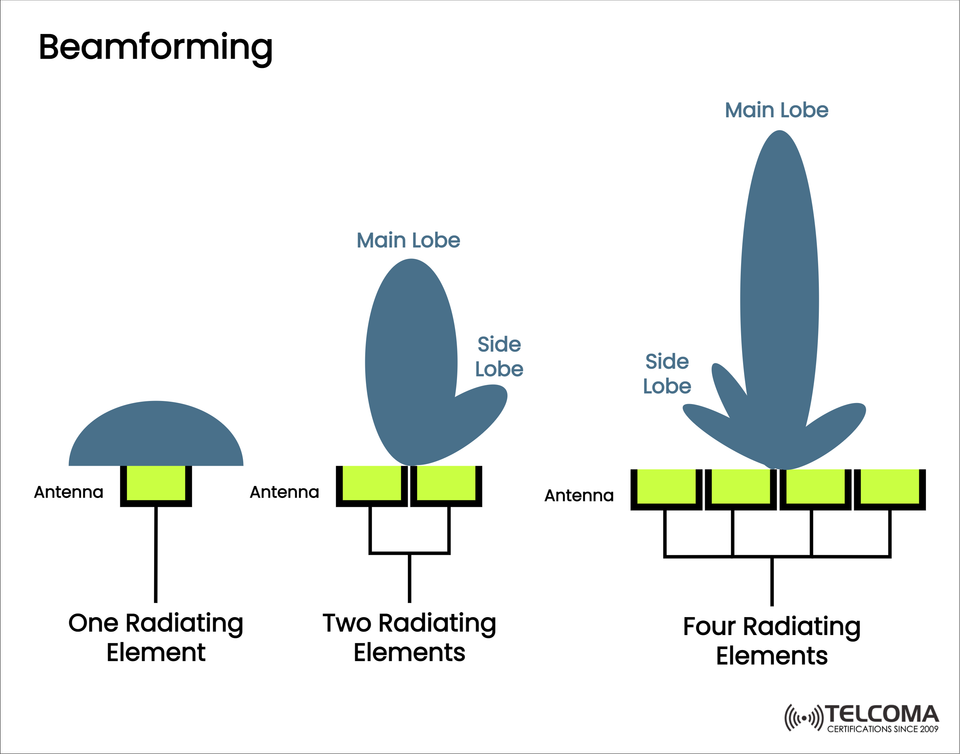
The image uploaded clearly shows how beamforming works: as the number of radiating elements goes up, the main beam gets narrower and more concentrated, while unwanted side lobes are kept to a minimum. Let’s dive deeper into how this all works.
What Is Beamforming?
Beamforming is a signal processing technique used in antenna arrays to direct radio energy specifically toward a receiver, like a mobile device, rather than broadcasting it evenly in every direction.
With traditional antennas, energy is radiated uniformly, which means a lot of the signal goes to waste in directions where there aren’t any users. Beamforming tackles this issue by shaping the radiation pattern of multiple antennas to maximize energy toward the intended user and minimize it elsewhere.
This makes beamforming a crucial feature in:
5G base stations (gNodeBs)
Wi-Fi 6/7 access points
Radar and satellite systems
Millimeter wave (mmWave) networks
Understanding Beamforming
In simple terms, beamforming uses multiple antennas that work together smartly. By adjusting the phase and amplitude of the signal at each antenna, the system can create constructive interference to boost signal strength in one direction and destructive interference to minimize it in others.
The outcome is a focused main lobe targeting a specific user, with smaller side lobes holding lower energy, as illustrated in the image.
Effect of Antenna Elements on Beamforming
The image beautifully outlines the core principle of beamforming through three stages of antenna configurations:
Configuration Radiation Pattern Explanation
One Radiating Element Wide coverage with no directionality The antenna sends energy evenly in all directions. This works for simple, short-range communication but isn’t efficient for larger networks.
Two Radiating Elements Narrower beam, one main lobe with side lobes Signals from both antennas combine to create a more focused beam. Some directionality starts to form, but side lobes still hang around.
Four Radiating Elements Strong main lobe, reduced side lobes More antennas mean the beam is highly focused, cutting down on interference and boosting gain in the desired direction.
This illustrates a key takeaway:
The more antenna elements you have in the array, the narrower and more powerful the main beam.
This idea is foundational to Massive MIMO (Multiple Input Multiple Output) systems used in 5G networks, where hundreds of antenna elements create highly directional beams for multiple users at the same time.
The Science Behind Beamforming
Beamforming is based on wave superposition — combining multiple electromagnetic waves so they reinforce each other in some directions and cancel out in others.
Mathematically, the array factor (AF) for an antenna array is:
AF(θ)=∑n=1Nwnejkdnsin(θ)
Where:
N: number of antenna elements
wn: complex weight (amplitude and phase) for element n
k = 2π/λ: wave number
dn: spacing between antenna elements
θ: angle of signal departure or arrival
By adjusting the weights, the array can steer the beam to a desired angle while suppressing unwanted directions — that’s the crux of beamforming.
Types of Beamforming
In today’s wireless systems, beamforming can be implemented in various ways depending on the network design and hardware capabilities.
- Analog Beamforming
Uses phase shifters to manage signal phase in the analog realm.
All antenna elements share a single RF chain.
Advantages: Low power consumption, good for mmWave frequencies.
Limitations: Can only form one beam at a time.
- Digital Beamforming
Controls both phase and amplitude digitally using several RF chains.
Each antenna element can send unique signals, which means it can create multiple beams at once.
Advantages: Flexibility is high, supports multi-user MIMO.
Limitations: More complex and costly.
- Hybrid Beamforming
Blends analog and digital methods to find a balance between cost and performance.
Common in 5G base stations.
Advantages: It supports multiple beams with fewer RF chains.
Ideal For: Massive MIMO setups in 5G networks.
Beamforming in 5G Networks
Beamforming is key in 5G New Radio (NR) systems, especially at millimeter-wave frequencies (24 GHz and up) where signals face a lot of path loss and struggle with penetration.
By concentrating the radio energy directly toward user equipment (UE), beamforming:
Extends coverage
Boosts data throughput
Improves reliability
Reduces interference
For users, this means:
Higher data speeds (up to multi-Gbps)
Lower latency
Stable connectivity, even in crowded urban areas
Beamforming is also vital for beam management, where the system keeps an eye on signal quality and adjusts beam directions on the fly to maintain top-notch performance.
Main Lobe and Side Lobes
The main lobe is where the radiation is strongest — that focused energy aimed at the target user.
On the flip side, side lobes are smaller, unintended radiation directions that could lead to signal leakage or interference.
Beamforming Design Goal:
Maximize the main lobe for effective communication.
Minimize side lobes to lessen interference and enhance efficiency.
As shown in the image:
With one element, radiation is broad and inefficient.
With two elements, the beam gets narrower, showcasing a clear main lobe.
With four elements, the main lobe is sharply defined, and the side lobes shrink down.
This illustrates how beamforming helps with directional gain — how effectively an antenna directs energy in one direction.
Benefits Description
Higher Signal Quality Focused energy boosts SNR (Signal-to-Noise Ratio).
Reduced Interference Steering beams away from other users cuts down on cross-talk.
Increased Capacity Lets more users connect at the same time while maintaining separation.
Better Energy Efficiency Concentrates power where it's most needed, cutting down on waste.
Extended Range Focused transmissions improve coverage.
These perks make beamforming essential for 5G, satellite communication, and the latest Wi-Fi technologies.
Challenges in Implementing Beamforming
Even with all its advantages, beamforming does have its challenges:
Complex Signal Processing: Beam optimization in real-time calls for powerful processors.
Hardware Cost: Having multiple antenna elements and RF chains can get pricey.
Calibration Issues: Mismatches between antennas can mess with beam shape.
Mobility Handling: Quick-moving users require continuous beam tracking.
To tackle these issues, AI-driven beam management and hybrid beamforming architectures are making headway in 5G and 6G networks.
Beamforming and the Path to 6G
As we look ahead to 6G, beamforming will need to become even smarter and more adaptive. Upcoming systems will integrate:
AI/ML-based beam prediction for real-time tracking of users
Reconfigurable intelligent surfaces (RIS) to control reflections based on the environment
Terahertz (THz) beamforming for super-fast communication
These enhancements will change beamforming from a static technique into a dynamic, learning signal control system that adapts to users, devices, and even the environment.
Conclusion
The uploaded image captures the core of beamforming — how more antenna elements sharpen and strengthen wireless communication beams.
From a single radiating element with broad coverage to multi-element arrays creating highly directed beams, beamforming is the backbone of modern wireless innovation.
By smartly directing energy where it’s needed most, beamforming allows for the high speed, low latency, and reliable connections that define today’s 5G networks — and it's set to continue driving the 6G systems of the future.
In our increasingly connected world, beamforming represents not just a technology — it’s the art of precise wireless communication.