
Broadband Forum in 2017: Evolution of Broadband Ecosystem and Services
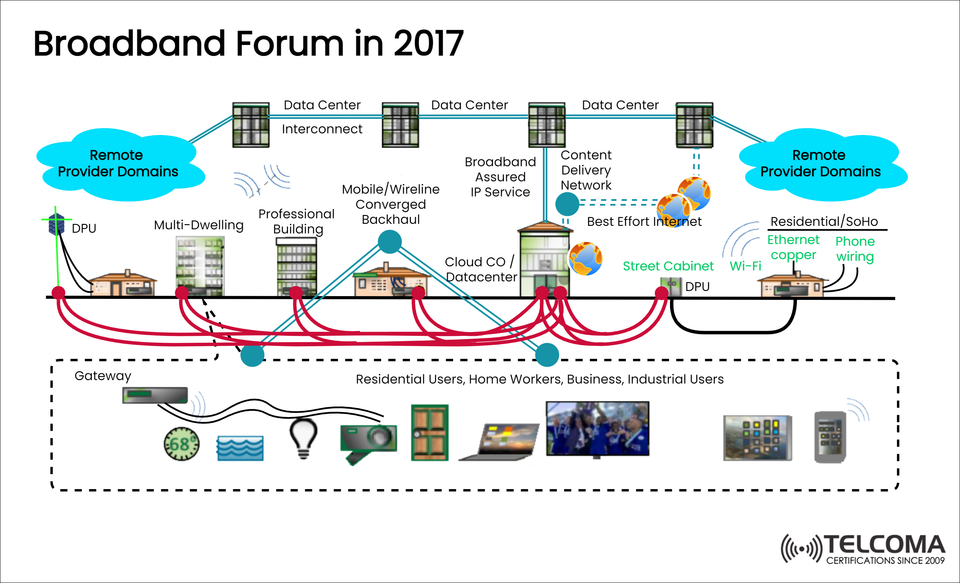

Broadband networks really are essential for digital transformation. Back in 2017, the Broadband Forum (BBF) played a key role in laying down the architectures, standards, and frameworks that helped fuel the rapid growth of internet services, smart devices, and 5G-ready infrastructures.
The image gives us a look at how BBF envisioned the whole broadband ecosystem, linking data centers, remote provider domains, cloud central offices, and both residential and business users into a cohesive and scalable framework. Let’s dive into the parts of this architecture and see how it has influenced telecom professionals and tech enthusiasts alike.
The Broadband Forum Vision in 2017
In 2017, the BBF was focused on tackling both technological innovation and rising service demand. They brought together fixed and mobile broadband, cloud services, and new delivery models to make sure residential, business, and industrial users had access to reliable and scalable connectivity.
Some key highlights from their 2017 vision include:
Merging mobile and wireline backhaul.
Launching Cloud Central Office (Cloud CO) for distributed computing.
Advancing assured IP services along with best-effort internet.
Ensuring smooth connectivity to remote provider domains.
A focus on the variety of end-users: homes, enterprises, and industrial IoT.
Core Components of the 2017 Broadband Ecosystem
- Data Centers and Interconnects
Data centers acted as the central hubs for traffic aggregation, cloud hosting, and connections with remote providers. Interconnects allowed for seamless peering between domains, making global connectivity possible.
Functions:
Hosting applications and content.
Serving as the backbone for cloud and content delivery networks (CDN).
Helping scale up for both enterprise and residential traffic.
- Mobile/Wireline Converged Backhaul
A major shift was that wireline and wireless backhaul were unified. This change supported the rising 5G transport requirements by providing low latency and high throughput.
Benefits:
More efficient use of existing fiber and copper infrastructure.
Boosted performance for mobile broadband users.
A single layer of transport for both fixed and mobile services.
- Cloud Central Office (Cloud CO)
The Cloud CO idea represented a major change. Traditional central offices transformed into virtualized, software-driven data centers that facilitated broadband access and edge computing.
Innovations in Cloud CO included:
Network Function Virtualization (NFV): Running network functions as software rather than hardware.
Distributed compute power: Bringing computing capabilities closer to the edge.
Service agility: Quicker rollout of new services for users.
- Broadband Assured IP Service vs. Best Effort Internet
The image highlights the differences between assured IP services and best-effort internet.
Broadband Assured IP Service: Guaranteed quality of service (QoS), which is critical for things like telemedicine, financial transactions, and team collaboration.
Best Effort Internet: Standard internet connectivity without strict QoS guarantees, typically used for general browsing and entertainment.
This two-pronged approach allowed operators to cater to both premium enterprise clients and everyday users.
- Street Cabinets and DPUs (Distribution Point Units)
Street cabinets and DPUs served as the link between the backbone and the end-users. These units managed last-mile connectivity using fiber, copper, or a mix of both.
Street Cabinets: Aggregated connections within neighborhoods.
DPUs: Enabled speedy broadband delivery in residential and multiple dwelling scenarios.
- Residential and Business Users
Ultimately, the goal of all these broadband innovations was to provide seamless services to end-users:
Residential Users: Access to Wi-Fi, IPTV, IoT devices, and entertainment options.
Home Workers: Reliable connectivity for video calls and remote work.
Businesses and Industry: High-speed internet, secure VPNs, and enterprise cloud services.
The diagram shows the range of connected devices—laptops, smart TVs, IoT gadgets, and smartphones—highlighting the growing digital lifestyle.
How the Broadband Forum Drove Change in 2017
The Broadband Forum was all about standardizing and aligning efforts among telecom operators, vendors, and service providers. Their projects aimed to create interoperable frameworks and push innovation in broadband services.
Key initiatives in 2017 included:
Crafting interoperable APIs for service delivery.
Supporting IoT integration within broadband networks.
Pushing wireless-wireline convergence to unify access.
Advocating for performance-aware services to guarantee a good user experience.
Impact on Telecom and Technology Landscape
By 2017, all of this work by the Broadband Forum resulted in:
Faster rollout of fiber-to-the-home (FTTH), GPON, and hybrid access.
5G transport readiness, with a converged backhaul and Cloud CO framework.
Scalable service delivery models for ISPs and operators.
Better user experiences, ensuring smooth video streaming, cloud services, and smart home connectivity.
This evolution created the blueprint for today’s next-generation broadband, where cloud-driven, converged, and virtualized networks set the global standard.
Conclusion
The Broadband Forum in 2017 marked a pivotal moment in shaping the broadband landscape. By combining cloud central offices, assured IP services, converged backhaul, and a user-focused design, BBF laid the groundwork for scalable and reliable global connectivity.
For telecom professionals, these efforts signified more than just small improvements; they represented a strategic shift toward cloud-native, service-driven broadband networks. The advancements we see today in 5G, edge computing, and smart home services owe a lot to what was established back then.
As networks keep evolving, the BBF’s vision from 2017 still holds true, highlighting the need for collaboration, interoperability, and innovation in our connected world.