
Carrier Aggregation vs. Dual Connectivity in 5G: Key Differences Explained

Carrier Aggregation vs. Dual Connectivity in 5G: Key Differences Explored
5G aims to provide super-fast data speeds, low latency, and smooth connectivity. To make this happen, two key techniques come into play: Carrier Aggregation (CA) and Dual Connectivity (DC).
At first, they look quite similar since both bring together multiple connections to boost throughput and enhance reliability. But the ways they operate, their architecture, and the performance benefits they offer are actually pretty different.
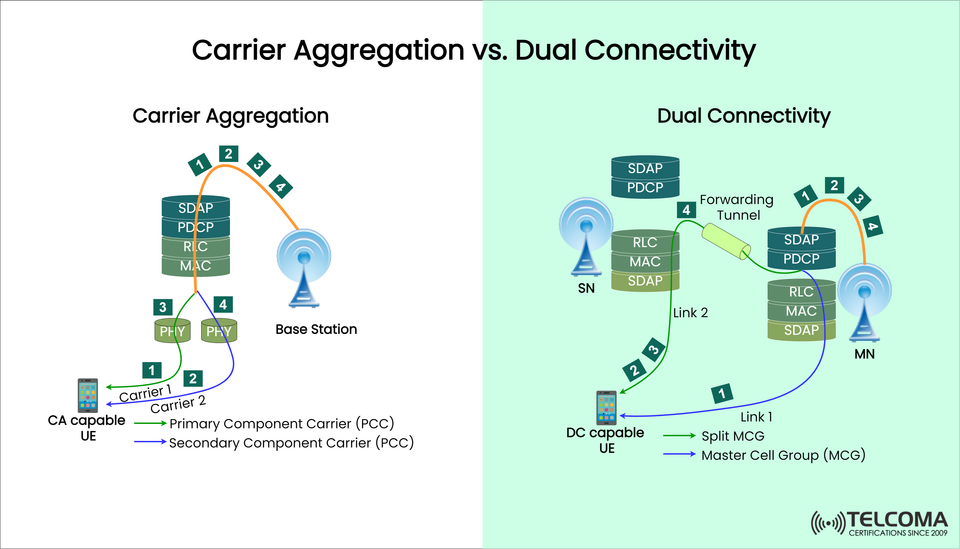
What sets Carrier Aggregation apart from Dual Connectivity, supported by the diagram above.
What is Carrier Aggregation (CA)?
Carrier Aggregation is a method that lets a single base station combine multiple frequency carriers to serve a CA-capable User Equipment (UE).
You can think of it like widening a highway: instead of just one narrow lane, multiple lanes are created to let more traffic (data) flow at the same time.
How Carrier Aggregation Works:
The Base Station brings together two or more carriers (Carrier 1, Carrier 2).
The UE (user device) gets data streams from these various carriers all at once.
Higher layers (SDAP, PDCP, RLC, MAC) manage the traffic before it gets divided into PHY layers.
Primary Component Carrier (PCC): This is the main carrier that handles control and signaling.
Secondary Component Carrier (SCC): These are extra carriers that help ramp up data rates.
Key Benefits of Carrier Aggregation:
Higher Throughput: Boosts bandwidth by merging multiple carriers.
Efficient Spectrum Utilization: Lets operators combine fragmented bits of spectrum.
Seamless User Experience: Enhances download/upload speeds in high-demand areas.
Limitations of Carrier Aggregation:
All carriers need to come from the same base station.
Works best in spectrum-rich urban areas.
Its efficiency relies on the UE's capability (like how many carriers it can support).
What is Dual Connectivity (DC)?
Dual Connectivity enables a UE to connect at the same time to two different base stations—a Master Node (MN) and a Secondary Node (SN).
It’s kind of like having two separate highways from different cities, both leading to the same destination.
How Dual Connectivity Works:
The UE connects to the Master Cell Group (MCG) through the Master Node (MN).
Simultaneously, the UE connects to a Split MCG via a Secondary Node (SN).
The MN and SN work together to manage traffic using forwarding tunnels.
Both connections are active, allowing the UE to aggregate data from two separate base stations.
Key Benefits of Dual Connectivity:
Better Coverage: Merges the resources from two base stations.
Higher Reliability: If one connection falters, the other keeps things steady.
Heterogeneous Network Support: Can combine LTE (4G) with 5G NR, aiding the transition from 4G to 5G.
Load Balancing: Spreads out traffic among multiple nodes.
Limitations of Dual Connectivity:
Needs solid coordination between nodes.
Has higher signaling overhead compared to Carrier Aggregation.
More complex deployment in larger networks.
Carrier Aggregation vs. Dual Connectivity: Key Differences
Here’s a quick side-by-side comparison:
Feature Carrier Aggregation (CA)Dual Connectivity (DC)Architecture Single base station combining multiple carriers Two different base stations (MN & SN) providing connectivity Control Signaling Managed by one base station (PCC)Master Node (MN) handles control, SN manages data Spectrum Usage Combines multiple carriers (intra-band or inter-band)Utilizes resources from different nodes, possibly various RATs Performance Gain Boosts throughput by adding bandwidth Enhances reliability, coverage, and load balancing Deployment Complexity Easier, since there’s just one node involved More complicated, needs coordination between MN & SN Use Case Urban areas with high spectrum availability Areas facing coverage challenges, LTE-NR integration or mobility needs
When to Use Carrier Aggregation vs. Dual Connectivity
Picking between CA and DC really hinges on your network design goals:
Best Scenarios for Carrier Aggregation:
In urban or metropolitan areas with lots of spectrum available.
Settings that require high-speed broadband.
Networks aiming to maximize spectrum efficiency.
Best Scenarios for Dual Connectivity:
Transitional networks that combine LTE and 5G NR.
Rural or semi-urban areas needing better coverage.
Situations that demand stable connections (like industrial IoT or mission-critical applications).
Technical Layer Differences
Let’s examine the protocol layers in a bit more detail:
In Carrier Aggregation:
Data is split at the MAC/PHY layer within the same base station.
The design is simpler since one node handles both signaling and aggregation.
In Dual Connectivity:
Splitting happens at higher layers (PDCP/SDAP).
Requires forwarding tunnels for coordination between MN and SN.
Offers more flexibility across RATs (like LTE + 5G NR).
This highlights why CA is more spectrum-focused, whereas DC is more architecture-focused.
Real-World Applications
Carrier Aggregation in Action
Widely used in LTE-Advanced and 5G NR.
Helps operators achieve gigabit speeds by merging fragmented spectrum blocks.
For instance, a 5G phone might use 100 MHz from mid-band plus 20 MHz from low-band at the same time.
Dual Connectivity in Action
Enables EN-DC (E-UTRAN NR Dual Connectivity) where LTE anchors control while 5G boosts data throughput.
Ideal for private 5G networks where reliability and redundancy are crucial.
Commonly deployed in early non-standalone (NSA) 5G networks to ensure a seamless user experience.
Future Outlook
As networks transition to standalone 5G and eventually 6G, both CA and DC will keep evolving:
Carrier Aggregation: Will be key in millimeter-wave (mmWave) 5G, where there’s a need to aggregate wide bandwidths for ultra-fast speeds.
Dual Connectivity: Will still be important in multi-RAT scenarios and future heterogeneous networks bringing together 5G, Wi-Fi 7, and satellite links.
With virtualization (like vRAN, O-RAN), the ability to dynamically choose between CA or DC based on real-time traffic will become a crucial function of network intelligence.
Conclusion
Both Carrier Aggregation (CA) and Dual Connectivity (DC) are essential parts of the 5G toolkit, but they tackle different challenges:
CA is all about maximizing speed from available spectrum within a single base station.
DC focuses on leveraging multiple nodes for better coverage, reliability, and inter-RAT integration.
For operators, the best deployment usually involves a mix of both techniques, with CA driving throughput in areas rich in spectrum, while DC ensures smooth mobility and broad coverage.