
Carrier Network Architecture Explained from the MEC Perspective
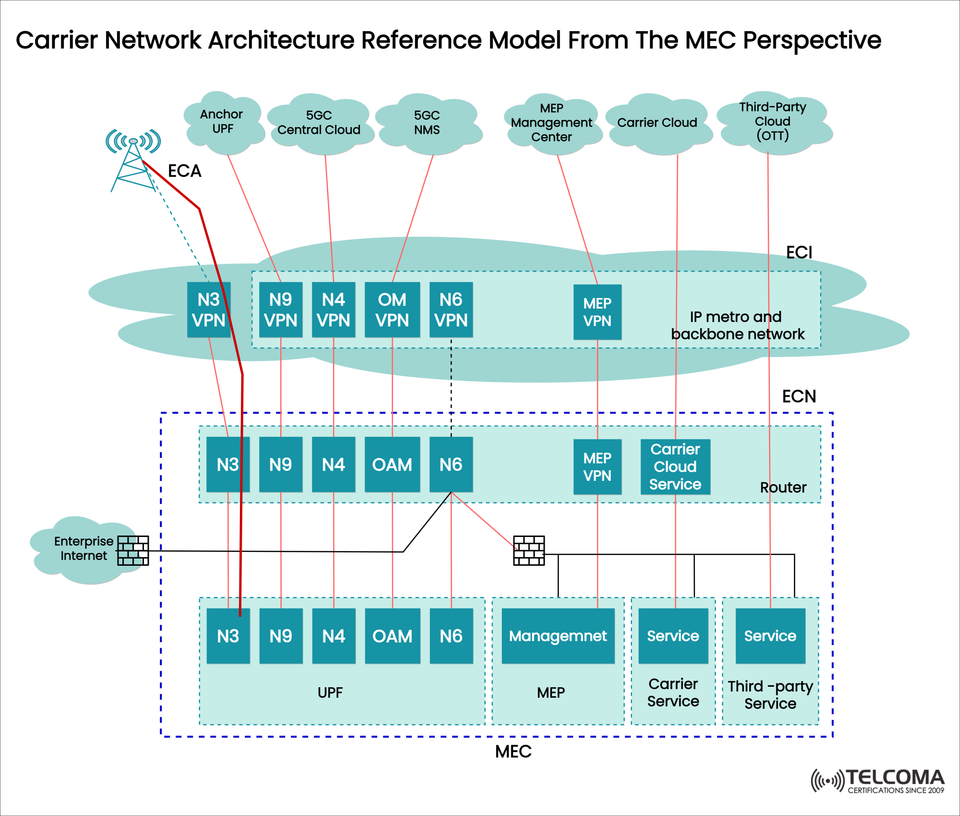

Carrier Network Architecture Reference Model: The MEC Lens
As a part of redefining the carrier network infrastructure, the emergence of 5G establishes MEC as a key architectural element providing a new dynamic and size for traditional network models. The architecture depicted in the figure provides a view to demonstrate the perspective of how the various network elements, VPNs and cloud components connect with each other from an MEC angle.
This specification is a useful disaggregation for either the telecommunications professional or technology enthusiast who wants to clarify the differing layers of functionality for network slicing, edge computing and virtualized functions planned for the 5G domain.
📌 Louis and Demo Platform
The picture depicts a layered modular perspective of the carrier network with demarcation outlining the Enterprise Customer Network (ECN), Edge Compute Infrastructure (ECI), and Metro and Backbone IP Network. The following describes each important section:
- Multi-access Edge Platform (MEP)
Delivers services as close as possible to end-users
Serves ultra-low latency applications
Allows for connectivity to:
Carrier Service
Third Party OTT Service
Management Systems
- User Plane Function (UPF)
Implements the data forwarding of the 5G packets through IP, and any transition to Mobile Edge Computing before handing over to the Carrier VPN - User Plane Function (UPF)
Performs data forwarding on 5G packets
Interfaces used:
N3, N9, N4, OAM, N6
All interfaces are VPN-protected to provide security
- Core Interfaces (N Interfaces)
Each interface referenced with a VPN path:
N3 VPN – From RAN to UPF
N9 VPN – Between UPF components
N4 VPN – UPF control signalling
N6 VPN – External networks and services traffic
OAM VPN – Operations, Administration, Maintenance communications
MEP VPN – MEP security and cloud connectivity
- Cloud and network elements
5GC Central Cloud
Anchor UPF
5GC NMS (Network Management System)
Carrier Cloud and Third-party OTT Cloud
Connectivity via IP metro and backbone networks via secured VPNs.
🗂️ Logical Flow of Data and Services
Layer Component Function
ECA RAN, Anchor UPF Access Layer
ECI Central Cloud, NMS, Carrier/OTT Cloud Core services
ECN MEP, UPF, VPN interfaces Edge control and service delivery
MEC MEP apps, carrier/third-party services Low-latency execution
🔐 VPN-Protected Interfaces
VPNs play a pivotal role in establishing secured and isolated communications across the network.
Red lines in the diagram correspond to VPN Tunnels transporting signalling and data.
OAM and N interfaces will need to use VPNs to secure data communication while retaining inter-operability.
VPN encapsulation will guarantee that traffic is ensured while traversing a 3rd Party cloud or utilizing a public infrastructres.
🌐 Integrating with 3rd Party Clouds
Carrier networks are now required to integrate with OTT providers/public cloud infrastructure where MEC supports:
Locally hosting services at the edge and reducing latency and improving QoS (quality of service) while allowing API driven orchestration and experience seamless VPN handoff.
Conclusion
This carrier network architecture from an MEC perspective shows how 5G networks are being built flexibility, security, and ultra-low latency in mind. MEC allows carriers to bring services as close as possible to users with a secure and robust connection to the core and to third-party systems. The structured VPN interfaces and distributed cloud connectivity options allow operators to deliver high quality next-gen applications and services like AR/VR, IoT, and mission-critical to name a few.
Tags (SEO-optimized):
5G carrier architecture; MEC network design; UPF and MEP in 5G; VPN in telecom networks; 5G N interfaces; edge computing in telecom; multi-access edge computing
🔧 Deployment Considerations for MEC in 5G Carrier Networks
Successful deployment of MEC in carrier network architecture depends on several considerations:
Latency sensitivity - MEC nodes need to be as close to users as possible to adequately satisfy the ultra-low latency requirement.
Scalability - The architecture needs to be able to scale dynamically based on the type of service delivered and demand from users.
Interoperability - The architecture needs to work nothing interoperability with third-party clouds (OTT), legacy systems and other 5GC components.
Security - Each interface will need to have attested secure tunneling (VPN) protecting sensitive data at rest and in motion.
🔄 Role of MEC in Real-Time Applications
MEC empowers modern applications by processing data locally instead of sending it to distant data centers. Real-world use cases include:
- Autonomous Vehicles: Real-time sensor processing near the edge.
- Industrial IoT: Instantaneous analytics and machine control in manufacturing.
- Augmented Reality (AR): Immersive experiences with minimal lag.
- Smart Cities: Local processing for surveillance, traffic management, and environmental monitoring.
🔍 How MEC Enhances Network Efficiency
By offloading processing from central cloud infrastructures, MEC optimizes both network load and performance:
- Reduces core network congestion
- Shortens data travel paths
- Improves service delivery times
- Facilitates content caching at the edge
🧩 Suggested Internal Linking (for WordPress)
To boost your SEO and user engagement, link this post to other relevant blog entries:
- Understanding 5G Core Architecture and Its Interfaces
- What is Multi-Access Edge Computing (MEC)?
- Role of UPF in 5G Network Slicing
- 5G Network VPN Security Explained
Schema Markup (Optional for Advanced SEO)
json
Copy
Edit
{
"@context": "https://schema.org",
"@type": "TechArticle",
"headline": "Carrier Network Architecture Explained from the MEC Perspective",
"author": {
"@type": "Organization",
"name": "Telcoma"
},
"datePublished": "2025-07-12",
"image": "URL_TO_IMAGE",
"publisher": {
"@type": "Organization",
"name": "Telcoma",
"logo": {
"@type": "ImageObject",
"url": "https://telcomaglobal.com/logo.png"
}
},
"description": "In-depth description of 5G Carrier Network Architecture through the MEC prism and its interfaces N3, N4, N6, and VPN secured cloud connections.",
"keywords": "5G carrier architecture, MEC perspective, VPN interfaces, user plane function, edge computing telecom"
}
(Replace URL_TO_IMAGE with the actual uploaded image path)
Final Thoughts
This reference model provides a visual and conceptual understanding of the MEC approach to Carrier Network Architecture for the 5G era. As the use of edge computing and private networks in hybrid clouds continues to build, understanding this design is critical for telecom engineers, network architects, and cloud specialists.
MEC is not a fad— it is the foundation of what responsive, secure, and efficient 5G networks will be built upon.