
CAVs in 6G Network Architecture: Enabling Connected Autonomous Vehicles with Space and Edge Networks

CAVs in 6G Network Architecture: Exploring How Connected Autonomous Vehicles Leverage Next-Generation Networks
The new era of wireless connectivity– 6G– is more than just faster speeds! It’s about creating intelligent, real-time systems and solutions that will revolutionize industries. One of the most exciting applications is Connected Autonomous Vehicles (CAVs), which rely on integrated communication from land, air, and even space-supported communications.
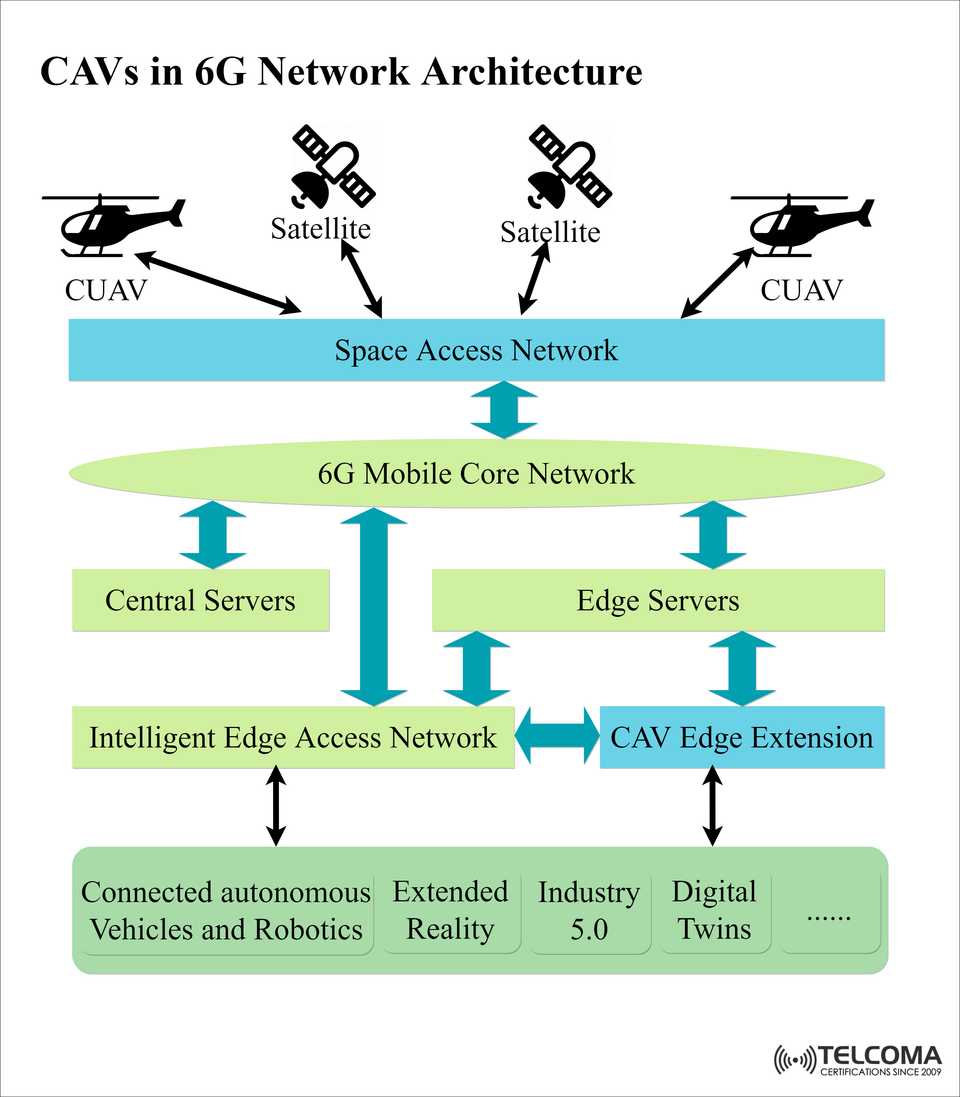
The diagram at the top illustrates a holistic architecture for 6G that supports CAVs and the stretch of connection from satellites, central and edge servers, and intelligent edge access networks along with edge extensions dedicated to CAVs.
This post will explain each layer of the architecture and how it enables future-ready applications such as autonomous vehicles, Industry 5.0, extended reality, and digital twins.
Overview of CAVs in 6G Architecture
The notion of a CAV in 6G is not in a vacuum, but part of an intelligent, multi-layered network fabric that ensures ultra-low latency, allows for massive amounts of data to be processed, and maintains uninterrupted connectivity, whether on land, in the air, or even in space.
The architecture shown previously consists of:
Space Access Network– includes satellites and CUAVs (Collaborative Unmanned Aerial Vehicles)
6G Mobile Core Network
Central and Edge Servers
Intelligent Edge Access Network
CAV Edge Extension
Together this stack of architecture enables real-time applications across multiple domains.
Key Features Explained
🛰️ Space Access Network
Comprising Satellites and CUAVs
Provides global access and open opportunities in remote, rural, and mobile decision-making contexts.
Serves as the first level of connectivity for aerial and high-mobility CAVs.
📡 6G Mobile Core Network
The mobile core network comprising a central control plane for orchestration, routing, and coordination for levels of the accessed networks.
Provides access for both edge and space-based systems.
🧠 Intelligent Edge Access Network
Facilitates real-time compute and storage capabilities at the data edge (i.e. CAVs) reducing latency for any mission-critical human interaction regarding obstacles or traffic coordination.
🔄 CAV Edge Extension
A part of the network unique to CAVs that extends the compute and communication position directly into the vehicle or robot.
Allows vehicle-to-vehicle and vehicle-to-everything interactions.
💾 Central and Edge Servers
Central servers conduct data intensive processes, e.g. updates, analytics, and AI model training.
Edge servers manage more immediate, e.g., sensor data and localization with route optimization.
Application Domains Enabled by 6G & CAVs
The 6G architecture that supports CAVs is designed to do more than just facilitate autonomous driving. It will likely facilitate:
Domain Function of 6G + CAV Architecture
Connected Autonomous Vehicles Ensures navigation, safety, efficiency, and fleet coordination in real-time.
Extended Reality (XR) Provides immersive environments in real-time.
6G Benefits for CAVs
When integrating CAVs into a 6G-driven architecture, the benefits may include:
⚡ Ultra-low latency (<1 ms): Vital for real-time decision-making in traffic situations
🌍 Widespread coverage: CAVs can be sustained over large areas through space access networks (satellites and CUAVs)
🔐 Secure and trusted communication: Edge encryption and AI-enhanced security layers
🧠 Distributed intelligence: Embedded and edge computing reduces dependence on the core
🔄 Network slicing: Resources are kept available to CAVs; no congestion on the network
Considerations of Integrating CAVs into a 6G network
While the potential for developing CAVs into a 6G ecosystem is promising, it involves specific technical and operational challenges.
Challenge Potential Mitigation within proposed 6G architecture
High Mobility Uninterrupted global coverage via space access networks
Data Overload Filtering and pre-processing via edge servers and CAV extensions
Network Congestion Intelligent slicing and load balancing at core and edge
Security Vulnerabilities Blockchain and AI-enhanced regional security systems
Key Considerations for Telecom Professionals
Telecom operators and network architects will need to prepare to:
Place edge nodes efficiently, near CAV corridors (e.g. highways, urban areas)
Incorporate satellite and aerial communication nodes back into terrestrial networks
Create AI orchestrators for distributed resources and manage them accordingly
Employ a service-based Architecture for 6G programmable slicing for a CAV-specific QoS (Quality of Service)
Real-World Consequences of CAVs in 6G
🛣️ More intelligent infrastructure
While governments and cities won't entirely abandon traditional transportation management, they will be able to deploy CAVs into an intelligent transport system (ITS), which means using 6G's edge node capabilities along roads, at intersections, and tunnels. It means systems of:
Predictive control of traffic signals
Autonomous response to accidents
Platooning of vehicles (convoy-like driving)
🏭 Industry 5.0 and Autonomic Logistics
If the supply chain flows through smart factories and warehouses, then CAVs can also be seen as a logistics robot or UAV (unmanned aerial vehicle) in close to what humans can achieve, with edge intelligence that has real-time capability. Examples include:
Automated delivery of a third-party autonomous delivery fleet on an industrial campus
An autonomous articulated forklift that is coordinated and synchronized with other digital twins in the warehouse - in the same fashion as autonomous vehicles operate.
CUAVs conducting stock counts, inspections, delivery, among other things.
🌍 Connectivity for rural and remote areas
Sending messages between CAVs and the local support infrastructure, combining the capabilities of the space access network for 6G, including any satellite connections and CUAVs are part of the long-standing challenge of addressing the necessities of delivering reliable bandwidth and communications infrastructure to:
Remote roads and highways
Agricultural automation areas
Disaster impact areas (for emergency related response)
Conclusion:
Driving into the 6G World Connected Future
The leverage of CAVs into 6G is a significant milestone towards developing intelligent ecosystems of rational autonomous systems into the sky and onto the road by connecting digital space and land to the cloud. Combining space access, edge intelligence with CAV edge extensions creates, real-time responsiveness to events and changes in circumstances, and created a global approach of connectivity, creating competition, and restructuring industries in transformation.
One can imagine autonomous fleets and extended reality experiences using this architecture as the evolution of 6G into the “true” backbone for mobility and automation.