
CCVPN Use Case Explained: How ONAP Orchestrates SD-WAN, SOTN, and vCPE for Multi-Site Connectivity

Introduction: The Importance of CCVPN in Modern Networks
As companies expand into different regions and cloud services, the demand for smooth, secure, and automated VPN connections becomes increasingly important. Traditional WAN solutions often fall short in terms of flexibility and scalability. This is where CCVPN (Cross-Domain and Cross-Layer VPN) comes into the picture.
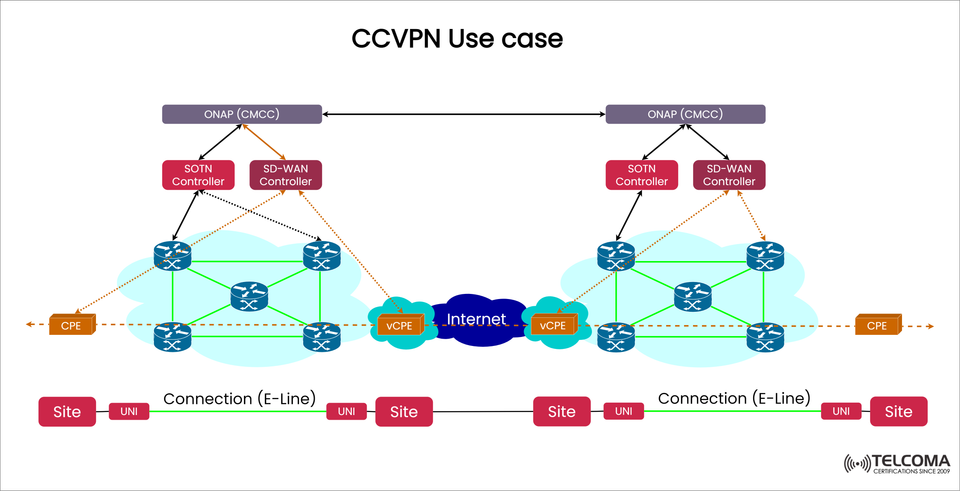
The diagram provided illustrates a use case for CCVPN, showcasing how ONAP coordinates both SD-WAN and SOTN (Software-Defined Optical Transport Network) controllers, working with vCPE (Virtualized Customer Premises Equipment) to offer high-quality, end-to-end connectivity.
This blog aims to break down the architecture, key elements, and technical processes behind CCVPN, catering to telecom professionals and tech fans alike.
What Exactly is CCVPN?
CCVPN, or Cross-Domain and Cross-Layer VPN, is a method for offering flexible, automated, and multi-domain VPN services.
It combines SD-WAN for IP/MPLS domain connectivity with SOTN for optical transport.
It integrates with ONAP (Open Network Automation Platform) for orchestration and automation.
This setup allows businesses to connect various locations, branches, and data centers securely with minimal manual effort.
In essence, CCVPN merges layered network domains (IP/MPLS + Optical) to create a cohesive service experience.
Understanding CCVPN Architecture Components (Based on the Diagram)
- ONAP (CMCC) – The Orchestrator
Functions as the central hub of CCVPN.
Orchestrates interactions across different domains (IP/MPLS and Optical).
Communicates with: * SD-WAN Controllers for packet-based VPNs * SOTN Controllers for optical-layer VPNs
- SD-WAN Controller
Oversees overlay connectivity for businesses.
Facilitates application-aware routing, traffic optimization, and encryption over the internet.
Collaborates with vCPE to extend SD-WAN services to customer locations.
- SOTN Controller
Manages optical transport networks to ensure high capacity and reliable underlay.
Guarantees bandwidth and resilient transport for VPN services.
Works with ONAP to dynamically allocate optical resources.
- vCPE (Virtual CPE)
Brings VPN services to enterprise locations.
Removes the need for physical routers at customer sites.
Virtually supports functions like routing, firewall, and WAN optimization.
- CPE (Customer Premises Equipment)
In certain situations, physical CPE may still be present at business locations.
Works alongside vCPE to ensure last-mile connectivity.
- Site-to-Site Connectivity
Enterprise sites (branches or offices) connect through UNI (User Network Interface).
Connections are set up as E-Line services (point-to-point Ethernet links).
- Internet + Transport Networks
The internet offers overlay reachability, while transport (MPLS/Optical) ensures underlay resilience.
Both layers work together smoothly with ONAP orchestration.
How CCVPN Functions (Step-by-Step Workflow)
Service Request: * A business requests a VPN service to link multiple sites. * This request is initiated via ONAP’s service orchestration portal.
Service Orchestration (ONAP): * ONAP identifies the necessary resources across IP/MPLS (SD-WAN) and Optical (SOTN). * It interfaces with the relevant controllers.
SD-WAN Deployment: * The SD-WAN controller creates VPN tunnels over the internet. * vCPE at each site is configured virtually, eliminating the need for physical installation.
SOTN Deployment: * The SOTN controller sets up optical transport paths between locations. * These ensure guaranteed bandwidth and QoS (Quality of Service).
Service Integration: * Both SD-WAN and SOTN domains merge into a single CCVPN service. * ONAP coordinates everything seamlessly and manages the lifecycle.
Enterprise Site Connectivity: * Locations connect using E-Line services (UNI to UNI). * The VPN is activated, providing secure, multi-domain connectivity.
Advantages of CCVPN
For Enterprises:
🌐 Seamless Multi-Site Connectivity – Connect offices, data centers, and cloud regions worldwide.
⚡ Faster Service Activation – Automated provisioning through ONAP cuts down on manual work.
🔒 Enhanced Security – End-to-end encryption with SD-WAN and reliable transport-layer security.
📈 Scalability – Easily integrate new sites without having to rework the entire VPN.
For Operators:
🛠️ Automation & Efficiency – Lower OPEX through ONAP-driven orchestration.
📊 Better Resource Utilization – Dynamic resource allocation across optical and packet layers.
🤝 Multi-Domain Integration – Supports cross-layer services without vendor lock-in.
💡 Preparedness for 5G & Cloud – Flexible architecture aligns with evolving 5G enterprise services.
CCVPN in Action: Practical Use Cases
Global Enterprise Connectivity: Linking multinational offices securely via VPN.
Cloud Access VPNs: Helping businesses connect to public cloud providers with guaranteed SLAs.
IoT Deployments: Securing backhaul from IoT sites to centralized data centers.
5G Enterprise Services: Supporting 5G slicing by merging transport and SD-WAN for specific industries.
Key Technical Highlights of CCVPN
Component Function in CCVPN Benefit ONAP Orchestration across domains Full automation SD-WAN Overlay VPN over IP/MPLS/Internet Flexibility & agility SOTN Optical transport management High capacity & QoS vCPE Virtualized site connectivity Cost reduction & scalability E-Line (UNI)Site-to-site Ethernet connection Simple enterprise access
Extended Blog Content
CCVPN and the Evolution of Telecom with ONAP
The Open Network Automation Platform (ONAP) has really changed the game for telecom operators around the world. In the past, network automation was all over the place, with various vendors providing their own disconnected solutions. But ONAP, supported by the Linux Foundation, brought everything together by offering a modular, open-source platform designed for:
Service design and creation
Lifecycle management
Policy-based orchestration
Closed-loop automation
One of ONAP’s standout features is the CCVPN use case, which shows how multi-carrier collaboration can be automated on a large scale. It’s a glimpse into the future of telecom, where operators work together instead of in silos, seamlessly connecting to provide global services.
The Importance of CCVPN for Telecom Operators
Telecom operators are feeling increasing pressure from enterprises, over-the-top (OTT) players, and cloud providers. Enterprises are looking for global VPN services that come with guaranteed SLAs, while big players like AWS, Google, and Azure are offering direct cloud connectivity.
If they don’t embrace automation, telecom operators could face:
Slow time-to-market (taking weeks or even months to provision a VPN)
High operational expenses because of manual setups
Customer churn if they can’t meet SLAs
CCVPN can help operators:
Make money off inter-carrier VPN services
Provide on-demand provisioning (getting VPNs up and running in minutes)
Compete effectively against cloud-native companies
Forge ecosystem-driven partnerships with other carriers
Conclusion: Looking Ahead at CCVPN in Telecom
CCVPN signifies the next phase of enterprise connectivity, blending SD-WAN agility, SOTN transport reliability, and ONAP automation. By utilizing vCPE and multi-domain orchestration, CCVPN streamlines complex VPN provisioning, enabling businesses to scale securely and efficiently.
For telecom operators, CCVPN isn't just another technology—it's a key driver for providing enterprise-quality services in the 5G and cloud-native landscape.
As businesses increasingly demand on-demand, SLA-supported, multi-cloud connectivity, CCVPN will remain pivotal in shaping the future of business networking.