
Cellular Technology Evolution: From 2G to 5G in Under 30 Years
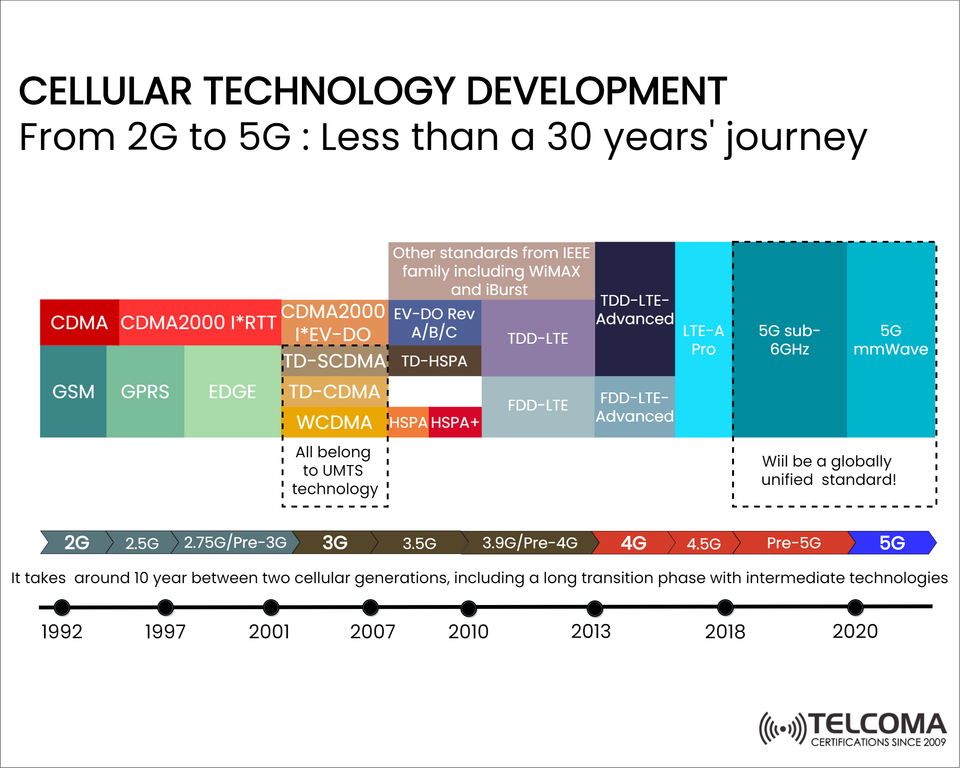

From 2G to 5G: A 30-Year Journey in Cellular Technology Development
In just under three decades, mobile communication has evolved from basic voice and text messaging to super-fast, low-latency 5G networks that power everything from self-driving cars to industrial IoT and immersive XR experiences. This incredible shift has been fueled by standardization, spectrum innovation, and constant R&D.
The image above, courtesy of Telcoma Certifications, offers a visual timeline covering cellular technology development from 1992 to 2020, highlighting major standards and the progression between generations. This post will explore that journey, catering to both telecom professionals and tech fans.
Understanding Cellular Generations (G's)
In the realm of mobile networks, each “G” (generation) marks a significant upgrade in capabilities, including:
Higher data rates
Better spectral efficiency
New services and applications
Changes in core and radio access network design
Timeline Overview
The chart outlines eight key phases in development:
2G (1992) – The digital voice revolution.
2.5G (1997) – Introduction of packet data with GPRS.
2.75G (2001) – EDGE arises for faster data rates.
3G (2007) – The mobile internet and multimedia explosion.
3.5G / 3.9G (2010–2013) – Approaching 4G speeds and IP-based improvements.
4G LTE (2013) – Full IP high-speed mobile broadband.
4.5G / LTE-A Pro (2018) – Advanced LTE with gigabit capabilities.
5G (2020) – A unified, ultra-fast, low-latency standard.
Typically, it takes about 10 years to see a major generational shift, but intermediate technologies help cover the gaps.
2G: The Digital Voice Era (1992)
Key Technologies
GSM (Global System for Mobile Communications) – Widely used in Europe and Asia.
CDMA (Code Division Multiple Access) – Common in North America.
Features:
Digital voice calls replace analog ones.
SMS text messaging comes into play.
Basic encryption for security.
2.5G: Enter Packet Data (1997)
GPRS (General Packet Radio Service)
Introduced packet-switched data.
Opened the door for basic mobile internet (WAP browsing).
Achieved data rates of up to 114 kbps.
Impact:
Enabled email, instant messaging, and basic apps on early mobile devices.
2.75G: Faster Data with EDGE (2001)
EDGE (Enhanced Data rates for GSM Evolution)
Enhanced modulation (8PSK) for increased throughput (~384 kbps).
Smoother transition to 3G.
3G: The Mobile Internet Boom (2007)
Core Technologies
WCDMA – Wideband CDMA for GSM advancement.
CDMA2000 – The 3G path for CDMA networks.
Upgrades & Variants
HSPA (High Speed Packet Access)
HSPA+ – Boosted uplink and downlink speeds (up to 42 Mbps).
TD-SCDMA / TD-CDMA – Time-division versions for specific markets.
Impact:
Introduced true mobile internet, video calls, and a thriving app ecosystem.
Laid the groundwork for location-based and multimedia services.
3.5G to 3.9G: Pre-4G Enhancements (2010–2013)
HSPA+ came close to early LTE speeds,
EV-DO Rev A/B/C improved data rates for CDMA.
TD-HSPA allowed for greater capacity in time-division systems.
This era blurred the lines between 3G and 4G, paving the way for greater speeds and an all-IP core.
4G LTE: The All-IP Broadband Era (2013)
LTE (Long Term Evolution)
FDD-LTE and TDD-LTE variants for paired/unpaired spectrum.
Achieved peak speeds in the hundreds of Mbps.
Latency dropped to under 50 ms.
LTE-Advanced (LTE-A)
Carrier Aggregation for combining spectrum.
MIMO enhancements for better efficiency.
Overall higher spectral efficiency.
Impact:
Made streaming HD video, mobile gaming, and cloud apps feasible.
4.5G: LTE-Advanced Pro (2018)
LTE-A Pro offered gigabit-class speeds.
Prepared the way for 5G NR migration with features like:
256-QAM modulation.
Massive MIMO trials.
Enhanced carrier aggregation.
3GPP Releases: The Standards Backbone of Cellular Evolution
The 3rd Generation Partnership Project (3GPP) has been leading the way in global cellular standardization since 1998. With each release, a new set of specifications comes to life that outlines fresh capabilities, network features, and device requirements.
Here's how the releases fit into the timeline from the earlier image:
3GPP Release | Year | Generation | Focus | Key Features
Release 99 | 1999 | 3G | WCDMA, first packet-switched core
Release 5–6 | 2002–2005 | 3G+ | HSDPA, HSUPA
Release 8 | 2008 | 4G | Start LTE, SAE core
Release 10 | 2011 | 4G+ | LTE-Advanced
Release 13 | 2016 | Pre-5G | LTE-A Pro, NB-IoT
Release 15 | 2018 | First 5G | NR, eMBB focus
Release 16 | 2020 | Full 5G | URLLC, industrial IoT
Release 17 | 2022 | 5G Expansion | NTN (non-terrestrial networks), extended IoT
Release 18 (5G-Advanced) | 2024 | Beyond 5G | AI/ML in RAN, XR optimization
Key insight:
While generational labels like 2G, 3G, 4G, and 5G are nice marketing milestones, 3GPP releases are really the technical roadmaps that operators and vendors follow.
5G Application Categories: From Connectivity to Transformation
The 5G NR standard isn’t just about being faster — it’s set up to handle three main service categories, each catering to different use cases:
eMBB (Enhanced Mobile Broadband)
Use cases: 4K/8K streaming, AR/VR, cloud gaming.
Key enablers: Massive MIMO, carrier aggregation, sub-6 GHz and mmWave spectrum.
URLLC (Ultra-Reliable Low-Latency Communications)
Use cases: Industrial automation, autonomous driving, remote surgery.
Key enablers: 1 ms latency, network slicing, edge computing.
mMTC (Massive Machine-Type Communications)
Use cases: Smart cities, IoT sensors, environmental monitoring.
Key enablers: Low-power wide-area technologies (NB-IoT, LTE-M), scalable network cores.
Why it matters:
Unlike what we’ve seen in earlier generations, 5G was designed to support industries and machines, not just people — marking a significant shift to digital infrastructure.
Bridging 4G and 5G: The Role of LTE-A Pro
Before we fully rolled out 5G, operators used LTE-Advanced Pro as a smooth transition:
Gigabit LTE speeds through advanced carrier aggregation.
Massive MIMO for increased capacity.
Integration with unlicensed spectrum (LAA).
Early trials of network slicing concepts.
This made it easier for 4G networks to work alongside 5G NR, helping to ease spectrum refarming and keep operator costs down.
Key difference:
If 5G is about connecting everything, then 6G will focus on making those connections smart and aware of their context.
Why This Evolution Matters for Telecom Professionals
For anyone involved in network planning, operations, R&D, and policy, understanding this evolution has direct consequences:
Spectrum allocation decisions need to take into account historical patterns and future needs.
Investment cycles are tied to release schedules and migration plans.
Service innovation relies on matching capabilities (like URLLC and mMTC) with business strategies.