
Centralized SON: Architecture, Workflow, and Benefits for Modern Mobile Networks

Centralized SON: Architecture, Workflow, and Benefits for Modern Mobile Networks
Mobile networks are evolving quickly with advancements like 5G, Open RAN, and a rising need for automated operations. The Self-Organizing Network (SON) framework has become essential in managing modern radio access networks (RAN) more efficiently while also enhancing performance. Out of the three main SON architectures—Centralized SON, Distributed SON, and Hybrid SON—Centralized SON (C-SON) is key for enabling coordinated optimization across the entire network.
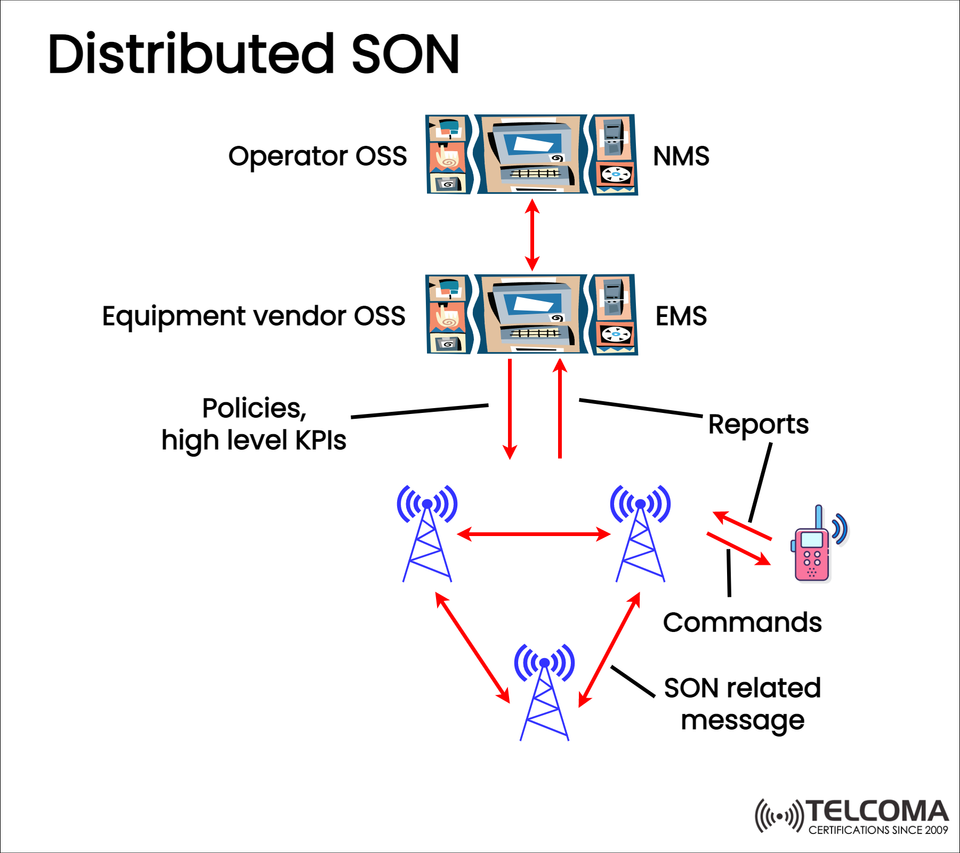
The diagram we've uploaded illustrates the Centralized SON architecture. In this setup, network measurements, KPIs, and performance data are sent to a centralized system for processing, which then sends commands or parameter updates back to the RAN nodes. Let’s take a closer look at what this framework means for telecom professionals and network planners.
What is Centralized SON (C-SON)?
Centralized SON is a deployment model where all SON functions—self-configuration, self-optimization, and self-healing—are centralized in a management system, like the operator’s OSS (Operations Support System) or NMS (Network Management System).
Instead of having local decision-making at each cell site (as in Distributed SON), C-SON gathers data from all over the network, processes it centrally, and sends back coordinated optimization commands to network elements. This approach facilitates multi-cell, network-wide coordination and helps prevent the conflicting actions that can happen when nodes operate independently.
Architecture of Centralized SON The image outlines the key components and the flow of communication:
Operator OSS / NMS (Network Management System): This is where the SON intelligence is located. It runs SON algorithms, processes performance data, and sends out optimized parameter settings.
EMS (Element Management System): Serves as a bridge between the OSS and individual network elements (like eNodeBs and gNodeBs). It manages alarms, performance counters, and configuration data.
RAN Elements (Base Stations): These send measurements, KPIs, and status reports to the EMS/OSS and receive optimization commands, which might include adjustments to power, neighbor relations, and handover thresholds.
Communication Flow:
Upstream: Measurements, KPIs, and performance reports are sent from the RAN to the EMS and then to the OSS.
Central Processing: The OSS collects the data, runs SON algorithms, and determines corrective actions.
Downstream: Parameter updates, configuration changes, and optimization commands are relayed back to the RAN nodes.
This closed-loop process enables ongoing and coordinated optimization of the network.
Core Functions of Centralized SON Centralized SON covers all three core SON functions:
- Self-Configuration Automates the setup and integration of new network elements.
Automatically discovers and registers new cell sites
Sets up IP configurations and neighbor lists
Enables plug-and-play deployment to minimize human error
- Self-Optimization Continuously tunes the network for optimal performance.
Load Balancing: Distributes traffic evenly across cells to avoid congestion
Interference Coordination (ICIC/eICIC): Reduces inter-cell interference for better coverage and capacity
Handover Optimization: Adjusts handover parameters to decrease call drops and avoid ping-pong effects
Energy Efficiency: Shuts down low-traffic cells during off-peak hours to save power
- Self-Healing Monitors network health and automatically triggers corrective actions.
Detects node or link failures through KPI monitoring
Automatically reroutes traffic to maintain service continuity
Facilitates remote recovery actions (like restarting failed nodes)
Centralized SON Workflow The workflow can be summed up like this:
Step Action 1 RAN nodes send measurements, alarms, and KPIs to EMS 2 EMS forwards data to OSS/NMS for analysis 3 OSS processes the data, runs SON algorithms, and decides on parameter adjustments 4 Optimized commands and settings are sent back to network elements 5 Ongoing monitoring checks improvements and ensures stability
This closed-loop cycle keeps repeating, allowing the network to adapt almost in real-time to traffic patterns and changing conditions.
Advantages of Centralized SON Centralized SON offers plenty of benefits for operators:
Comprehensive Network View: Optimization decisions take the entire network into account, not just individual cells.
Vendor-Agnostic Deployment: Works in multi-vendor settings as long as standardized interfaces are available.
Better Coordination: Prevents conflicts that can happen in distributed optimization (like neighboring cells making opposing parameter changes).
Improved QoS & QoE: Users experience better coverage, fewer dropped calls, and more consistent throughput.
Operational Efficiency: Cuts down on manual site visits, reduces OPEX, and speeds up deployment cycles.
Centralized SON vs Distributed SON | Feature | Centralized SON (C-SON) | Distributed SON (D-SON) |
|----------------|---------------------|-------------------------|
| Decision Location | OSS/NMS | Base station (eNodeB/gNodeB) |
| Optimization Scope | Network-wide, multi-cell | Local (single cell or small cluster) |
| Response Time | Slower (depends on data collection) | Faster (real-time adjustments) |
| Complexity | Easier to coordinate but needs solid backhaul | More complex per-node intelligence |
| Best Use Cases | Load balancing, energy saving, PCI planning | Handover optimization, interference control |
Many operators also use Hybrid SON, which combines both centralized and distributed methods to maximize benefits.
Challenges of Centralized SON Despite its advantages, C-SON faces some challenges:
Latency: Centralized processing can introduce delays, making it less suitable for real-time functions.
Backhaul Load: It requires significant data transfers between RAN and OSS.
Scalability: As networks expand, the central processing may need more robust computing power.
Vendor Integration: Achieving interoperability in multi-vendor situations can be tricky if standards aren’t strictly followed.
Use Cases for Centralized SON Centralized SON works especially well for:
Network-Wide PCI Planning: Automatically assigns and resolves conflicts for Physical Cell IDs.
Global Load Balancing: Evenly distributes traffic across a large cluster or entire network.
Energy Saving Campaigns: Coordinates the sleep/wake cycles of multiple cells during low-traffic times.
Long-Term Optimization: Uses historical data to plan for future growth in the network.
Conclusion:
Centralized SON is a vital component of network automation, allowing operators to make coordinated optimization decisions across the entire RAN. By utilizing OSS/NMS intelligence, it ensures consistent parameter adjustments, efficient load balancing, and reduced operational workload.
As we see 5G deployments expand and Open RAN architectures gain momentum, centralized SON will become even more critical—integrating AI and machine learning to make optimization not just reactive but also proactive and predictive. For those in the telecom field, getting a handle on the architecture and workflow of centralized SON is essential for designing and sustaining high-performance, future-ready networks.