
Centralized SON in Mobile Networks: Architecture, Functionality, and Benefits

Centralized SON in Mobile Networks: What It Is, How It Works, and Why It Matters
As mobile networks continue to develop to support 5G, IoT, and ultra-reliable low-latency communications (URLLC), intelligent automation has become essential. Self-Organizing Networks (SON) are crucial for automating important processes like network configuration, optimization, and healing. Among the three primary SON architectures—Centralized SON, Distributed SON, and Hybrid SON—centralized SON is one of the most commonly used, especially in large networks.
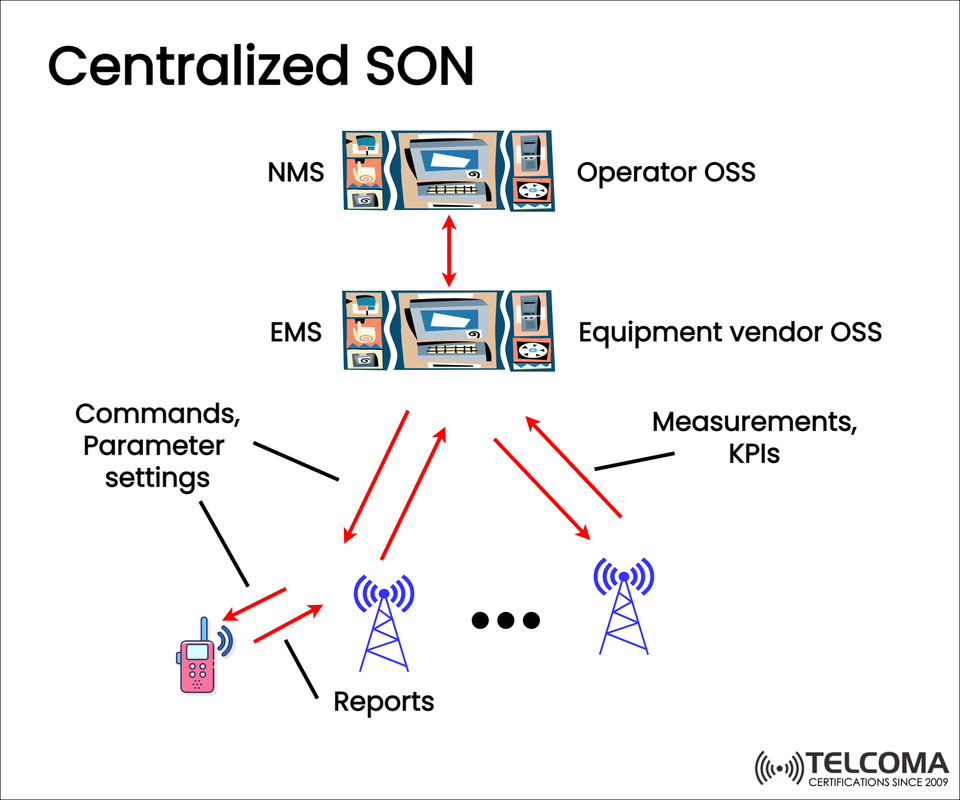
The image above shows the Centralized SON (C-SON) architecture and workflow, highlighting how OSS (Operations Support Systems) and EMS (Element Management Systems) interact with RAN elements to boost network performance. In this post, we’ll dive into how centralized SON functions, its benefits, challenges, and specific use cases.
What Is Centralized SON (C-SON)?
Centralized SON refers to a network automation strategy where the SON functionality is housed in one central location—usually in the Network Management System (NMS) or the operator’s OSS. Instead of optimizing locally at the base station, like in distributed SON, C-SON gathers information from the entire network, analyzes it, and sends parameter updates back to network elements.
This setup allows for network-wide optimization, which is especially beneficial for large-scale coordination tasks such as load balancing, interference management, and capacity planning.
Breaking Down Centralized SON Architecture
The image uploaded gives a clear view of a typical C-SON setup, which includes:
Operator OSS (Operations Support System): This is the central control layer that oversees SON applications, policies, and global parameter settings.
EMS (Element Management System): Serves as the link between OSS and network elements. EMS collects performance data, Key Performance Indicators (KPIs), and measurements from cell sites, forwarding them to OSS for centralized analysis.
RAN Elements (e Node Bs, g Node Bs): These are the actual radio nodes within the network. They send back measurements and alarms and take commands or parameter updates from the EMS/OSS layer.
Communication Flow:
Upstream: RAN elements transmit KPIs, measurements, and reports to EMS.
Processing: OSS processes this data, applies SON algorithms, and figures out needed corrective actions.
Downstream: EMS sends back updated parameters or optimization commands to RAN elements.
This closed-loop system ensures ongoing optimization and enhances performance without needing manual input.
Key Functions of Centralized SON
Centralized SON enables various network automation functions, including:
- Self-Configuration
Automatically sets up new cell sites and integrates them with existing nodes.
Generates neighbor cell lists automatically.
Simplifies plug-and-play deployment.
- Self-Optimization
Load Balancing: Spreads traffic evenly across cells to prevent congestion.
Interference Coordination (ICIC/eICIC): Reduces inter-cell interference for better coverage.
Handover Optimization: Enhances mobility performance and cuts down on call drops.
Energy Saving: Automatically turns off underused cells during low-traffic times.
- Self-Healing
Detects faults by monitoring KPIs.
Automatically reroutes traffic in case of failures.
Takes proactive measures to minimize downtime.
Benefits of Centralized SON
Centralized SON offers several advantages for network operators and users:
Holistic Network View: With central optimization, decisions are made with a complete overview of the network, leading to more coordinated outcomes.
Vendor-Agnostic Flexibility: C-SON can manage networks with equipment from multiple vendors as long as standard interfaces (like I t f-N, Net Conf) are supported.
Efficient Resource Allocation: Centralized algorithms are better suited for handling global load balancing and interference management versus localized methods.
Rapid Deployment: New cells can be added to the network with minimal manual configuration.
Enhanced Q o S and Q o E: Ongoing optimization leads to better coverage, capacity, and overall user experience.
Centralized SON vs. Distributed SON
Aspect | Centralized SON (C-SON) | Distributed SON (D-SON)
Location of Logic | Centralized (OSS/NMS) | Local (RAN Node)
Optimization Scope | Network-wide, multi-cell coordination | Single cell or local cluster
Latency | Higher (depends on data collection and processing time) | Lower (real-time adjustments possible)
Complexity | Easier to manage centrally but requires more backhaul | Requires intelligence at each node
Use Cases | Load balancing, energy saving, global planning | Handover optimization, interference mitigation
A lot of operators these days are opting for a hybrid SON approach that blends the best features of both centralized and distributed architectures.
Challenges of Centralized SON
While C-SON is powerful, it doesn’t come without its hurdles:
Latency Issues: Since decisions are made centrally, the response might be slower in real-time compared to D-SON.
Data Overhead: It needs a lot of data collection from all RAN elements, which can lead to increased signaling traffic.
Scalability: Centralized processing may struggle as the network expands.
Interoperability: Getting multiple vendors and SON solutions to work together can be tricky without proper standards.
Use Cases for Centralized SON
Centralized SON works best for:
Network-Wide Load Balancing: Maximizing capacity use across many cells and clusters.
Energy Optimization: Coordinating when to switch cells on and off to save power.
PCI (Physical Cell ID) Planning: Automatically assigning cell IDs to avoid conflicts.
Long-Term Capacity Planning: Analyzing historical KPI data to predict future expansions.
Wrapping Up
Centralized SON is foundational for mobile network automation, enabling operators to conduct large-scale, coordinated optimization throughout their networks. By gathering KPIs and measurements from the RAN, analyzing them centrally, and sending optimized settings back, C-SON cuts down on manual tasks, boosts operational efficiency, and improves user experience.
As we move toward 5G and eventually 6G, centralized SON is set to keep evolving with AI and machine learning, paving the way for even smarter, faster, and more predictive network functions. For those in the telecom industry, grasping C-SON is crucial for designing, deploying, and maintaining modern, high-performing mobile networks.