
Centralized vs Distributed vs Hybrid SON: Comparing Modern SON Architectures in Telecom Networks

📡 An Outline of SON Architectures: Centralized, Distributed, and Hybrid SON
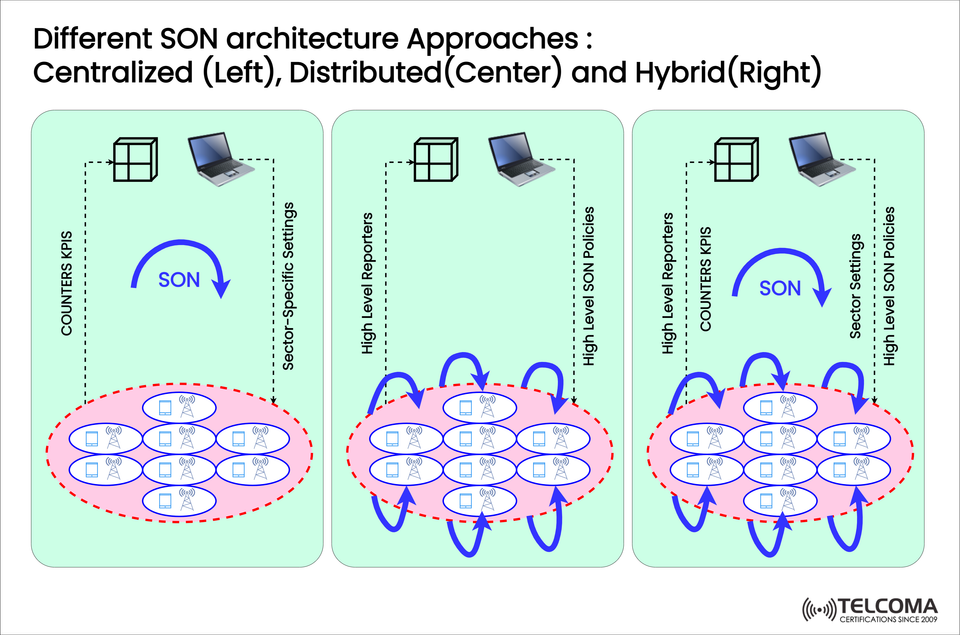
With the introduction of 5G and beyond, Self-Organizing Networks (SON) have become necessary for optimizing mobile networks, lowering operational expenses, and automating many complex engineering tasks. The posted image by Telcoma introduces the three main SON architectures—Centralized, Distributed, and Hybrid—all of which have a unique approach to managing Key Performance Indicators (KPIs), settings, and optimization logic.
This blog will provide an overview of each SON type, how it works, and situations when each can be applied.
🔧 What is a Self-Organizing Network (SON)?
SON is an architectural framework that utilizes networks in 4G, 5G, and future networks to automate the configuration, optimization, and healing of network elements to be more efficient, have faster deployments, and require lesser direct human input.
There are three main types of SON based on where the intelligence is derived from:
Centralized SON (C-SON)
Distributed SON (D-SON)
Hybrid SON (H-SON)
🧭 SON Architecture Models Explained
🟦 1. Centralized SON (Left Panel)
Centralized SON features a central server within the Network Management System (NMS) or Operations Support System (OSS) that performs the optimization logic. Key performance indicators (KPIs) from the base stations are collected to a central location, and then settings get pushed back to the network.
Key Features:
Global targeted KPIs from all network elements
Central SON function that applies to sector-specific settings
Visibility and control from a higher level
Advantages:
Greater coordination across layers of the network
More effect for large-scale policy enforcement
Central point for troubleshooting and audit trails
Disadvantages:
Latency in optimization loops
Less responsive to localized issues (such as sudden load)
🟨 2. Distributed SON (Center Panel)
Distributed SON represents a not-quite but decentralized SON architecture where the optimization intelligence is decentralized to the edge meaning that each element in the network (such as base station or cell) is generate local actions based on locally available data and global SON policies.
Key Features:
Intelligence is embedded in the base stations or controllers
Real-time decisions based on local conditions (eg load balancing- to handover)
Reporting is limited to high-level summaries
Advantages:
Very low latency in optimization
Immediate adaptation to local conditions in network
More scalable in dynamic 5G scenarios
Disadvantages:
Coordination across the network for optimization is harder
Potential for conflicting actions between nodes
🟩 Third Segment: Hybrid SON (Right Panel)
Hybrid SON allows for both methods. A central unit defines global policies and aggregate KPIs, while local functions implement the decisions. This is contemporary to AI-Native 5G architectures and Open RAN deployments.
Key Attributes:
Dual intelligence model - central + distributed
Highly responsive + global visibility
Both COUNTER KPIs and high-level SON policies is leveraged
Advantages:
Best of both worlds: low latency + excuting coordination
Accomodates 5G/6G complexity
Flexible and future-proof
Challenges:
The complexity of implementation
Requires sufficient orchestration between layers, as both a central and local layer must executed the SON elements
Summary of Comparison
Feature Centralized SON Distributed SON Hybrid SON
Control Location NMS/OSS Base stations Both central and local
Optimization Speed Medium Fast (real-time) Fast + Coordinated
Scalability High Very High Very High
Complexity Low Medium High
Best Use Case Macro-level policies Local event handling 5G, Open RAN, AI-driven
Example Tasks Network Planning Handover tuning, Load Balancing Combined Tasks
💡 When to accept which SON architecture?
Scenario Best SON Type
Static rural network Centralized SON
Dense urban with variable load Distributed or Hybrid SON
Real-time mobility and hand-over control Distributed SON
5G/Open RAN networks with edge compute Hybrid SON
Greenfield 5G deployment Hybrid SON
🧩 Conclusion: The Progression to Hybrid SON
The increase in network complexity due to 5G, IoT, and edge computing means Hybrid SON is now viewed as the most viable operational model. Hybrid SON offers low-latency automation while maintaining global optimization policies to provide operators much needed flexibility in this multi-vendor, virtualized environment.
Operators need to keep in mind that they may want to initially select Centralized or Distributed SON based on their current needs, but have a clear progression path to reach Hybrid SON for future resilience and automation.
📘 Additional Insights: Future Trends Driving SON Architectures
While telecom networks are moving from LTE to 5G Standalone (SA) and onwards to 6G, considerations for SON architecture and model selections are not only for automation, they fundamentally must also align with evolving network requirements such as:
Network slices
MEC (Multi-access Edge Computing)
AI/ML optimization
Open RAN/disaggregated architectures
🔮 SON Architectures with Future Trends
Future Trend Centralized SON Distributed SON Hybrid SON (Most preferred)
Open RAN Compatibility Low (limited flexibility) Moderate (local RIC) High (non-RT & near-RT RIC)
Network Slicing Limited customization Good for slice tuning Excellent for end to end control
Edge Computing (MEC) Not effective Very effective Most effective
AI/ML SON Implementation Central SON not ideal Needs edge integration Best option for closed-loop AI SON
Vendor Interoperability Vendor-locked OSS Requires precise coordination Encourages vendor-neutral control
📈 Practical Examples
Urban 5G Networks
Use Hybrid SON to adjust as user handover times are minimized but interference coordination and load balancing are also needed by applying AI policies at the edge as well as analytics at the centre.
Rural LTE Rollout:
Centralized SON is sufficient as deployments are fairly static and periodic optimization is more appropriate. No need for elaborate edge compute OAC/EAI.
🔧 TIPS FOR ADOPTING SON IN MULTI-VENDOR SCENARIOS
Make use of open APIs and orchestration platforms that allow for vendor neutrality.
Normalize KPIs between OEMs and ensure a fair comparison.
Test conflict resolution methods for Hybrid SON situations.
Integrate with RIC in Open RAN models:
Non-RT RIC → Centralized SON
Near-RT RIC → Distributed/local SON
✅ FINAL THOUGHTS
SON architectures will lay the groundwork for telecoms moving to automation. Your decision on Centralized, Distributed or Hybrid SON must depend on:
Network topology (macro versus small cell, static versus variable)
Latency requirements (real-time optimization or some service bulk configuration)
Level of operational maturity (in-house AI/ML capability, readiness for edge)
Vendor environment (Octo-vendor environment versus single OEM)