
Channel Availability in 2.4, 5, and 6 GHz Wi-Fi Bands: A Comprehensive Breakdown

Why Does Channel Availability Matter When Deploying Wi-Fi?
As demands for high bandwidth applications (think 4K video streaming, cloud gaming, or the enterprise level need for cool connectivity) increase, demand for Wi-Fi networks will require more spectrum and increased throughput. A central factor in Wi-Fi performance is the channel availability (or how many channels are usable) in each frequency band. Each usable channel on a frequency band provides for a new data stream, and wider channels allow for faster speeds, so it's paramount to consider channel availability when planning high-performance wireless networks.
Channel Width and Frequency Bands - Brief Introduction to Remember
Wi-Fi channels have a variety of widths, supporting 20 MHz, 40 MHz, 80, MHz, 160 MHz, and now with Wi-Fi 7 (802.11be) 320 MHz. Wider channels
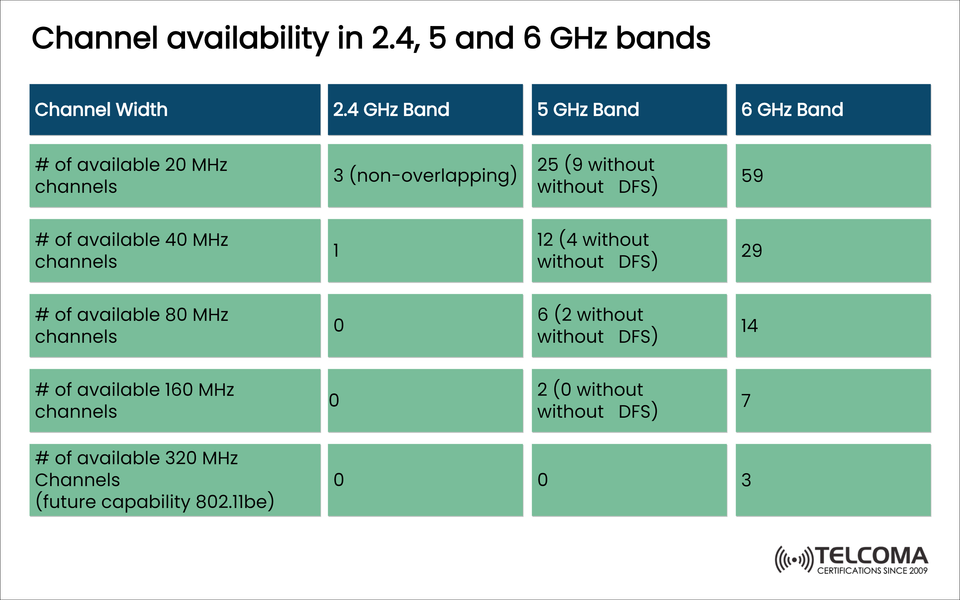
Comparative Table: Available Channels by Bands
Channel Width 2.4 GHz Band 5 GHz Band 6 GHz Band
20 MHz Channels 3 (non-overlapping) 25 (9 without DFS) 59
40 MHz Channels 1 12 (4 without DFS) 29
80 MHz Channels 0 6 (2 without DFS) 14
160 MHz Channels 0 2 (0 without DFS) 7
320 MHz Channels (802.11be) 0 0 3
Key Points for Network Planners
✅ 2.4 GHz: Limited but Compatible
- MAY have several 20 MHz channels, only 3 are non-overlapping.
- Very little potential for wider channel widths.
- Significant potential for interference (e.g., Bluetooth, microwaves).
✅ 5 GHz: Compromise, but Many Contours
- 25 total 20 MHz channels, but only 9 without DFS.
- DFS (Dynamic Frequency Selection) may create some delay on channel access if the radar system is detected (e.g., weather, military, airport).
- and are a reasonable amount of support for 40, 80, and 160 MHz channels.
✅ 6 GHz: High Capacity Band for Current Wi-Fi
- No DFS Requirements:
- 59 x 20 MHz channels — the highest of all bands.
- Support a range of advanced configurations:
- 29 x 40 MHz
- 14 x 80 MHz
- 7 x 160 MHz
- 3 x 320 MHz (with Wi-Fi 7)
What is DFS, or why does it matter?
DFS (Dynamic Frequency Selection) is a regulatory requirement ensuring you don't interfere with radar systems. There is significant overlap with radar systems for the 5 GHz band (e.g., weather, military, or airport). A device with DFS must listen to the channel prior to transmitting which can create delay and even disconnect.
- Pro: you gain significantly more channels.
- Con: you may experience delay before receiving access to the channel or disconnection (potential crash).
Conclusion: Selecting the Appropriate Band for Your Network
Whether designing or upgrading a Wi-Fi network, understanding the availability of the 2.4 GHz, 5 GHz, and 6 GHz channels is fundamental. Presented here is a brief recap.
The 2.4 GHz band should be used when the goal is compatibility across multiple radio types and extended range, particularly when low-bandwidth use is expected.
The 5 GHz band should be used where speed is the predominant concern and when ambiance places aren't dense— subject to potential slowdowns from DFS.
The 6 GHz band should be used with much larger capacity and lower latency expectations in mind— and networks should be designed accordingly with Wi-Fi 6E and Wi-Fi 7 in mind.
The wireless communication architecture will continue to advance through the band and as cable technologies mature. The 6 GHz band will deliver unmatched flexibility and performance, and is intended to be the foundation of future-focused network deployments.
Real-World Applications of Band Choices Based Upon Deployment
🏠 Home Networks
2.4 GHz: For basic browsing, and smart home requiring range.
5 GHz: For HD streaming, online gaming, and multiple devices in home.
6 GHz: For a smart home utilizing all Wi-Fi 6E or Wi-Fi 7 routers and devices for high bandwidth.
🏢 Enterprise & Office Settings
5 GHz: The sweet spot between speed and avoiding interference in a medium density office.
6 GHz: Best for conference rooms, and collaborative VR, AR, and low-latency applications with Wi-Fi 6E APs.
5 GHz DFS channels need to be planned well to avoid interrupting service.
🏙️ Public Hotspots & High Density Operating Areas
6 GHz: Offers the channel density for a stadium, airport, or convention center environment.
5 GHz: Still probably used, but it continues to get crowded out in public deployments.
Regulatory Climate and Global Implementation
When deploying or designing in hardware across countries, be mindful of the regulatory format:
2.4 GHz: Unlicensed and available anywhere.
5 GHz: DFS rules and regulations vary per country (ie, EU and U.S. are more stringent).
6 GHz:
Available only in certain parts in North America, Europe, Brazil, Saudi Arabia, South Korea, etc.; but full 6 GHz implementation is still pending for the above mentioned regions.
Resources and Tools to Help You Design Better Wi-Fi
There are some tools and sites that professionals use for channel planning:
Ekahau or NetSpot: Use for site surveys and RF planning.
WiFi Explorer Pro: Use for detailed channel and spectrum analysis.
Vendor-specific planners: From Cisco, Aruba, Ubiquiti, and others.
Conclusion: The Future is 6 GHz
As the number of wireless devices grows and the data demand explodes the 6 GHz spectrum can provide the expansion that this industry needs. With zero DFS delays, support for wider channels (up to 320 MHz) and cleaner airwaves, 6 GHz is the most significant leap since 5 GHz was introduced.
For the telecom industry professionals and network engineers, this is the time to begin designing, deploying and optimizing the 6 GHz band — not just for today, but for the next 10 years.
Spectrum Efficiency and Channel Bonding in 6 GHz
The 6 GHz band is purpose built for high efficiency, allowing for increased channel bonding, which is the ability to combine adjacent channels for use as a wider channel. Channel bonding is important with:
High throughput applications: Streaming, VR/AR & high-speed enterprise backhaul
Low-latency networking: Necessary for real-time collaboration, video conferencing, and remote surgery.
Keywords:
Wi-Fi channel availability, 2.4 GHz Wi-Fi, 5 GHz Wi-Fi, 6 GHz Wi-Fi, DFS, 802.11be, Wi-Fi 6E, Wi-Fi 7, wireless spectrum planning, telecom network design, channel width comparison.