
Channel Bandwidth vs Transmission Bandwidth in 5G NR Explained

Understanding Channel Bandwidth and Transmission Bandwidth in 5G NR
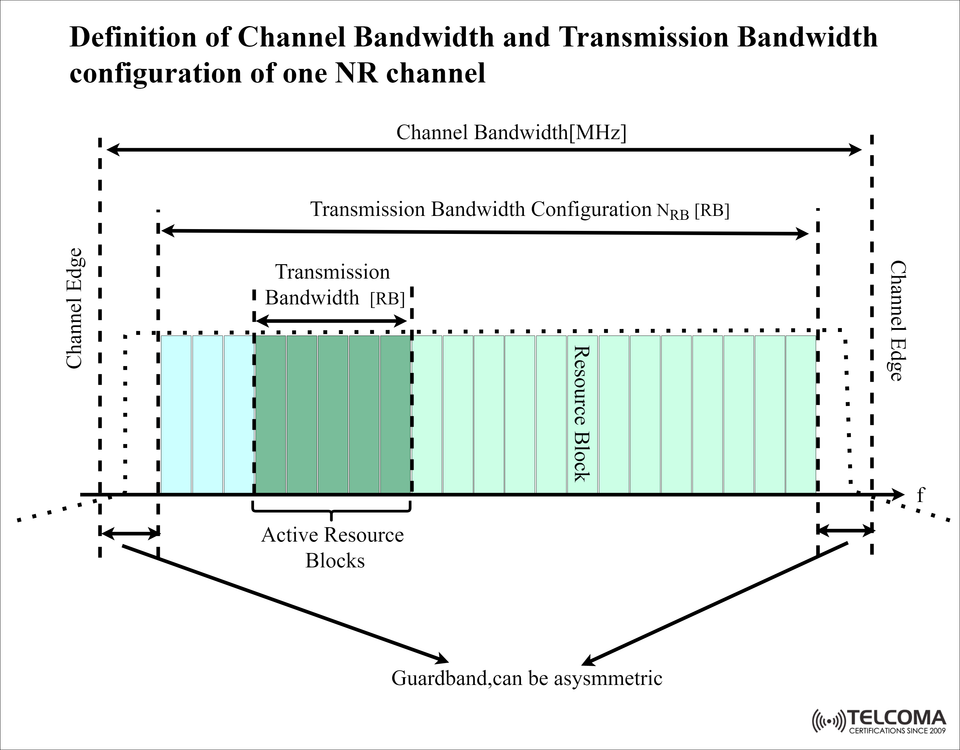
With 5G New Radio (NR changing the way we connect wirelessly, it’s important for telecom engineers and tech fans alike to grasp what channel bandwidth and transmission bandwidth really mean. The diagram we’ve uploaded gives a good visual of how these bandwidth setups function in a 5G NR environment.
In this post, we’ll get into the basics, compare channel bandwidth with transmission bandwidth, explain resource blocks (RBs) and guard bands, and discuss how they all impact 5G performance.
What is Channel Bandwidth in 5G NR?
Channel bandwidth is basically the total width of the frequency band that the spectrum license allows for NR.
Unit: Measured in MHz.
Scope: Covers the entire channel from one edge to the other.
Role: Sets the max possible transmission capacity that the network can offer.
For instance:
A 5G operator could be assigned 100 MHz in the 3.5 GHz band.
This 100 MHz represents the channel bandwidth, but not every part of it is usable for actual data transmission.
What is Transmission Bandwidth in 5G NR?
While channel bandwidth indicates the allocated spectrum, transmission bandwidth is the segment of that spectrum that’s actively used to transmit user data.
It’s defined by Resource Blocks (RBs).
The formula for Transmission Bandwidth is NRB × Subcarrier Spacing (SCS).
It excludes the unused sections, known as guard bands.
For example:
In a scenario with a 100 MHz channel bandwidth, the actual transmission bandwidth may only use 96 MHz, leaving 4 MHz as guard bands.
Why Are Guard Bands Necessary?
Guard bands are buffer frequencies located at the peripheries of a channel.
Purpose: * Prevent interference with neighboring channels. * Enhance spectral efficiency by reducing out-of-band emissions.
Properties: * They can be either symmetric or asymmetric based on how they're deployed. * They don’t carry any user data.
So, guard bands play a key role in ensuring clearer signal transmission and better performance overall.
Resource Blocks: The Basic Units of NR Transmission
In 5G NR, a resource block (RB) is the smallest unit of spectrum allocation.
Definition: 12 consecutive subcarriers in the frequency domain × 1 slot in the time domain.
Configurable: Size can change with subcarrier spacing (SCS). * At 15 kHz SCS, it’s 180 kHz per RB. * At 30 kHz SCS, it’s 360 kHz per RB.
Role: The transmission bandwidth is determined by a certain number of RBs (NRB).
Visualizing Channel vs Transmission Bandwidth
The image we’ve uploaded shows the difference:
Channel Bandwidth (MHz): Full spectrum allocation (outer edges).
Transmission Bandwidth (RBs): Active RBs used for sending data (inner area).
Guard Bands: Small unused frequency ranges at the edges to avoid interference.
This layered setup aims to strike a balance between maximum throughput and signal quality.
Key Differences: Channel Bandwidth vs Transmission Bandwidth
Feature Channel Bandwidth Transmission Bandwidth Definition Total allocated frequency band Portion of band used for transmission Unit MHz Resource Blocks (RBs)Includes Guard Band? Yes No Usage Regulatory spectrum assignment Actual user data and signaling Impact Defines spectrum license scope Defines network performance
Practical Example
Let’s take a 100 MHz 5G NR channel with a 30 kHz subcarrier spacing:
Channel Bandwidth = 100 MHz
Each RB = 360 kHz
Maximum possible RBs = around 273
But keep in mind, not all of these are usable since guard bands take some away.
Transmission Bandwidth Configuration = 270 RBs × 360 kHz = 97.2 MHz
So, the operator is transmitting within about 97.2 MHz, leaving roughly 2.8 MHz as guard bands.
Why Is This Important for 5G Networks?
Getting a handle on bandwidth configurations affects many aspects of designing 5G:
Spectral Efficiency: Making the most of the throughput within the given spectrum.
Interference Management: Guard bands help cut down overlap with neighboring carriers.
Capacity Planning: It’s essential for operators to gauge user capacity and quality of service.
Device Compatibility: It ensures that UEs (User Equipment) can function correctly within the defined transmission bandwidths.
3GPP Standards and Bandwidth Configurations
The 3GPP has set specific channel bandwidth options for 5G NR, depending on the frequency range:
FR1 (Sub-6 GHz): 5 to 100 MHz per channel.
FR2 (mmWave): 50 to 400 MHz per channel.
Transmission bandwidth configurations are then determined within these parameters, ensuring devices around the world can work together seamlessly.
Real-World Considerations for Telecom Experts
For engineers and network planners:
Network Dimensioning: Thoughtful bandwidth planning is crucial to meet the demands of 5G traffic.
Spectrum Auctions: Operators need to consider usable transmission bandwidth, not just the raw channel bandwidth.
Deployment Scenarios: The size of guard bands may vary depending on the spectrum environment, like whether it’s dense urban or rural areas.
Device Testing: Chipset and handset manufacturers have to make sure devices align with NR transmission setups.
Bringing It All Together
The difference between channel bandwidth and transmission bandwidth in 5G NR might not be immediately obvious, but it’s really important for network efficiency and performance.
Channel Bandwidth = the total spectrum allocation.
Transmission Bandwidth = the actively used segment (measured in RBs).
Guard Bands = the protective buffers that make sure signal quality is up to par.
Getting a solid grasp on these differences empowers telecom professionals to design, optimize, and run 5G networks that deliver high throughput, minimal interference, and dependable connectivity.
As 5G keeps progressing, mastering these foundational concepts will help both enthusiasts and engineers stay ahead in the fast-evolving world of wireless communication.
Bandwidth Efficiency in 5G NR
One of the main reasons 5G NR distinguishes between channel bandwidth and transmission bandwidth is to boost efficiency. Unlike LTE, where the channel often mirrored the usable transmission space, NR brings in flexibility.
Operators can tweak the transmission bandwidth configuration (NRB) based on how they plan to deploy.
This way, networks can find the best balance between throughput, coverage, and interference protection.
Take for instance:
In crowded urban areas, operators might opt for maximum transmission bandwidth to achieve higher throughput.
In areas prone to interference, they could choose to widen guard bands, giving up a bit of throughput for more stability.
This level of flexibility is one of the key elements of 5G NR performance optimization.
The Role of Guard Bands in Network Coexistence
Guard bands might look like “unused spectrum,” but they’re actually vital for spectrum coexistence.
In multi-operator scenarios, guard bands shield neighboring networks that are working in similar frequency ranges.
In shared spectrum situations (like CBRS in the U.S.), they help avoid overlapping signals.
For multi-band carrier aggregation, guard bands reduce interference between channels.
Case Study Example:
When a U.S. operator rolls out 100 MHz of 5G NR at 3.7 GHz near a satellite band, they implement wider guard bands to avoid any disruption to satellite communications.
This illustrates how regulatory requirements and technical strategies come together in managing bandwidth.