
CL-Related Management Capabilities in ZSM: Governance, Coordination, and Cross-Domain Integration

CL-Related Management Capabilities in ZSM: Governance, Coordination, and Cross-Domain Integration
As telecom networks move towards 5G and beyond, automation is becoming essential for achieving scalability, agility, and effective operations. The Zero-touch network and Service Management (ZSM) framework is key in this shift, facilitating autonomous, intent-driven, and cross-domain management.
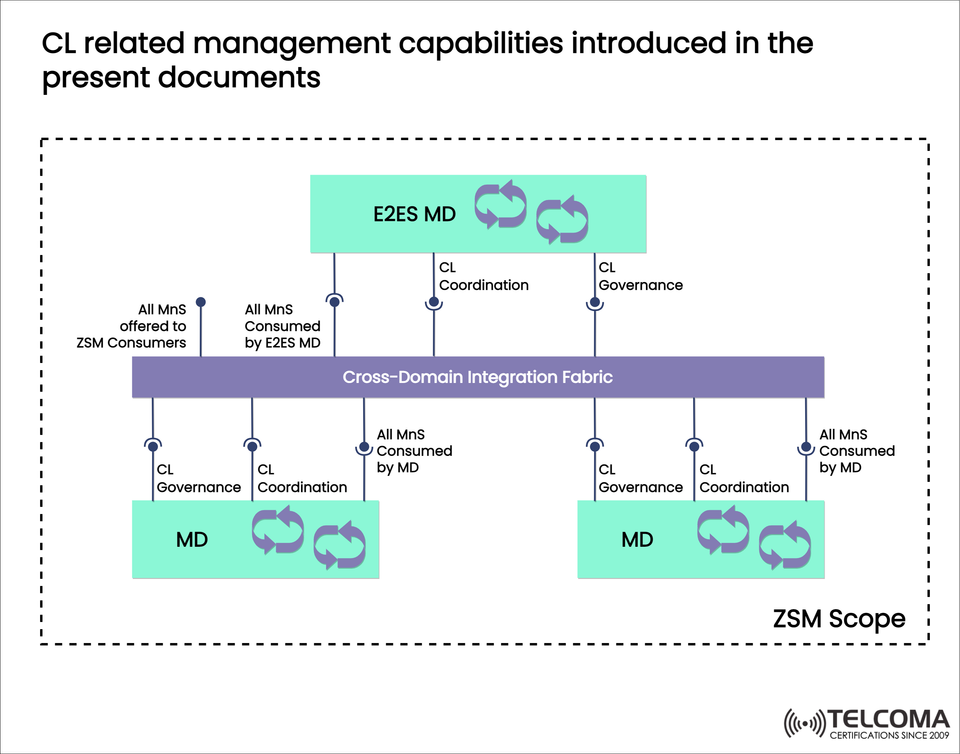
The accompanying diagram sheds light on the CL (Closed-Loop) related management capabilities introduced in ZSM, showcasing their interaction with management domains (MDs), the cross-domain integration fabric, governance, and coordination.
In this article, we’ll unpack each element in the diagram, discuss how these components work together, and highlight their significance for telecom professionals focusing on next-generation network automation.
What is ZSM (Zero-touch network and Service Management)?
ZSM is a standards-based framework that was introduced by ETSI to facilitate end-to-end automation across diverse telecom environments that involve multiple domains and vendors. Its primary objectives include:
Achieving zero-touch operations (no need for manual input).
Supporting end-to-end service orchestration.
Allowing for closed-loop automation across different domains.
Ensuring cross-domain integration with consistent governance and coordination.
What are Closed-Loop (CL) Management Capabilities?
Closed-loop management is a feedback-driven automation process where systems consistently monitor performance, assess conditions, and initiate corrective actions automatically, without any human involvement.
In the context of ZSM, CL management guarantees that services are reliable, efficient, and adaptable to shifting network conditions. The two key capabilities discussed in the diagram are:
CL Governance – Establishes the rules, policies, and oversight necessary to ensure closed-loop processes align with business and operational objectives.
CL Coordination – Facilitates smooth interactions between several closed loops that function across domains, helping to avoid conflicts and inefficiencies.
Breaking Down the Diagram
The graphic illustrates the structure of CL-related management capabilities in ZSM, showing how they interact with:
E2ES MD (End-to-End Service Management Domain)
MD (Management Domains)
Cross-Domain Integration Fabric
CL Governance & CL Coordination
ZSM Consumers
Let’s dive deeper into each component.
- ZSM Consumers
These are end-users or external systems that utilize management services.
All MnS (Management Services) are made available to ZSM consumers through the integration fabric.
Examples include service providers, enterprise clients, or higher-level orchestration platforms.
- E2ES MD (End-to-End Service Management Domain)
This domain orchestrates and manages services across various domains.
It takes management services from MDs and combines them into a seamless service experience.
Ensures that all end-to-end SLAs (Service Level Agreements) are upheld.
The E2ES MD encompasses:
CL Governance: Makes sure all closed-loop actions at the service level are in sync with broader business and operational goals.
CL Coordination: Manages potential overlaps or interdependencies between domain-specific closed loops to maintain system harmony.
- Management Domains (MDs)
Each MD represents a specific network or service domain (like RAN, Core, Transport).
They're in charge of domain-level closed-loop automation.
They consume M n S from the cross-domain fabric and provide insights specific to their domain.
Each MD includes:
CL Governance: Implements policies to oversee domain-specific closed-loop actions.
CL Coordination: Prevents conflicts when multiple loops operate simultaneously within the domain.
- Cross-Domain Integration Fabric
This acts as the central layer connecting all domains and facilitating interoperability.
It serves as the communication backbone linking MDs and the E2ES MD.
Ensures that M n S (Management Services) can be consistently offered and utilized.
Supports data exchange, orchestration, and policy enforcement across various domains.
With this integration fabric, ZSM achieves smooth automation across different vendors, technologies, and service layers.
Flow of Management Services (M n S)
According to the diagram:
All M n S are offered to ZSM Consumers via the integration fabric.
E2ES MD consumes M n S from the fabric to manage services end-to-end.
MDs consume M n S from the integration fabric for their specific automation tasks.
CL Governance and Coordination ensure alignment and avoid conflicts throughout the layers.
Key CL Management Functions
To clarify the functional scope, here are the main responsibilities of CL Governance and CL Coordination:
CL Governance
Establishes rules, thresholds, and compliance policies for closed-loop operations.
Guarantees that automated actions align with intent and SLAs.
Ensures auditing and accountability for automated decisions.
CL Coordination
Harmonizes multiple loops running across different domains.
Prevents race conditions or redundant actions.
Ensures cohesive automation outcomes across the network.
Benefits of CL Management in ZSM
Introducing CL-related management capabilities in ZSM offers several benefits:
Autonomous Operations: Cuts down on manual efforts, speeding up service delivery.
Consistency: Governance ensures automated actions are aligned with organizational aims.
Efficiency: Coordination avoids duplicate efforts across domains.
Scalability: Facilitates large-scale multi-domain automation with less overhead.
Resilience: Closed loops identify and resolve issues proactively, leading to less downtime.
Example Use Case: 5G Network Slice Management
In 5G, network slicing involves managing distinct virtual networks across RAN, Core, and Transport domains.
Each domain (MD) manages its own closed-loop automation (like adjusting bandwidth in RAN, rerouting traffic in Transport).
The E2ES MD ensures slice SLA compliance by coordinating these domain loops.
CL Governance applies slice policies (latency, throughput, isolation).
CL Coordination prevents conflicts, ensuring that actions in one domain don’t adversely affect another.
Challenges in Implementing CL Capabilities
Even though there are clear advantages, introducing CL-related management in ZSM has its challenges:
Interoperability: Multi-vendor setups need standardized integration.
Complex Coordination: Aligning hundreds of loops across various domains isn’t straightforward.
Security: Automated actions must be safeguarded against malicious triggers.
Policy Complexity: Crafting governance policies across domains requires meticulous planning.
Conclusion
The diagram illustrates how CL-related management capabilities—governance and coordination—are effectively embedded within the ZSM framework through cross-domain integration.
Management Domains (MDs) handle specific automation tasks.
The E2ES MD manages service-level orchestration.
The Cross-Domain Integration Fabric connects everything together.
For telecom professionals, this framework lays the groundwork for zero-touch, intent-driven, and closed-loop automation in 5G and beyond. As networks become more complex, CL capabilities will be vital for maintaining efficiency, compliance, and resilience in telecom operations.