
Closed-Loop Automation Between Service Orchestration and Assurance in 5G Networks
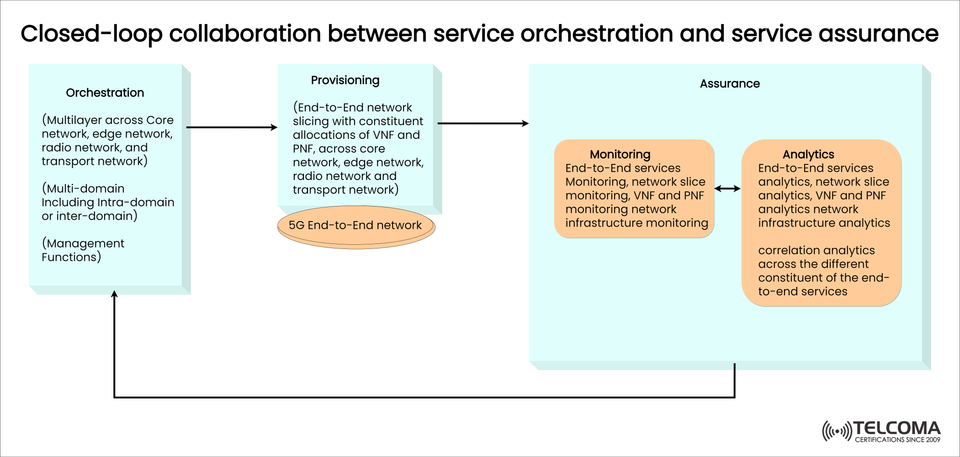

🔄 Closed-Loop Collaboration Between Service Orchestration and Service Assurance in 5G
5G networks now necessitate intelligent, dynamic, and automated operations across a multitude of distributed domains under a variety of operational models. One aspect of intelligent automation is the closed-loop collaboration between service orchestration and service assurance. This ensures a process of provisioning, monitoring (in real-time), and acting on insights from analytics - ensuring applicable SLA considerations while ensuring service performance remains optimum.
🧠 What Is Closed-Loop Automation in 5G?
Closed-loop automation is an iterative process that:
Monitors service and infrastructure performance and health.
Analyzes data in real-time.
Provides feedback (insights) to orchestration layers to make adaptive decisions.
In 5G, circulated logistics and managing VNFs (Virtual Network Functions) and PNFs (Physical Network Functions) across the core, edge, radio, and transport networks is dependent on this loop.
🧱 Key Components Described (As Depicted in Diagram)
Component Description
Orchestration - Provides orchestration across multiple domains (core, edge, radio transport).
- Handles intra-domain and inter-domain coordination, managing domain operations.
- It is the central controller for network resources.
Provisioning - Provides VNFs and PNFs relative to the network slice. - Enables end-to-end service creation.
- Converts service-intent to deployable service.
🔄 Closed-Loop Automation in Action
Orchestration Starts Service Deployment
When user demand requires it or business policies dictate.
Allocates resources (VNF/PNF) across the 5G domains.
Provisioning Develops Deployment
Connects and configured each network function as part of a network slice.
Assurance Starts Monitoring
Continuously monitors service behavior and performance.
Records any anomalies, latency, packet loss, or drops in throughput.
Analytics Processes and Correlates Insight
Correlates metrics across VNF, PNF, and infrastructure.
Determines where throughput bottlenecks were identified or where degradation is detected.
Sends Feedback to Orchestration
Recommendations, or auto-corrections are fed back to orchestration as a signal to:
Scale resources
Re-route traffic
Heal faults
📊 Capabilities of Closed-Loop Integration in Telecom Networks
✅ Swift Fault Recovery: Set up proactively fix problems and take precautionary action through analytics.
✅ Dynamic Scaling: Automatically scale VNFs and PNFs depending on traffic or performance.
✅ Service Level Agreement (SLA) Compliance: Continuous loop of feedback ensures services remain within KPIs.
✅ Decreased OPEX: Reduce human intervention, and maximize automation.
✅ Enhanced Customer Experience: Visibility into real-time service health ensures timely and optimal delivery.
⚙️ Real World Use Cases
Network Slice Optimization: Automatically scale or migrate slices after the detection of congestion.
Self-Healing: Automatically replace VNFs or dynamically reconfigure, while running and detecting faults.
Predictive Maintenance: Early stages of identifying and proactively monitoring the development of degradation patterns before the service is introduced.
🚀 Best Practices for Implementation
📡 Use open standards (ETSI MANO, 3GPP) for interoperability of orchestration and assurance.
🔐 Ensure data security and privacy in the feedback loop.
📊 Use AI/ML models for analysis and anomaly detection.
🧪 Run service simulations pre-deployment to validate your service.
🧩 Integration with Network Slicing
Closed-loop automation is completely symbiotic with network slicing, one of the most significant capabilities of 5G which allows for many virtual networks to run on the same infrastructure.
🎯 Feedback Loops in Network Slicing
Feedback Loop Type Purpose
Fast loop Assumes real-time, low latency decisions (e.g., reroute traffic, failover recover)
Slow loop Assumes in-depth analytics for policy changes, capacity planning, and or complete redesign of a service.
Thus, the feedback loops will help ensure:
Each slice meets its SLO.
Proactive changes can be made before SLAs are breached.
🛠️ Enabling Technologies Supporting the Closed-Loop Model
To develop these intelligent systems, several underlying technologies are leveraged:
🧠 AI/ML for Analytics & Decisions
Forecast resource consumption
Detect performance degradation (respond to actual incidents)
Automate correlation and root-cause analysis
🔗 API-enabled Orchestration
Open APIs (for example TM Forum Open APIs, and ETSI NFV)
Interoperable among multiple vendors, and through multi-layers
📶 Telemetry and Observability
Real-time telemetry streams from VNFs/PNFs, continuous KPI monitoring (latency, jitter & packet loss)
🧱 Cloud (Native) Infrastructure
Containers and Kubernetes for microservices orchestration
Provisioning for programmable Infrastructure-as-code (IaC)
📌 Summary Table:
Closed-Loop 5G Automation
Function Tool/Tech Value
Monitoring Telemetry, Agents Real-Time visibility
Analytics AI/ML, Correlation Engines Insights for Action
Orchestration NFV-MANO, SDN Controllers Agility as a Service
Assurance SLA Engines, Probes Compliance to Policy
Feedback Loop Intent-Based Interfaces Dynamic Control
📈 Business and Operational Benefits
💰 Cost Savings: Automating fault management, managing capacity provides OPEX reduction
⚡ Faster Time to Market: Launch new Services or Slices faster
🧘 Operational Simplicity: Automating cross-domain management simplifies operators' decisions by leveraging AI/ML-driven decisions
📉 Churn Reduction: Better reliability and responsiveness will improve subscriber churn
🔮 The Next Steps: Toward Autonomous Networks (ZSM)
The ultimate objective will be the realization of Zero-touch Service Management (ZSM)—where networks can self-configure, self-optimize, and selfheals. Closed-loop.
🧪 ZSM-Driven Evolution
Closed-loop is becoming even more intent-driven.
AI/ML loops evolve from reactive to predictive to prescriptive.
Human-in-the-loop becomes human-on-the-loop - supervisory only.
📢 Final Thoughts
Closed-loop collaboration with orchestration and assurance is no longer a choice - it is a strategy for any operator that wants to be the leading edge of the 5G revolution and beyond. With real-time monitoring, analytics, and automated orchestration, telecom networks can become self-optimizing digital fabrics that support smart cities, autonomous vehicles, immersive media, Industry 4.0, and more.
🏁 Conclusion
The closed-loop partnership between service orchestration and assurance is the intelligent control plane of 5G networks. It converts static, "desperate" operation systems to self-aware and adaptive systems, for the purposes of provisioning, managing, and optimizing services in real time. As networks grow in complexity, closed-loop approaches will become mandatory practice for achieving zero-touch operations, and satisfying the forceful evolution of user and industrial needs.