
Closed-Loop Collaboration Between Service Orchestration and Assurance in 5G Networks
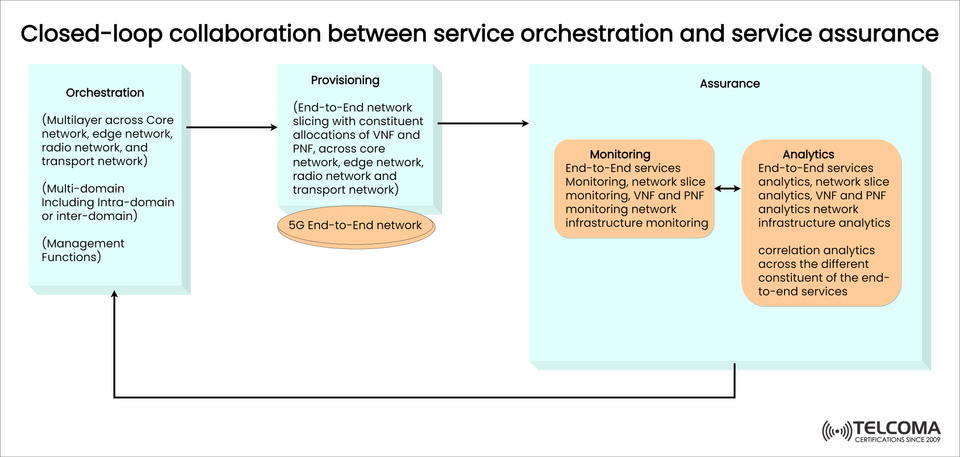

Closed-loop collaboration between orchestration and assurance in 5G networks
With the arrival of 5G networks, higher levels of dynamism, intelligence and automation is expected in managing service and network infrastructure. An important enabler of this agility is closed-loop collaboration between orchestration and assurance.
For the purpose of this post, and with inspiration from visuals used by Telcoma, we will explore how orchestration, provisioning, monitoring and analytics work together to create an intelligent feedback loop = providing Communication service providers (CSPs) the ability to deliver real-time responsiveness and assured user experience.
🌐 What is closed-loop network automation?
Closed-loop network automation is synonymous with self-sustaining system automations in which orchestration activities trigger decisions that then go through assurance functions where they are continuously assessed. Adjustments are made based on monitoring and analytics - also in near real-time to ensure KPIs, SLAs are met and resources are optimized.
🧩 Closed-loop model components
- Orchestration Layer
The orchestration layer represents the cognitive layer providing the service lifecycle management brain. Orchestration handles:
Multi-layer orchestration (Core, Edge, Radio, Transport).
Multi-domain orchestration (intra- and inter-domain).
End-to-end service and slice management functions.
- Provisioning
This defines turning intent to reality:
Allocates Virtual Network Functions (VNFs) and Physical Network Functions (PNF) across domains;
Creates E2E slicing across all segments (RAN, core, transport);
Builds basic foundation for the 5G End-to-End network. - Assurance Layer
The assurance layer provides feedback to the orchestrator related to performance:
📡 Monitoring:
Monitors end-to-end services, slices, VNFs/PNFs, and infrastructure;
Detects anomalies, SLA violations and degradation of service in real-time.
📊 Analytics:
Provides correlation across all layers and domain(s);
Derives actionable intelligence from the monitoring data;
Enables proactive remediation through automated policies.
🔁 How Does Closed-Loop Automation Work?
The closed-loop feedback connects the following functions:
Orchestration triggers provisioning;
Provisioned network operates with continuous monitoring;
Analytics-based engines process performance data;
An issue or opportunity to optimize is identified;
The orchestration sends update to the orchestrator;
Orchestration updates configurations or resources;
All this means autonomous adaptivity, availability, and performance.
🧠 The Closed Loop Orchestration & Assurance Benefits
Benefit open description
Agility Ability to provision service and optimization from a real time perspective;
Resilience Ability to detect issues and remediate before they become impactful;
Operational Efficiency Substantially less manual intervention therefore lower OPEX;
Customer Experience Consistent service delivery that meets SLAs;
🛠️ Use Cases
Dynamic scaling of network slices based on traffic variability;
📘 Glossary
Term Meaning
VNF Virtual Network Function
PNF Physical Network Function
SLA Service Level Agreement
E2E End-to-End
CSP Communication Service Provider
🏁 Conclusion
With an ever-connected service landscape, static provisioning and reactive fault management will not be enough in a 5G world. Orchestration and assurance, working together in a closed loop, will be fundamental to provide:
Real-time agility
End-to-end service quality
Automated fault resolution
Scalable and intelligent networks
🧩 Deeper Dive: The Technical Alignment of Orchestration and Assurance
📦 Orchestration in 5G
Today's 5G service orchestration applications are working across multiple layers and domains. These orchestrators are expected to:
Transform the business intent (e.g. provide ultra-low latency) into configurations in the network.
Control end-to-end service chains through determining the best location in the network to deploy VNFs and PNFs.
Take advantage of multi-domain orchestration to bring together the Radio Access Network (RAN), Transport, Core, and Edge.
Orchestrators will need to be intelligent and policy driven and will need to support:
Resource allocation across common resources.
Real-time reconfiguration of services based on assurance feedback into the orchestration process.
Working in tandem with existing Legacy systems that will eventually co-exist with newer cloud-native functions.
🛡️ Service Assurance - More Than Monitoring
Modern assurance is not simply reactive, but proactive and predictive. Some of the key characteristics include:
Multi-dimensional monitoring - including QoS, QoE and infrastructure health.
AI/ML-based analytics for predictive degradation and root cause failure analysis.
*Considerations for Implementation for CSPs.
If telecoms want to use a closed-loop model, consider these aspects:
- Key Technologies
- ONAP (Open Network Automation Platform)
- ETSI NFV MANO
- TM Forum Open APIs
- AI/ML pipelines for real time analytics.
- Integration Issues
- Consistency of data model across domains.
- Real Time visibility across hybrid cloud + telco infra.
- Coordinating the orchestrator and vendor for assurance systems.
- Maturity Roadmap
Phase Goal
1 Monitoring integrated with service orchestration.
2 Use rule based automation for SLA violations.
3 Enable full AI-driven closed-loop automation with intent-based inputs.
FAQs
Q1: Is closed-loop a good fit for private 5G networks?
Yes. Closed-loop systems are a good fit for private 5G use cases like manufacturing or enterprise networks, where applications are very deterministic, and low latency is critical to performance.
Q2: What is the difference between closed-loop and traditional network assurance?
Traditional assurance is manual and a post-facto activity. Closed-loop is real-time, self-correcting, and dramatically reduces Mean Time to Repair (MTTR).
Q3: What is the role of APIs in orchestration-assurance loops?
Open APIs provide interoperability across orchestration engines, assurance systems and third party tools which is essential to providing end-to-end automation across vendor-neutral environments.
🚀 Closing Thoughts
As 5G will transition to 6G, the closed loop orchestration and assurance relationship will no longer be a competitive advantage; it will be essential for operation. Telecom professionals, architects, and engineers will need to architect networks that include:
Open modular platforms
AI/ML powered analytics
Real time orchestration frameworks
Intent-based policy engines
With this type of systems in place, CSPs will enjoy service agility, SLA consistency and sustainable operational efficiency.