
Closed Loop Lifecycle in Telecom: Phases, Activities, and Automation Explained

Understanding the Closed Loop Lifecycle in Telecom: Phases, Activities, and Automation
These days, in telecom networks, automation isn't just a nice-to-have; it's an absolute must. As things get more complex with 5G, network slicing, IoT, and cloud-native setups, operators need smart automated systems to keep everything running smoothly and efficiently.
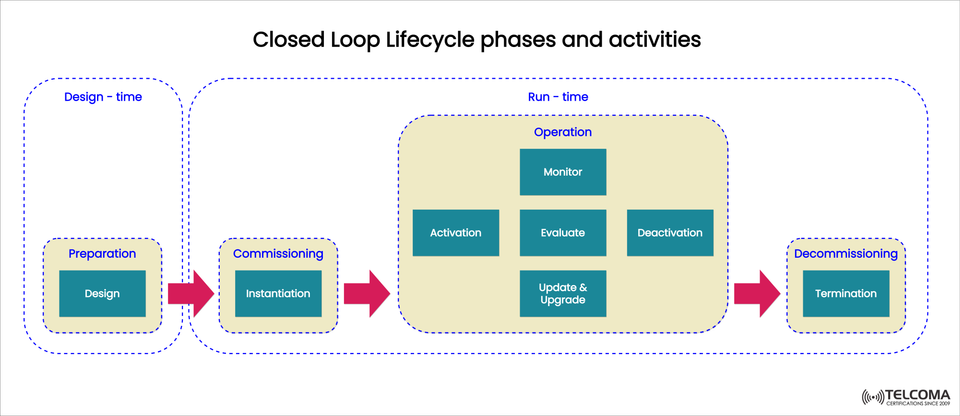
A key player in this automation game is the Closed Loop (CL) Lifecycle. The diagram we’ve provided lays out the entire lifecycle of closed loops in telecom, highlighting how each phase—from prep to decommissioning—contributes to making operations more autonomous and intent-driven.
In this blog, we’re going to dive into the phases, activities, and importance of the closed loop lifecycle specifically in the context of telecom and network automation.
What Does Closed Loop Mean in Telecom?
A closed loop is basically an automated feedback-driven process where a system keeps:
Monitoring its state and surroundings.
Evaluating conditions against policies or SLAs.
Taking corrective actions (like activation, reconfiguration, or deactivation).
This loop helps networks stay flexible and optimize themselves. In telecom, closed loops are crucial for:
Dynamically managing 5G slices.
Keeping ultra-low latency and high reliability.
Automating fault detection and recovery.
Boosting energy efficiency.
The Four Key Phases of the Closed Loop Lifecycle
The diagram points out four main phases in the lifecycle of a closed loop system:
Preparation (Design-time)
Commissioning (Instantiation)
Operation (Run-time)
Decommissioning (Termination)
Each phase involves specific tasks to guarantee the closed loop system is reliable and effective.
- Preparation (Design-time Phase)
During the design phase, we lay out how the closed loop will operate.
Activity: Design
Pinpoint the goals for the closed loop (like fault management, energy optimization, or QoS assurance).
Set monitoring metrics (like latency, throughput, and error rates).
Create the rules and policies that will guide evaluation and decision-making.
Select automation tools and models (particularly AI/ML).
This phase makes sure the closed loop aligns with business intent and service-level agreements (SLAs).
- Commissioning (Instantiation Phase)
After the design’s in place, the closed loop gets instantiated in the live system.
Activity: Instantiation
Launch the closed loop in the operational environment.
Set up monitoring points, data collectors, and actuators.
Link the closed loop with domain controllers and orchestration layers.
This step ensures the closed loop is up and running, ready to monitor and act on real-time data.
- Operation (Run-time Phase)
The operation phase is the most extensive and vital part. Here, the closed loop actively runs and makes autonomous decisions.
Key activities include:
Monitor: Keep an eye on network or service KPIs, like packet loss, throughput, or CPU usage.
Evaluate: Check the monitored data against thresholds, policies, or AI/ML predictions.
Activation: Trigger corrective actions, like scaling up resources, rerouting traffic, or enabling backup links.
Deactivation: Turn off functions that are no longer necessary to maximize efficiency.
Update & Upgrade: Adjust closed loop configurations, introduce new rules, or improve AI models as things change.
This stage captures the essence of closed loop automation—self-monitoring, self-evaluation, and self-healing.
- Decommissioning (Termination Phase)
At the end of the lifecycle, a closed loop is terminated once it’s no longer required.
Activity: Termination
Shut down monitoring and evaluation processes.
Release any tied resources.
Archive performance data for compliance and auditing.
This phase ensures a clean removal without wasting resources.
A Closer Look at Closed Loop Lifecycle Activities
Here’s a quick summary of activities across the phases:
Phase Activity Description Preparation Design Set goals, KPIs, rules, and models for the closed loop operation. Commissioning Instantiation Deploy and configure the closed loop in the operational system. Operation Monitor Gather real-time metrics and data. Evaluate Compare observed data against policies and thresholds. Activation Trigger corrective or optimization actions. Deactivation Turn off unnecessary processes to save resources. Update & Upgrade Refine and evolve the closed loop over time. Decommissioning Termination Remove the closed loop and release resources.
Why the Closed Loop Lifecycle is Important in Telecom
The closed loop lifecycle extends beyond just technical processes; it’s the backbone of zero-touch automation.
Benefits include:
Proactive Fault Management: Problems get spotted and fixed before they affect users.
Optimized Resource Use: Loops can turn resources on or off as needed.
Better SLA Assurance: Ongoing monitoring and evaluation guarantee compliance.
Lower OPEX: Reduced manual work cuts down operational costs.
Faster Innovation: Rolling out updates and upgrades becomes a breeze.
Real-World Example: Closed Loop in 5G Network Slicing
Let’s look at a practical example of 5G network slice management:
Preparation: Set slice QoS requirements (like ultra-low latency for autonomous vehicles).
Commissioning: Instantiate closed loops within RAN, core, and transport domains.
Operation:
Monitor latency and throughput.
Evaluate if the slice meets SLA standards.
Activate more resources or reroute traffic if performance dips.
Adjust loop parameters based on traffic forecasts.
Decommissioning: Terminate slices when they’re no longer needed.
This ensures that slices dynamically adjust to user demand while staying within SLAs.
Challenges in Implementing the Closed Loop Lifecycle
Even though the lifecycle framework is clear, telecom operators run into some challenges:
Complexity: Creating closed loops across various domains needs a lot of coordination.
Standardization: Different vendors might have various ways of implementing automation.
Security: Automated actions must be protected against unauthorized interference.
Data Accuracy: Effective monitoring relies on dependable and high-quality data.
Tackling these challenges is crucial to fully unlock the benefits of closed loop automation.
Wrapping Up
The Closed Loop Lifecycle is fundamental to telecom automation, allowing networks to function with minimal human oversight while ensuring performance and reliability.
Preparation and Commissioning set up and deploy the loop.
Operation focuses on continuous monitoring, evaluation, and taking corrective actions.
Decommissioning ensures smooth shutdown and resource optimization.
For those in telecom, getting a handle on the closed loop lifecycle is key to building networks that are ready for the future—autonomous, resilient, and capable of meeting the challenges of 5G, IoT, and beyond.
By understanding these phases and activities, operators can confidently create zero-touch closed loops that will support the next generation of telecom operations.