
Cloud Distribution and Edge Computing: Powering the Connected World

Cloud Distribution and Edge Computing: Powering the Connected World
The digital landscape is growing at an incredible pace, with billions of IoT devices, autonomous systems, and connected services coming online. As this ecosystem expands, traditional centralized cloud models are becoming stretched. Issues like high latency, bandwidth bottlenecks, and inefficient data routing can really hold back essential applications, such as connected cars, smart grids, and real-time analytics.
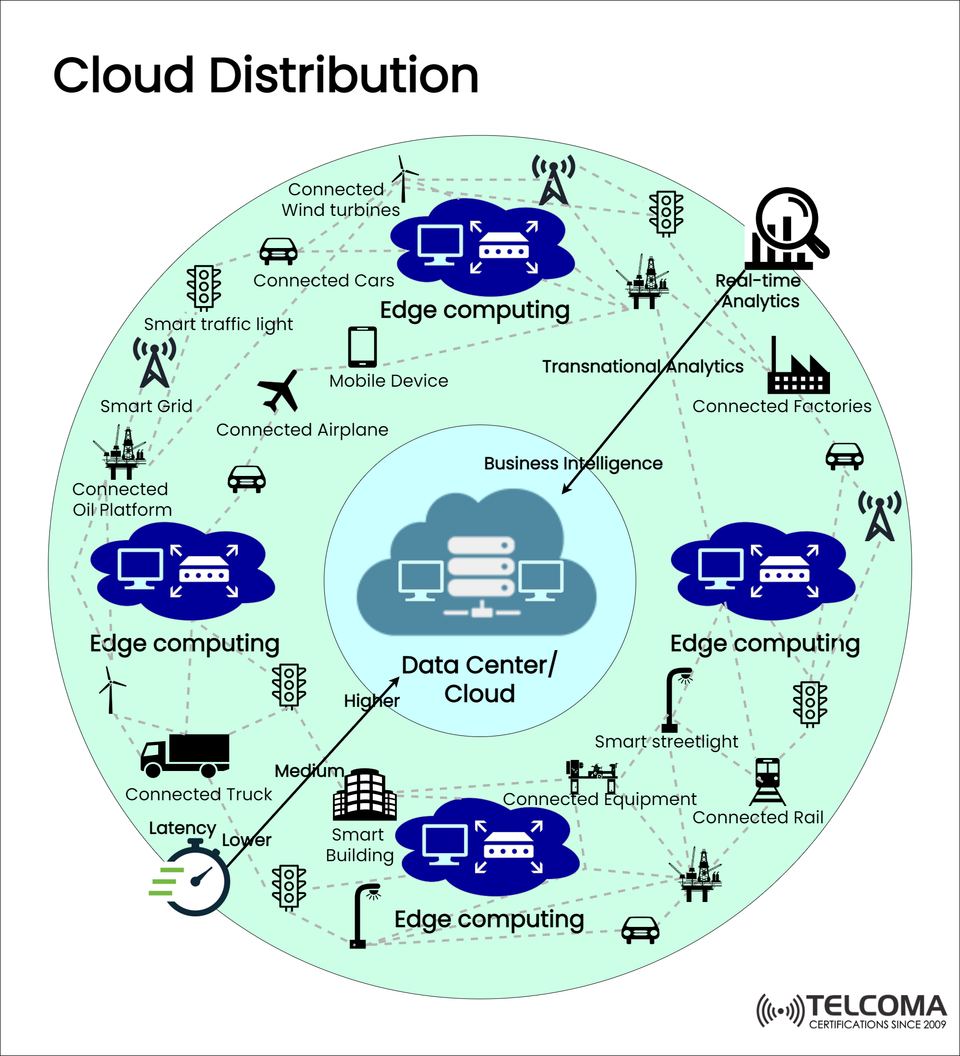
This is where cloud distribution and edge computing step in. The image shows how edge nodes are positioned closer to end devices, while still linked to centralized data centers or cloud hubs. Together, they form a distributed computing ecosystem that's much better at managing data.
For telecom professionals and companies, getting a handle on this architecture is crucial for enabling 5G, IoT, and future 6G systems.
Why Cloud Distribution Matters
The cloud isn’t just tied to centralized data centers anymore. It’s becoming distributed across multiple layers:
Core Cloud (Data Centers): This is where large-scale storage, business intelligence, and transnational analytics happen.
Edge Computing Nodes: These are placed closer to devices, helping to cut down on latency and support real-time decision-making.
Connected Devices: They create huge amounts of data from vehicles, buildings, factories, and other infrastructure.
By spreading out the cloud, we address some pretty major challenges:
⚡ Lower Latency: Processing data near its source cuts delays, which is crucial for autonomous vehicles, industrial robots, and AR/VR.
🌐 Scalability: Edge nodes help balance workloads to prevent overload in the cloud.
📉 Bandwidth Efficiency: Not all data needs to travel back to the central cloud—just the important insights.
🔒 Security & Privacy: Sensitive info can be processed closer to the source, reducing exposure risks.
Edge Computing in Action
The image showcases various real-world applications of edge computing across different industries:
- Connected Transportation
Connected Cars, Trucks, and Rail: Edge nodes facilitate vehicle-to-everything (V2X) communication for improved safety, navigation, and efficiency.
Connected Airplanes: They provide real-time monitoring and predictive maintenance.
- Smart Cities
Smart Traffic Lights & Smart Streetlights: AI-driven traffic management and energy-efficient lighting.
Smart Buildings: Focus on energy optimization, predictive maintenance, and security monitoring.
Connected Equipment: This enhances industrial IoT with quick responses.
- Energy & Infrastructure
Connected Wind Turbines: They keep tabs on performance and predict failures.
Smart Grids: Help balance energy loads and incorporate renewables.
Connected Oil Platforms: Provide real-time analytics for safety and efficient production.
- Manufacturing & Industry
Connected Factories: These enable automation and predictive maintenance.
Real-Time Analytics: Essential for making quick decisions to optimize processes.
These edge-enabled systems not only reduce latency but also boost efficiency, all while sending aggregated data back to the central cloud for business intelligence.
Latency in Cloud Distribution
One key aspect highlighted in the image is reducing latency.
Centralized Cloud: Experiences higher latency because of the distance from devices (better suited for long-term analytics, archival, and strategic choices).
Edge Computing Nodes: Offer lower latency since they’re closer to data sources (perfect for real-time applications like connected cars and smart grids).
This creates a hierarchical latency model:
Lower Latency → Edge computing for real-time processing.
Medium Latency → Regional cloud processing.
Higher Latency → Centralized cloud for large-scale analytics.
Cloud Distribution Layers
Here’s a straightforward table that outlines the functions of various layers:
Layer Function Example Use Cases Edge Computing Real-time, local processing near devices Smart traffic lights, connected cars, smart factories Regional Cloud Aggregated processing & intermediate storage Smart cities, industrial clusters Central Data Center/Cloud Business intelligence, large-scale analytics Transnational data analysis, AI model training
Benefits for Telecom and Enterprises
The mix of distributed cloud and edge computing offers some transformative perks:
📡 For Telecom Operators: * Optimize 5G networks by easing the backhaul load. * Provide edge-as-a-service to companies. * Enable ultra-reliable low-latency communications (URLLC).
🏭 For Enterprises: * Quick decision-making for manufacturing and logistics. * Enhanced IoT performance in critical operations. * Scalable infrastructure for Industry 4.0 and smart cities.
👩💻 For Consumers: * Improved AR/VR, gaming, and immersive experiences. * Smooth connectivity for autonomous vehicles. * Smarter, more energy-efficient homes and offices.
Challenges in Cloud Distribution
Despite its potential, cloud distribution has its challenges:
Infrastructure Investment: Setting up edge requires significant upgrades to hardware and networks.
Interoperability: Multiple vendors and platforms need standard frameworks to work together.
Data Governance: Managing privacy across decentralized environments can be tricky.
Scalability: Keeping consistency across thousands of edge nodes is crucial.
Energy Efficiency: Balancing processing power with sustainability needs.
Future of Cloud Distribution in 6G
Looking ahead, 6G networks will heavily depend on cloud distribution and edge computing:
AI-Driven Edge: AI models will run directly at edge nodes for instant decision-making.
Edge-Cloud Convergence: A seamless orchestration of workloads between edge, regional, and core cloud.
Ultra-Low Latency Services: Supporting holographic communications, autonomous mobility, and industrial automation.
Global IoT Management: Efficiently managing billions of devices with predictive analytics.
Sustainability Goals: Edge computing will cut down energy waste by processing data closer to its source.
By 2030, distributed cloud won’t just be an option—it will be the default infrastructure for 6G and Industry 5.0.
Conclusion
Cloud distribution, paired with edge computing, is reshaping the way data flows in our digital world. By moving computing power closer to devices, networks achieve lower latency, more efficiency, and better scalability.
For telecom operators, enterprises, and governments, this architecture is essential for unlocking the future of smart cities, industrial IoT, and 6G readiness. The way forward is a hybrid model where edge and core cloud work together, ensuring a smarter, more connected world.