
Cloud VR Network Architecture: How F5G Enables Low-Latency Immersive Experiences

Cloud VR Network Architecture: How F5G Enables Low-Latency Immersive Experiences
Virtual Reality (VR) is moving beyond just a niche tech for entertainment into a widespread platform for gaming, training, healthcare, education, and collaboration in business. But to really offer a smooth, immersive VR experience, you need high bandwidth, low latency, and reliable connectivity—something traditional broadband often struggles to provide.
This is where Cloud VR architecture, backed by Fifth Generation Fixed Networks (F5G), comes into play. By shifting the heavy lifting of rendering to the cloud and utilizing fiber-based optical transport networks, providers can deliver high-quality, scalable VR experiences without users needing to spend a fortune on local hardware.
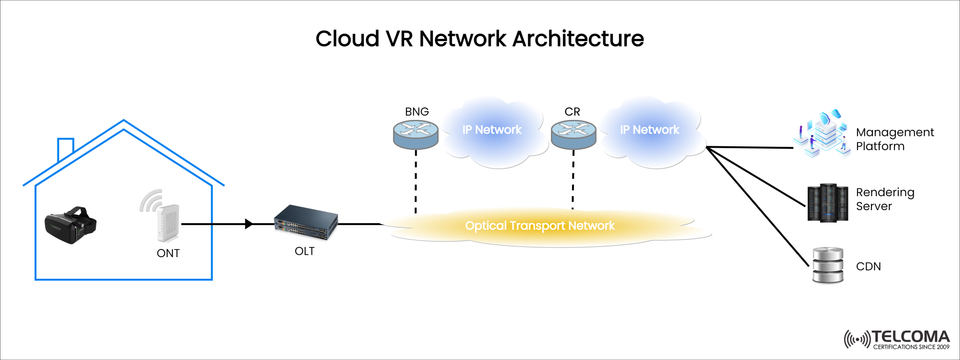
Let’s take a closer look at the architecture detailed in the diagram and see how each part plays a role in creating next-gen immersive connectivity.
What is Cloud VR?
Cloud VR is about delivering virtual reality experiences over cloud infrastructure, where:
The heavy lifting of VR graphics processing happens on remote servers.
The user’s VR headset mostly acts as a display and input device.
The experience streams in real-time over a low-latency broadband connection.
This method cuts down on costs for users while making high-quality VR content available from just about any connected spot.
Key Components of Cloud VR Network Architecture
The diagram outlines the main building blocks:
- End-User Devices and Access Network
VR Headset: This is the user’s entry point into the virtual world, needing stable low-latency connectivity to prevent motion sickness and keep the experience immersive.
ONT (Optical Network Terminal): This device converts optical signals from the broadband line so they can be used by the VR headset through WiFi or Ethernet.
- Access Node (OLT)
Optical Line Terminal (OLT): It links multiple ONTs to the broader optical network, managing traffic and ensuring efficient bandwidth use.
Operates within PON (Passive Optical Network) frameworks like GPON or 10G-PON, which are essential for F5G setups.
- Optical Transport Network (OTN)
Acts as the backbone for fast, reliable data transfer.
Delivers consistent latency, which is vital for real-time VR rendering.
Scales up bandwidth to 10 Gbps or more, crucial for ultra-high-definition VR visuals.
- IP Network Layers
BNG (Broadband Network Gateway): Takes care of user authentication, session management, and subscriber traffic.
CR (Core Router): Routes traffic across the IP backbone to ensure quick and efficient data delivery.
- Cloud Components
Rendering Server: Handles the intensive calculations needed to create VR environments in real-time.
CDN (Content Delivery Network): Caches and distributes VR content closer to users to cut down on latency.
Management Platform: Manages orchestration, monitoring, and optimization of VR sessions, ensuring a quality experience.
Why F5G is Critical for Cloud VR
F5G brings three main elements—Enhanced Fixed Broadband (eFBB), Full-Fiber Connection (FFC), and Guaranteed Reliable Experience (GRE)—that tackle VR’s specific network challenges:
eFBB (10 Gbps Speeds): To deliver immersive 4K/8K visuals with minimal compression, Cloud VR needs a lot of bandwidth.
FFC (Fiber Everywhere): Bringing fiber connectivity into homes, rooms, and even devices helps ensure stable, low-loss connections.
GRE (Ultra-Low Latency ~1 ms): Keeping motion-to-photon latency to a minimum is crucial for smooth streaming in VR to avoid lag and confusion.
All these features make F5G a key player in enabling scalable Cloud VR services.
Cloud VR Architecture Workflow
Here’s the data flow in this architecture:
The VR headset picks up user input (like motion and gestures).
The ONT sends this input via fiber to the OLT.
Signals travel through the Optical Transport Network to the IP core (BNG and CR).
At the Rendering Server, input data gets processed to create real-time VR environments.
The optimized VR stream goes back through the CDN and returns via the OTN.
Finally, the VR headset presents the environment in near-real-time with minimal lag.
The Management Platform ensures quality by constantly monitoring performance and adjusting as needed.
Challenges Addressed by Cloud VR Architecture
- Latency Reduction
Regular networks might have delays of around 10–20 ms, which can mess with the VR experience. F5G brings this down to ~1 ms, allowing for lifelike interactivity.
- Bandwidth Demand
Depending on the resolution and interactivity, VR can need 25–100 Mbps per stream. F5G’s multi-gigabit capacity can support several users in VR simultaneously.
- Scalability
By handling rendering in the cloud, there’s no need for costly local GPUs, making VR more affordable for consumers and scalable for providers.
Quality of Experience (QoE)
Thanks to the CDN and traffic prioritization, Cloud VR can keep frame rates smooth and visuals immersive, even when demand peaks.
Real-World Applications of Cloud VR
Cloud VR isn’t just for gaming. Its architecture supports:
Healthcare: Things like remote surgeries and immersive medical training.
Education: Virtual classrooms and interactive learning experiences.
Enterprise Collaboration: Team meetings in virtual spaces and digital twin simulations.
Entertainment: Cloud-based VR gaming, virtual concerts, and sports events.
Tourism: Virtual experiences of travel and culture without leaving home.
Cloud VR vs. Local VR
Feature Local VR Cloud VR Processing Power Handled by local GPU/PC Handled by cloud rendering servers Latency Dependent on local hardware Optimized via F5G GRE (~1 ms)Cost Expensive high-end hardware Lower: headset + subscription Scalability Limited to device capacity Unlimited cloud scalability Updates Hardware-bound Continuous cloud-side upgrades
Strategic Opportunities for Telecom Operators
Cloud VR offers high-value use cases for F5G networks, leading to:
New revenue streams from subscription-based VR services.
Chances for partnerships with content creators in gaming, education, and healthcare.
Improved brand positioning as suppliers of cutting-edge immersive experiences.
Integration with 5G mobile networks for a smooth fixed-mobile convergence.
Conclusion
The Cloud VR Network Architecture shows how F5G networks can truly unlock immersive experiences. By combining optical transport networks, IP routing, CDN caching, rendering servers, and management platforms, service providers can offer VR that's not just responsive and smooth but also scalable and cost-effective.
For telecom professionals, this architecture serves as a blueprint for future-ready services that do more than just provide connectivity; they're transforming networks into experience enablers.
As VR usage picks up speed in the coming years, F5G-powered Cloud VR will reshape how we work, play, learn, and interact—marking the dawn of a truly immersive connectivity era.