
Clustered Tree Mesh Network Topology: Formation, Hops, and Benefits

Introduction
As networks grow to accommodate millions of devices, having effective topologies becomes really important for maintaining performance, scalability, and reliability. One noteworthy design is the clustered tree mesh network topology, which has become increasingly relevant in telecom and IoT spaces.
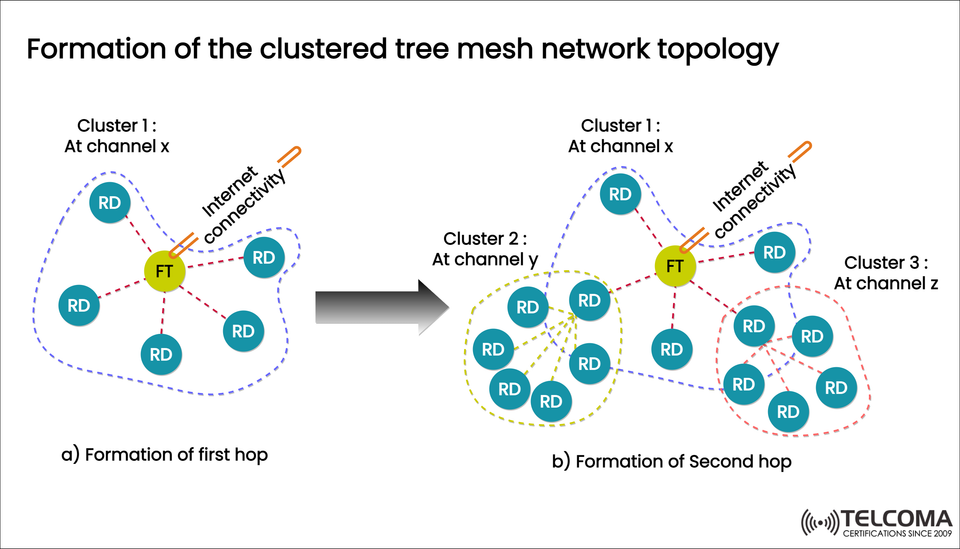
This setup merges tree-based hierarchical clustering with the robustness of mesh networking. The diagram provided shows how this topology develops in stages: it starts with a first hop, where a Fusion Terminal (FT) connects to several Relay Devices (RDs), and then moves to a second hop, where more clusters form across different channels.
This hybrid design ensures low latency, effective bandwidth usage, and fault tolerance—qualities that are particularly vital for 5G, IoT, and wireless communications.
Key Components of the Clustered Tree Mesh Network
- Relay Devices (RDs)
Relay Devices serve as the foundation of the clustered tree mesh network.
What RDs do:
They forward packets to other nodes or Fusion Terminals (FTs).
They help expand network reach through multi-hop communication.
They lower energy consumption by managing traffic flows efficiently.
They keep connections active on specified channels.
- Fusion Terminals (FTs)
Fusion Terminals act as gateways or cluster heads, providing internet access and facilitating communication between clusters.
Main roles of the FT:
Gathering data from connected RDs.
Granting internet connectivity for the cluster.
Managing frequency channels to reduce interference.
Supporting the formation of more hops and clusters.
- Clusters
A cluster is made up of RDs working together under the direction of an FT. Each cluster operates on its own channel, preventing interference.
Cluster 1 (Channel X): The first cluster that forms directly around the FT.
Cluster 2 (Channel Y): Added during the second hop, extending coverage.
Cluster 3 (Channel Z): Another cluster operating on a different frequency channel.
Clusters create the hierarchical structure of the tree, while mesh connections provide backup options.
- Channels (X, Y, Z)
The topology utilizes a variety of channels to keep clusters separate. For example:
Channel X – Used by Cluster 1.
Channel Y – Assigned to Cluster 2.
Channel Z – Dedicated to Cluster 3.
By using different channels, the network avoids interference and allows multiple clusters to function at once.
Step-by-Step Formation of the Clustered Tree Mesh Topology
The diagram showcases two key phases:
a) Formation of the First Hop
An FT makes a direct connection to several RDs.
These RDs create Cluster 1 on Channel X.
The FT provides internet access while serving as the gateway.
At this point, the network resembles a simple star topology focused around the FT.
b) Formation of the Second Hop
More RDs come together to form Cluster 2 (Channel Y) and Cluster 3 (Channel Z).
These clusters link through the FT, allowing multi-hop communication.
Mesh-like redundancy arises as clusters can share data through the FT and neighboring RDs.
The network transitions into a clustered tree mesh, with each hop adding to its scalability and resilience.
Advantages of the Clustered Tree Mesh Topology
This hybrid model brings several technical perks:
Scalability: New clusters can be introduced as second, third, or more hops.
Reduced Interference: Each cluster operates on its own channel.
Redundancy & Fault Tolerance: Mesh connections guarantee data delivery, even if some paths fail.
Optimized Bandwidth: Effective channel use reduces congestion.
Hierarchical Organization: The tree-like structure makes management easier.
Cloud/Internet Access: FTs function as internet gateways for local devices.
Real-World Applications
This topology proves especially useful in situations that demand high scalability and dependable connectivity:
5G Small-Cell Networks: Improves coverage in densely populated urban areas.
IoT & Smart Cities: Connects thousands of dispersed sensors while minimizing interference.
Industrial IoT: Guarantees reliable machine-to-machine communication in factories.
Rural & Remote Networks: Multi-hop clusters bring connectivity to underserved areas.
Disaster Recovery Networks: Self-healing mesh guarantees continuity during outages.
Comparison with Other Topologies
Aspect Tree Topology Mesh Topology Clustered Tree Mesh Topology
Structure Hierarchical Fully connected Hybrid of tree and mesh
Scalability High but limited by bottlenecks High but complex Very high, with structured growth
Fault Tolerance Low High High (with redundancy)
Interference Management Limited Complex Efficient with channel allocation
Internet Integration Limited to root node Multiple gateways possible Efficient via FTs
Challenges in Deployment
Even with its benefits, clustered tree mesh networks have some challenges:
Channel Management: Needs smart frequency planning to prevent overlap.
Complex Synchronization: Timing must be kept consistent for multi-hop connections.
Security Risks: More nodes and hops lead to increased vulnerabilities.
Management Overhead: Clustered systems need strong orchestration to function well.
Advanced orchestration tools, AI-based traffic management, and secure protocols can help tackle these issues.
Deep Dive into Clustered Tree Mesh Networks
- Hybrid Structure: Tree + Mesh
The tree topology establishes a clear parent-child hierarchy, while the mesh topology adds redundancy between nodes. Combining these two creates a clustered tree mesh network that:
Removes single points of failure (which is a common issue in pure tree topologies).
Simplifies complexity compared to fully mesh networks.
Delivers structured growth alongside resilience, a crucial feature for telecom and IoT.
- Fusion Terminals' Role in Scalability
In large deployments, multiple Fusion Terminals (FTs) can be used, managing clusters across various regions or frequencies. This setup enables:
Smooth handovers between different clusters.
Load balancing that’s distributed across the network.
Redundancy at the gateway level (meaning if one FT fails, another can take over the Internet connection).
- Real-World Multi-Hop Expansion
Every additional hop extends network reach, but it also brings challenges:
Increased latency – Multi-hop communication can add a few milliseconds of delay.
Higher energy consumption – Nodes that forward data through multiple hops may deplete their energy faster in wireless sensor networks.
Potential data collisions – More hops mean a higher chance of retransmissions.
Telecom engineers tackle these issues with smart routing protocols, such as:
RPL (Routing Protocol for Low-Power and Lossy Networks)
AODV (Ad hoc On-Demand Distance Vector)
Hybrid proactive-reactive protocols
- Channel Reuse and Avoiding Interference
In the diagram, we see Cluster 1 (Channel X), Cluster 2 (Channel Y), and Cluster 3 (Channel Z). When scaling up:
Non-overlapping channels (like Wi-Fi channels 1, 6, and 11) are reused for distant clusters.
Cognitive radios or AI-based spectrum allocation can dynamically adjust channels based on interference levels.
Telecom operators often adopt SDN (Software-Defined Networking) for centralized spectrum management.
- Security in Clustered Tree Mesh Networks
As clusters and hops increase, so do the entry points for potential attackers. Security measures include:
End-to-End Encryption: Safeguards data throughout the hops.
Cluster-Level Firewalls: FTs can scan and filter out malicious traffic.
Zero-Trust Networking: Ensures no RD or FT is inherently trusted, requiring ongoing authentication.
Blockchain-Based Security: Employed in IoT for decentralized trust verification.
Uses in Next-Gen Networks
5G and Beyond
5G networks heavily depend on small-cell deployments to broaden coverage. A clustered tree mesh design allows these small cells to:
Self-organize into clusters.
Efficiently backhaul traffic via FTs.
Tackle ultra-dense device environments like stadiums and smart cities.
IoT and Smart Cities
In IoT, billions of devices need to be managed across various layers. The clustered tree mesh topology backs:
Streetlight networks where RDs transmit sensor data.
Utility grids for real-time monitoring of power, water, or gas.
Public safety systems that maintain robust mesh communication, even during outages.
Industrial IoT (IIoT)
Factories and supply chains need low-latency, high-reliability communication:
Clusters can correspond to different production areas.
FTs connect to centralized control systems.
Multi-hop resilience ensures minimal downtime, even if one RD fails.
Disaster Recovery & Emergency Networks
In the wake of natural disasters, centralized infrastructure often breaks down. A clustered tree mesh can be quickly deployed using portable FTs and low-power RDs to:
Provide emergency connectivity.
Facilitate coordination for first responders.
Reconnect isolated clusters with the global Internet.
Future of Clustered Tree Mesh Networks
- AI-Powered Cluster Management
Artificial Intelligence (AI) will assist in:
Predicting traffic spikes and pre-allocating channels accordingly.
Dynamically balancing loads across clusters.
Detecting anomalies and potential failures in real time.
- Integration with Satellite Networks
With the rise of LEO (Low Earth Orbit) satellites like Starlink, FTs may connect directly to satellites, broadening cluster reach worldwide without solely depending on land-based infrastructure.
- Quantum-Safe Security
As quantum computing evolves, traditional encryption might become outdated. Going forward, FTs and RDs will likely use quantum-safe cryptographic algorithms to ensure secure communications.
- Edge Computing in Clusters
Instead of sending all data to the cloud, RDs and FTs will incorporate edge AI to process data locally, cutting down on latency and bandwidth use.
Conclusion
The formation of the clustered tree mesh network topology shows how networks progress from a simple first-hop layout into a scalable, resilient multi-hop framework.
By fusing tree hierarchy with mesh redundancy, this topology embodies the best of both worlds: structured growth, effective resource usage, and fault-tolerant connections. Fusion Terminals (FTs) provide global internet access, while Relay Devices (RDs) manage local traffic within clusters.
For telecom professionals, grasping this topology is crucial for crafting future-proof 5G, IoT, and enterprise networks. For tech enthusiasts, it illustrates how intelligent clustering and mesh connectivity form the backbone of contemporary communication systems.