
Co-located CUPS-Based Solution Explained: Architecture & Benefits for LTE and 5G

Telecom networks are changing fast to keep up with the growing need for high bandwidth, low latency, and flexible services. A key innovation making this possible is the Control and User Plane Separation (CUPS) architecture. By separating the control plane (which manages signaling and sessions) from the user plane (responsible for data forwarding), CUPS gives operators the freedom to deploy, scale, and manage their network resources more effectively.
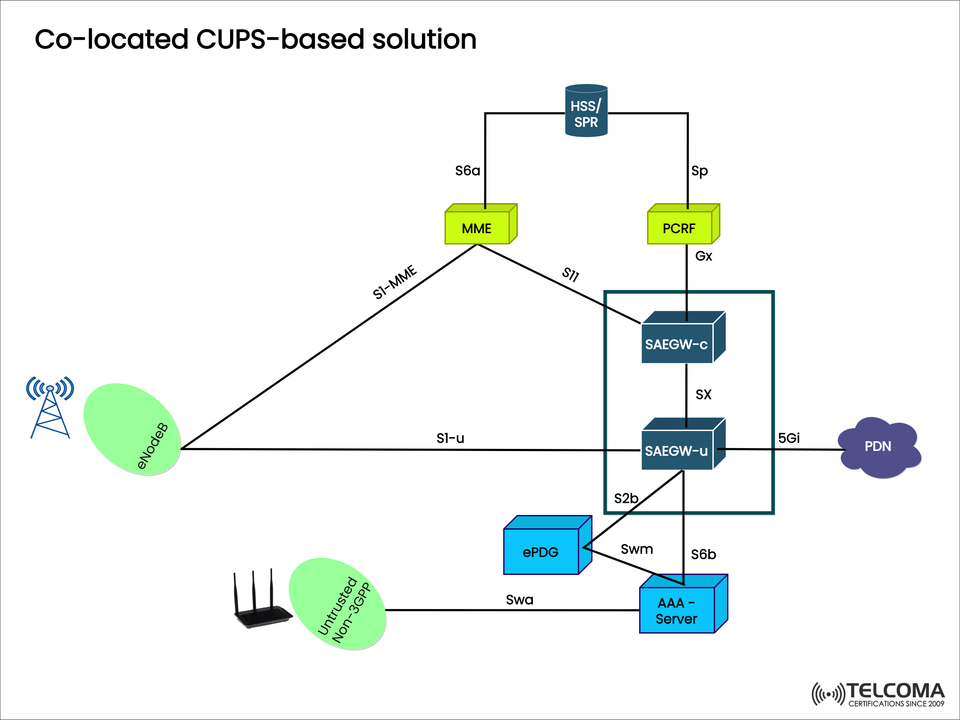
The image provided shows a Co-located CUPS-based solution, where both the control and user plane components are housed at the same physical site. This setup enhances efficiency, makes deployment easier, and lowers latency. In this blog, we’ll take a closer look at its components, architecture, and the benefits it brings to LTE and 5G networks.
What is CUPS?
CUPS (Control and User Plane Separation) is a design principle outlined in 3GPP standards. Its main goals include:
Separating control and user plane functions.
Allowing independent scaling for signaling and data processing.
Offering flexibility in deployment (whether centralized or distributed).
Supporting edge computing and the transition to 5G core.
In traditional EPC (Evolved Packet Core), both planes are integrated, which limits scalability. With CUPS, they’re modularized, making resource use much more efficient.
Co-located CUPS-Based Architecture
The image displays a co-located architecture where the SAEGW-C (control plane) and SAEGW-U (user plane) functions are deployed side by side.
Here’s a quick rundown of the main components:
- eNodeB (Evolved NodeB)
Serves as the LTE base station.
Connects user equipment (UE) to the core network.
Communicates with the Mobility Management Entity (MME) through the S1-MME interface for signaling.
Transfers user data to the core via the S1-U interface.
- MME (Mobility Management Entity)
Acts as the central control point for mobility, session management, and authentication.
Interfaces include:
S1-MME: Links to eNodeB.
S11: Connects to SAEGW-C for session and bearer control.
S6a: Links to HSS/SPR for subscriber data.
- HSS/SPR (Home Subscriber Server / Subscription Profile Repository)
Stores subscriber identities, profiles, and authentication vectors.
Works alongside MME to validate user sessions.
- PCRF (Policy and Charging Rules Function)
Establishes QoS (Quality of Service) and charging policies.
Communicates with SAEGW-C using Gx to enforce these policies.
- SAEGW-C (Serving and PDN Gateway – Control Plane)
Manages control-plane signaling for data sessions.
Interfaces:
S11: With MME.
Gx: With PCRF.
SX: With SAEGW-U.
- SAEGW-U (Serving and PDN Gateway – User Plane)
Handles data forwarding in the user plane.
Interfaces:
S1-U: With eNodeB for user data.
S2b/S6b: With ePDG and AAA for non-3GPP access.
5Gi: Toward PDN (Packet Data Network, like the Internet).
SX: With SAEGW-C for session rules.
- ePDG (Evolved Packet Data Gateway)
Ensures secure connectivity for untrusted non-3GPP access (like Wi-Fi).
Communicates with the AAA Server using Swm/Swa interfaces.
- AAA Server (Authentication, Authorization, Accounting)
Authenticates users connecting through non-3GPP access.
Makes sure the interworking is secure.
- PDN (Packet Data Network)
Represents the external data network (like the Internet, IMS, or enterprise networks).
It's the final stop for user traffic.
Advantages of Co-located CUPS-Based Solutions
Simplified Deployment
With SAEGW-C and SAEGW-U in the same spot, network complexity is reduced.
Reduced Latency
Co-location cuts down on signaling and forwarding delays.
Best for applications that need low latency (like video streaming or gaming).
Improved Resource Utilization
Shared resources between control and user plane functions lead to cost efficiency for operators handling moderate traffic.
Seamless Interworking
Works with both 3GPP (LTE) and non-3GPP (Wi-Fi) access networks.
Ensures consistent subscriber authentication and policy control.
Scalability Path
While it’s co-located for now, this architecture can support future moves to distributed deployment models.
Enhanced Policy Enforcement
Close integration between PCRF and SAEGW-C guarantees that QoS and charging rules are applied efficiently.
Use Cases of Co-located CUPS
Mid-Sized LTE Deployments: Operators focusing on regional or city-level coverage can find it easier to deploy.
Private LTE/5G Networks: Businesses that run networks on campuses or in factories value co-location for better security and lower latency.
Wi-Fi Offload Solutions: Smooth integration of untrusted Wi-Fi access through ePDG.
5G Transition Path: Acts as a stepping stone before fully switching to a distributed 5G core.
Co-located vs Distributed CUPS
Feature Co-located CUPS Distributed CUPS Latency Low (due to co-location)May vary depending on distance Scalability Limited High (independent scaling)Deployment Complexity Simple More complex Use Case Fit Medium-scale LTE, private 5GNationwide 5G, URLLC-heavy services Future Proofing Moderate Strong
Why Co-located CUPS Matters for 5G Evolution
Even though 5G Core (5GC) is fully service-based and supports the separation of control and user planes, many operators are still using evolved EPC with CUPS. Co-located solutions strike a good balance:
They keep the efficiency and simplicity of LTE EPC.
They get networks ready for future migration to 5GC.
They enable edge computing integration when implemented closer to users.
Conclusion
The Co-located CUPS-based solution plays an important role in the telecom industry's shift from LTE EPC to 5G Core. By separating the control and user planes while keeping them physically together, operators achieve simplicity, low latency, and efficient resource use.
For mid-sized deployments, private networks, and transitional phases, co-located CUPS provides a solid balance between today’s LTE needs and the demands of 5G ahead. As telecom networks evolve into 5G-centric IoT and ultra-reliable services, understanding CUPS architectures—both co-located and distributed—will be essential for professionals and network designers.