
Common Infrastructure and Operations Across RAN, CN, and MEC in 5G

Common Infrastructure and Operations Across RAN, CN, and MEC in 5G
The rise of 5G networks is changing the game for telecom infrastructure by uniting the Radio Access Network (RAN), Core Network (CN), and Multi-access Edge Computing (MEC) under a single infrastructure approach.
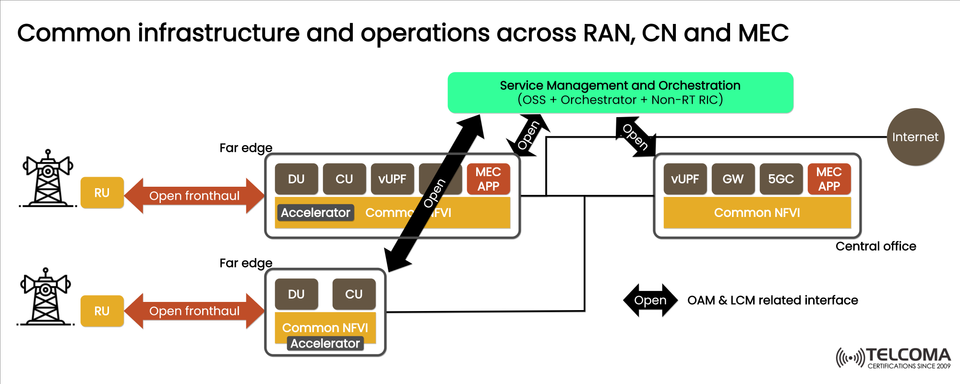
The diagram we've shared shows how common NFVI (Network Functions Virtualization Infrastructure), open interfaces, and orchestration systems work together to provide smooth coordination across different network areas.
This integration is key for achieving the flexibility, scalability, and intelligence that today’s mobile networks demand, especially as we move towards O-RAN, network slicing, and edge-based applications.
Breaking Down the Components
The diagram lays out three main areas: RAN, CN, and MEC. Here’s a closer look at each:
- RAN (Radio Access Network)
RU (Radio Unit): Takes care of radio frequency transmission and reception, linked to the DU (Distributed Unit) via open fronthaul.
DU (Distributed Unit): Handles real-time L2 and L3 tasks near the RU, which helps cut down on latency.
CU (Centralized Unit): Manages higher-level functions like mobility and session management.
Key Feature: Open fronthaul allows different vendor RUs and DUs/CUs to work together.
- CN (Core Network)
Includes 5GC (5G Core), Gateways (GW), and vUPF (User Plane Function).
It runs on common NFVI at the central office, providing flexibility for scaling.
Key Role: Takes care of authentication, mobility, routing, and subscriber services.
- MEC (Multi-access Edge Computing)
MEC applications are placed closer to the far edge to minimize latency.
It collaborates with the DU, CU, and vUPF to offer super-low latency services like AR/VR, self-driving cars, and industrial automation.
Integration Point: Uses the same NFVI as RAN and CN functions.
Role of Common NFVI and Accelerators
At the heart of this architecture is the common NFVI, which supports virtualized network functions across RAN, CN, and MEC.
Advantages:
* Simplifies the infrastructure by eliminating hardware silos.
* Enables software-based deployment for more agility.
* Facilitates network slicing through dynamic resource allocation.
Accelerators (like FPGA or GPU-based solutions) boost processing for: * Real-time RAN workloads.
* Edge computing applications.
* User plane functions requiring high throughput.
This lets telecom operators run various workloads on shared hardware, increasing efficiency and cost-effectiveness.
Service Management and Orchestration
At the top of the diagram is the Service Management and Orchestration (SMO) framework, featuring:
OSS (Operations Support Systems).
Orchestrator.
Non-RT RIC (Non-Real-Time Radio Intelligent Controller).
Functions of SMO:
Coordinates services across RAN, CN, and MEC.
Provides policy-driven automation.
Ensures closed-loop optimization with non-RT RIC.
Manages lifecycle operations (OAM & LCM interfaces).
This orchestration layer makes sure that even as networks become multi-vendor and distributed, they stay manageable, flexible, and intelligent.
Open Interfaces: Enabling Multi-Vendor Interoperability
The roadmap highlights various open interfaces across the different areas:
Open fronthaul between RU and DU/CU.
Open links connecting the far edge, central office, and MEC apps.
OAM & LCM interfaces for operations and lifecycle management.
Why it matters:
Encourages a multi-vendor ecosystem.
Reduces vendor lock-in.
Boosts innovation by allowing third-party MEC apps and RIC xApps/rApps.
This openness is foundational to O-RAN architecture.
Operational Flow Across RAN, CN, and MEC
Let’s follow how operations flow in this setup:
Access Layer (RU): User equipment (UE) connects to the RU for radio services.
Far Edge (DU/CU): Real-time functions process data nearer to the user, cutting down latency. MEC apps also operate here for edge services.
Central Office (CN): Core functions like vUPF, gateways, and 5GC oversee higher-level services.
Orchestration (SMO): Provides oversight and optimization throughout all domains.
Internet Connectivity: Ensures external communication, optimized by vUPF and gateways.
This forms an end-to-end, software-defined ecosystem that balances performance, scalability, and agility.
Benefits of Common Infrastructure
- Efficiency and Cost Savings
Shared NFVI cuts down on hardware duplication.
Virtualized functions can scale based on demand.
- Flexibility
Open interfaces facilitate the integration of multi-vendor solutions.
Supports new MEC applications without needing to rework the entire network.
- Performance
Accelerators provide low latency for critical functions.
MEC ensures highly reliable services at the network edge.
- Automation
SMO and RIC lead to predictive, policy-driven optimization.
Closed-loop management keeps networks self-healing.
- Future-Readiness
Supports network slicing for enterprise and IoT scenarios.
Lays the groundwork for 6G and AI-driven networks.
Comparison: Traditional vs. Common Infrastructure
Aspect Traditional Networks Common NFVI Approach (5G)Architecture Siloed hardware for RAN, CN, MEC Shared NFVI across domains Flexibility Limited, vendor-dependent Multi-vendor, software-driven Latency Higher due to centralized processing Lower via MEC at far edge Cost High OPEX/CAPEX Reduced via virtualization Scalability Hardware-bound Elastic, cloud-native Automation Minimal Advanced orchestration with SMO & RIC
Real-World Applications
Smart Cities: MEC at the edge enables traffic monitoring and AR-based navigation.
Industry 4.0: Provides ultra-reliable, low-latency automation in factories.
Autonomous Vehicles: MEC delivers predictive services for real-time safety responses.
Enhanced Mobile Broadband (eMBB): Ensures high-speed connectivity through flexible NFVI.
Massive IoT: Efficient resource distribution among millions of devices.
Future Outlook
The integration of RAN, CN, and MEC under common infrastructure will only strengthen as operators pursue:
Full O-RAN adoption with richer xApps and rApps on RIC.
Edge-native 6G services that combine AI and distributed intelligence.
Cross-domain orchestration, merging telecom with IT and cloud-native operations.
Looking ahead, we’re heading towards a completely automated, AI-native network, where decisions happen on their own across all layers.
Conclusion
The move to common infrastructure and operations across RAN, CN, and MEC is a vital part of the 5G era. By utilizing common NFVI, open interfaces, accelerators, and advanced orchestration, operators gain remarkable efficiency, flexibility, and intelligence.
This unified approach isn’t just about cutting costs — it’s about making way for the future of telecom, where edge computing, automation, and AI come together to provide next-generation experiences.
For those in telecom, the roadmap is clear: embracing common, open, and orchestrated infrastructure is crucial for thriving in the evolving 5G and future 6G landscape.