
Comparing 5G, 4G, and Wi-Fi 6: Key Differences in Speed, Coverage, and Security

Comparing 5G with Other Technologies: 5G vs 4G vs Wi-Fi 6
The way wireless connectivity has evolved is changing how we interact—whether it’s people, businesses, or machines—in this digital age. You’ve got Wi-Fi 6 making waves in homes and businesses, 4G LTE keeping us connected globally, and now 5G stepping up with super-fast, low-latency networks. Each of these technologies has its own important role to play.
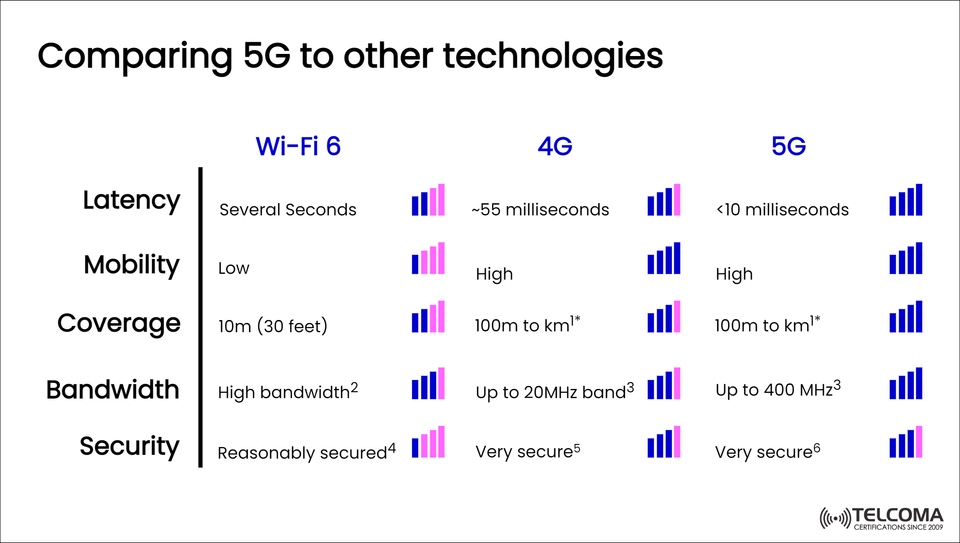
The image I've shared gives a clear side-by-side look at 5G, 4G, and Wi-Fi 6, focusing on key performance aspects like latency, mobility, coverage, bandwidth, and security. This blog dives into each area, making it easier for tech fans, telecom experts, and businesses to figure out what they really need.
Latency: Speed of Response
Wi-Fi 6: Can take several seconds (it really depends on traffic and interference). It works well for home or office but isn’t suited for real-time industrial tasks.
4G LTE: Average response time is around ~55 milliseconds. It’s decent for mobile browsing, streaming videos, and making calls.
5G: Less than 10 milliseconds—that’s what makes it great for real-time experiences like AR/VR, self-driving cars, and crucial IoT applications.
Key Insight: 5G really cuts down the response time, which makes it the top choice for applications where every millisecond counts.
Mobility: Staying Connected on the Move
Wi-Fi 6: Not very mobile; it's mainly designed for fixed spaces like homes, offices, or hotspots.
4G: High mobility support with smooth transitions, great for people on the go.
5G: Matches or even beats 4G in mobility, keeping you connected at high speeds whether you’re in a train, car, or plane.
Key Insight: When it comes to mobility, both 5G and 4G shine, while Wi-Fi 6 is better for stationary use.
Coverage: How Far Can They Reach?
Wi-Fi 6: Has a range of up to 10 meters (30 feet) indoors, but walls and other interferences can cut that down.
4G: Offers a wide coverage area, from 100 meters to several kilometers.
5G: Similar to 4G (100 meters to kilometers), though it varies by frequency:
Low-band 5G: Offers long-range similar to 4G.
Mid-band 5G: Balances coverage and speed.
High-band (mmWave): Super-fast but limited to a few hundred meters.
Key Insight: Both 4G and 5G are great for covering large outdoor areas, while Wi-Fi 6 is mostly for indoor settings.
Bandwidth: Capacity for Data
Wi-Fi 6: Delivers high bandwidth in a small area, perfect for connecting many devices in crowded spaces.
4G: Supports bandwidth of up to 20 MHz per channel. Good for mobile data but doesn’t compare to 5G.
5G: Can reach up to 400 MHz, allowing for multi-gigabit speeds and huge IoT networks.
Key Insight: 5G beats both Wi-Fi 6 and 4G in terms of bandwidth, making it the best choice for smart cities and advanced systems.
Security: Protecting Data
Wi-Fi 6: Generally considered reasonably secure, especially with WPA3 encryption, but can be risky if not set up right.
4G: Offers very secure connections with SIM-based authentication and strong encryption.
5G: Very secure, building on 4G’s protections with better algorithms, more privacy features, and things like SUCI (Subscription Concealed Identifier) to protect identities.
When to Use 5G, 4G, or Wi-Fi 6
Wi-Fi 6:
Best for homes, offices, and indoor settings where multiple devices need fast internet over short distances.
4G LTE:
Remains a solid option for wide coverage and general mobile needs. It's still crucial in areas without 5G.
5G:
Perfect for next-gen applications like:
Autonomous vehicles
Industrial IoT
Remote surgeries and healthcare
Augmented & Virtual Reality (AR/VR)
Smart cities and massive machine communications
Why 5G Stands Out
5G isn’t just an upgrade from 4G—it’s a complete game-changer. By merging ultra-low latency, massive bandwidth, and enhanced security, it opens up entirely new possibilities that neither 4G nor Wi-Fi 6 can provide on their own.
While Wi-Fi 6 does great indoors and 4G still covers a lot of ground, 5G bridges the gap between mobility, scale, and speed—making it the most promising technology for the future.
In-Depth Look: Comparing 5G, 4G, and Wi-Fi 6
In the first part of this blog, we went through a clear side-by-side technical comparison. Now, let’s explore more about what these technologies mean for the industry, how they’re being deployed, and what the future might hold.
- Latency in Action: Why It Matters
Latency isn’t just a number—it really shapes what's possible.
With Wi-Fi 6, latency can stretch to several seconds, which is fine for browsing, streaming, and regular office tasks. But it just doesn’t cut it in mission-critical situations like industrial automation, healthcare, or connected transport.
4G latency, around 55 ms, is a step in the right direction but still not enough for things like remote machinery, autonomous driving, or telesurgery.
5G latency, under 10 ms, opens the door for real-time interactivity, which is crucial for things like: * AR/VR experiences (you want that immersive experience without delays) * Remote robotics in manufacturing or healthcare * Connected vehicles needing instant responses for safety
- Mobility: Beyond Smartphones
Wi-Fi 6 struggles with seamless mobility. When you move from one access point to another, you’ll often experience drops, making it not great for mobile-first scenarios.
4G and 5G are built for high-speed mobility, enabling things like: * Continuous video streaming while on the go * Vehicle-to-infrastructure (V2I) communication * High-speed train connectivity
Conclusion
Looking at 5G, 4G, and Wi-Fi 6, it’s clear:
Wi-Fi 6 is best for local, indoor use.
4G is still important for wide coverage and mobile connectivity.
5G is a step ahead, offering unmatched latency, mobility, bandwidth, and security for the next wave of digital services.
For telecom experts, embracing 5G is all about gearing up for a world where autonomous systems, smart cities, and instant applications are just the norm.