
Conventional Array vs Beamforming Array | Antenna Technology in 5G

The rapid increase in wireless data traffic has really pushed antenna technology to evolve in the latest communication systems. Antenna arrays that worked fine for 2G, 3G, and parts of 4G are now struggling to keep up with the demands of 5G networks and beyond.
That's where beamforming antenna arrays come in. They smartly direct radio signals to specific users or devices, which brings a bunch of benefits over traditional arrays, like better signal strength, less interference, and more efficient use of the spectrum.
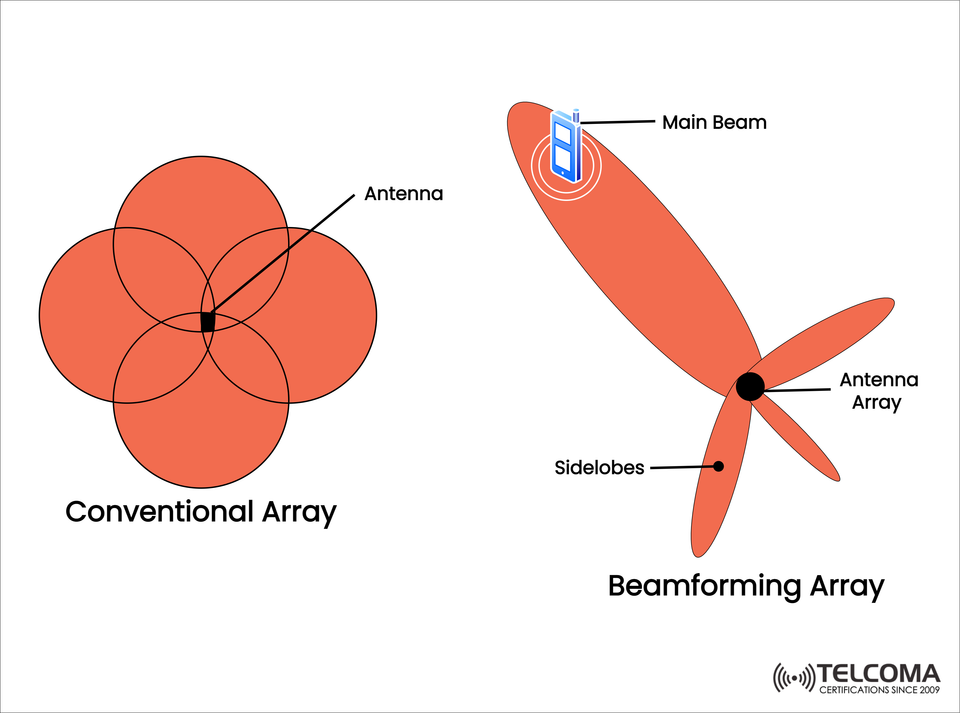
Take a look at the image uploaded; it clearly shows the difference. Conventional arrays spread signals across broad, overlapping patterns, while beamforming arrays focus their main beams, reducing energy wastage in unwanted directions.
What’s a Conventional Antenna Array?
A conventional antenna array has several antennas that send out signals in wide, fixed radiation patterns, usually set up in sectors to cover large areas.
Key Features of Conventional Arrays:
They offer omnidirectional or sectoral coverage (like 120° or 90° sectors).
Signals spread in all directions within the sector, no matter where the user is.
Energy distribution is uniform but not very efficient.
Overlap between adjacent antennas can cause interference.
They don’t adapt well to how users move or changes in traffic demands.
While these arrays were fine for older mobile networks, they just can't keep up with today’s needs, which include handling a massive number of devices, ultra-low latency, and high reliability.
What’s a Beamforming Antenna Array?
A beamforming antenna array uses multiple antenna elements along with advanced signal processing to direct beams at specific users or locations. Instead of spreading signals across the sector, these arrays focus energy into a main beam, which enhances both efficiency and coverage.
Key Features of Beamforming Arrays:
Main Beam: Focused signals directed at the target user, ensuring stronger reception.
Sidelobes: Smaller, unintended signals with lower power that are minimized to cut down on interference.
Dynamic Steering: The beams can be adjusted electronically to follow users as they move.
Adaptive Control: The beam width and direction can be modified based on the current network conditions.
Beamforming is a crucial component of 5G NR (New Radio) and supports technologies like massive MIMO (Multiple Input Multiple Output).
Conventional Array vs. Beamforming Array
Here’s a quick comparison of the two:
Feature Conventional Array Beamforming Array Coverage Pattern Fixed, wide radiation patterns Narrow, focused beams Signal Distribution Uniform across sector Directed at specific users Efficiency Lower, with wasted energy Higher, with targeted energy use Interference Higher due to overlapping sectors Reduced by minimizing sidelobes User Adaptation Static, not user-specific Dynamic, user- and location-specific Suitability for 5GLimitedEssential for massive MIMO and 5G NR
How Beamforming Works
Beamforming takes advantage of constructive and destructive interference from signals sent by multiple antenna elements. By tweaking the phase and amplitude of these signals, the antenna array can:
Boost signals in the right direction (constructive interference).
Cancel out signals where they’re not needed (destructive interference).
This results in a directional main beam aimed at the user, while sidelobes are kept to a minimum.
Types of Beamforming:
Analog Beamforming:
Utilizes phase shifters.
Less complex, good for single-beam operations.
Digital Beamforming:
Controls beams in the digital baseband.
Can manage multiple beams at once.
Offers more flexibility but is more complex.
Hybrid Beamforming:
Combines analog and digital techniques.
Aims to balance performance with cost.
Advantages of Beamforming Arrays over Conventional Arrays
- Better Signal Quality
Beamforming focuses energy on users, which leads to a higher Signal-to-Noise Ratio (SNR) and Signal-to-Interference-plus-Noise Ratio (SINR).
- Less Interference
By narrowing beams and cutting down on sidelobes, interference from neighboring cells is minimized.
- Increased Capacity
Targeted beams make it possible for the network to reuse frequencies more effectively, boosting spectral efficiency.
- Improved Coverage
Users at the edge of the cell, who often get less service, benefit from stronger, directed beams.
- Energy Efficiency
Focusing power where it’s needed helps lower overall energy use.
- Supports Massive MIMO
Beamforming is crucial for massive MIMO, a key technology for 5G.
Practical Example
Picture a packed stadium where thousands want to access 5G services:
With conventional arrays, signals are spread out uniformly, leading to wasted energy and lots of interference.
With beamforming arrays, the antenna can create narrow beams that follow groups of users or even individual devices, ensuring efficient and reliable connections.
This setup allows the network to scale and deliver consistent high-speed experiences, even in busy environments.
Challenges of Beamforming
Even though beamforming has clear benefits, there are challenges to overcome:
Complexity: Needs advanced hardware and real-time signal processing.
Cost: Setting up large antenna arrays can be pricey.
Beam Tracking: Keeping the beams aligned with moving users requires sophisticated algorithms.
Sidelobe Management: Inadequate sidelobe suppression can still cause interference.
Despite these hurdles, beamforming is vital for the success of 5G and beyond.
Applications of Beamforming
5G Mobile Networks: Better coverage and capacity.
Satellite Communications: Enhanced link reliability.
Wi-Fi 6/7: More targeted coverage in indoor settings.
IoT and Smart Cities: Efficient management of numerous device connections.
Defense and Radar Systems: Accurate tracking and detection.
Conclusion
Moving from conventional antenna arrays to beamforming arrays represents a major change in wireless communication. While older arrays offered broad and fixed coverage suitable for past networks, they fall short of meeting today’s needs for high data rates, low latency, and dense device connectivity.
Beamforming arrays make it possible to create focused, adaptive beams that deliver:
Stronger, more reliable connections.
Efficient use of the spectrum.
Less interference.
Better coverage for users both in the center and at the edges.
For telecom professionals and engineers, grasping this shift is crucial, as beamforming forms the backbone of 5G NR and future 6G networks. It transforms antennas from simple transmitters into intelligent systems that adapt and shape the future of connectivity.