
Coordinated Multi-Point (CoMP) in 5G: Enhancing Reliability with Spatial Diversity

Why Reliability Matters in 5G
As more industries start using 5G for crucial applications—like smart factories, self-driving cars, and remote healthcare—having a reliable network becomes essential. Unlike its predecessors, 5G is expected to provide ultra-reliable low-latency communication (URLLC) with 99.999% availability to support automation and real-time tasks.
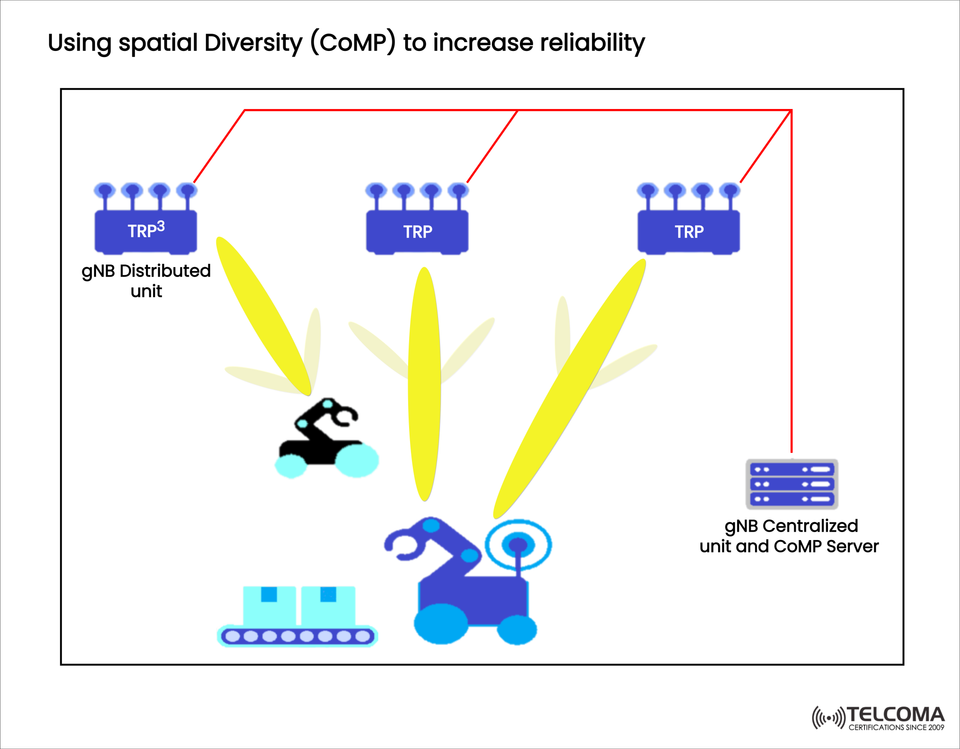
One of the best ways to achieve this is through spatial diversity with Coordinated Multi-Point (CoMP). The diagram we’ve uploaded shows how various Transmission Reception Points (TRPs) and gNodeB units work together to enhance coverage and lessen signal loss, which boosts reliability.
Understanding CoMP in 5G
Coordinated Multi-Point (CoMP) is a feature in 5G that allows several base stations or TRPs to work together to send and receive data to and from a user device. Instead of just one cell managing the communication, multiple TRPs partner up to provide a stronger and more dependable connection.
What CoMP Aims to Achieve:
Boosting reliability with backup transmission paths.
Improving spectral efficiency by cutting down interference.
Increasing throughput through simultaneous data streams.
Reducing latency for applications that require real-time responses.
Breaking Down Spatial Diversity
Spatial diversity in 5G uses multiple TRPs spread across different locations to connect with the same user equipment (UE). So, if one transmission path is affected by fading, shadowing, or interference, the other paths can step in to help out.
In the diagram:
Several TRPs (antennas) are shown sending signals to robotic equipment in a factory.
A gNB Distributed Unit (DU) oversees the TRPs at the edge.
A gNB Centralized Unit (CU) with CoMP server manages the transmissions.
This setup guarantees constant and reliable connectivity for time-sensitive industrial tasks.
How CoMP Works in Real Life
Signal Coordination: The CoMP server reviews radio conditions to figure out the best TRPs to serve a device at the same time.
Joint Transmission (JT): Multiple TRPs transmit the same data stream to the UE, which enhances reliability.
Dynamic Point Selection (DPS): The system picks the best TRP to use for transmission in real-time.
Coordinated Scheduling/Beamforming (CS/CB): TRPs align their transmission schedules and beamforming patterns to reduce interference.
Advantages of Spatial Diversity (CoMP) in 5G
- Reliability in Tough Settings
Ensures steady connections in factories where metal structures can mess with signals.
Provides strong links for autonomous guided vehicles (AGVs) and robotic arms.
- Less Interference
TRPs work together to eliminate co-channel interference.
Especially beneficial in crowded urban areas or indoor industrial environments.
- Increased Throughput
Devices can pull data from multiple TRPs, ramping up capacity.
Supports seamless connections for AR/VR, teleoperation, and high-definition streaming.
- Ultra-Low Latency
Multiple coordinated TRPs cut down on retransmissions.
This is vital for URLLC applications like remote surgeries or collaborative robots (cobots).
CoMP Applications Across Different Sectors
Smart Manufacturing (Industry 4.0)
Robots, conveyor systems, and automation rely on stable, low-latency 5G connections.
CoMP guarantees steady control signals, preventing costly downtimes.
Autonomous Vehicles & Logistics
Keeps vehicles connected as they move between TRPs.
Helps avoid handover failures in ports, warehouses, and smart cities.
Healthcare
Assists with AR-aided surgeries and remote patient monitoring.
Reliability is crucial for life-saving procedures.
Energy & Utilities
CoMP enhances coverage in power plants, oil rigs, and remote locations.
Helps prevent communication failures during emergencies.
Challenges in Implementing CoMP
Even though CoMP brings great advantages, deploying it comes with challenges:
Backhaul Capacity: TRPs need to transfer large amounts of data to the centralized CoMP server.
Synchronization: Precise time and phase syncing are critical between TRPs.
Processing Overhead: Coordinated scheduling demands a considerable amount of computing power.
Cost & Complexity: More infrastructure and sophisticated algorithms are necessary.
Comparing Transmission Methods in CoMP
CoMP Technique Description Benefit Use Case Joint Transmission (JT)Multiple TRPs transmit the same data at once High reliability URLLC in factories Dynamic Point Selection (DPS)TRP chosen dynamically for each time slot Efficiency & adaptability Mobile logistics hubs Coordinated Scheduling (CS)TRPs schedule to dodge interference Spectrum efficiency Dense urban coverage Coordinated Beamforming (CB)TRPs align beams to minimize interference Better SINR Campus & stadium networks
What This Means for Telecom Professionals
For telecom engineers and experts, CoMP is more than just a feature—it's a strategic advantage for industrial 5G.
Operators can position CoMP-enabled 5G as a unique selling point for mission-critical sectors.
Enterprises should consider CoMP when setting up private 5G networks in manufacturing or logistics.
Vendors need to create radios and baseband units that are optimized for synchronization and backhaul requirements.
Final Thoughts
5G is about more than just speed—it’s about reliability and resilience. With spatial diversity through CoMP, devices can stay connected even in tough conditions. By coordinating TRPs and utilizing advanced techniques like Joint Transmission and Dynamic Point Selection, CoMP turns ultra-reliable low-latency communication (URLLC) into a reality.
For factories, self-driving transport, healthcare, and critical infrastructure, CoMP acts as a bridge between 5G’s potential and practical reliability. Those in the telecom field who embrace this technology will lead the charge in Industry 4.0 and beyond.