
CORD Architecture Explained: Cloud-Native Transformation for Access Networks

What is CORD?
CORD (Central Office Re-architected as a Datacenter) is an open source project that brings data center economics and cloud agility to the telecom central office. CORD combines SDN Souce-Defined Networking), NFV (Network Functions Virtualization), and cloud native principles to enable service providers to deliver next-generation services to mobile, enterprise, and residential networks.
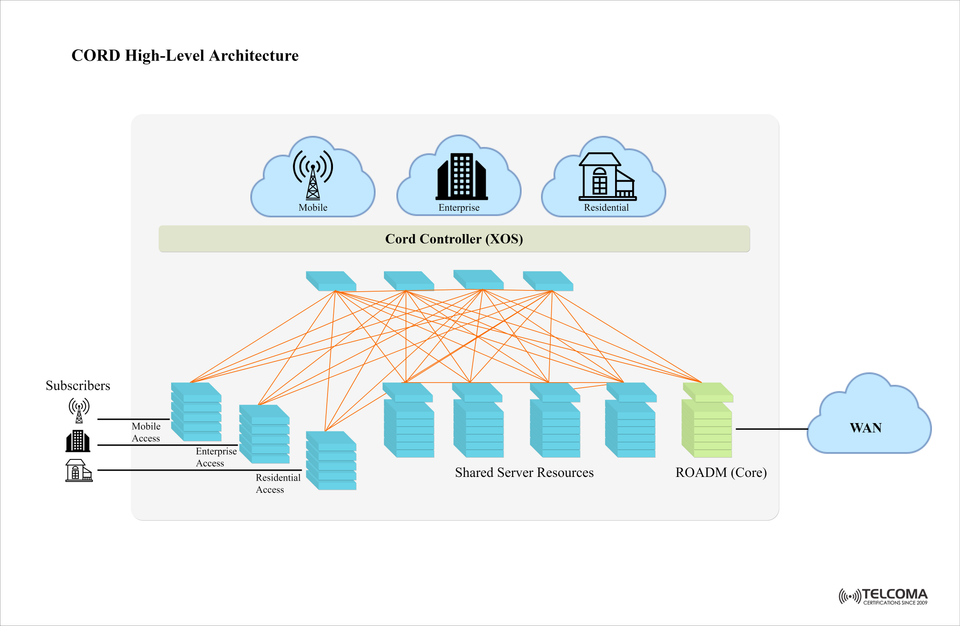
In the diagram, we see how the CORD architecture virtualizes traditional access networks, giving Network Operators cost reductions, increased agility, and rapid service deployment.
Main Components of CORD Architecture
In the image, the architecture can be broken down into many layers and the components are:
- Subscriber Access Points
Mobile Access – connectivity into cellular users (i.e. phones).
Enterprise Access – faster access for large businesses.
Residential Access – broadband or fiber connections into houses.
These are all ingress points into the CORD system from user devices and user networks.
- CORD Controller (XOS)
Service orchestrator for CORD.
Manages the lifecycle of services and resources.
Abstracts physical resources and virtual resources to create services.
- Shared Server Capacity: The shared server capacity is the essence of the virtualized infrastructure and consists of:
i. White box servers: Affordable hardware that can directly replace vendor proprietary telco gear.
ii. Virtualized Network Functions (VNFs): Software-based implementations of traditional telco operations.
iii. Containers and microservices: Scalable agile service development.
These interconnected servers perform all processing and delivery for services through a software defined network (SDN) controlled fabric that allows great flexibility and performance.
- ROADM (Core): Reconfigurable Optical Add-Drop Multiplexer: Aggregates the local access network to the Wide Area Network (WAN), supports dynamic and wavelength based switching, and facilitates easy access to larger relatively seamless optical transport metro and core networks.
CORD Service Domains
Domain Description
Mobile-CORD (M-CORD) Designed for support of 5G, includes, vRAN, MEC, and network slicing capabilities.
Enterprise-CORD (E-CORD) Programmable enterprise services such as VPNs and SD-WAN.
Residential-CORD (R-CORD) Legacy BNG replacement with virtual OLT's and virtual subscriber management system.
Benefits of CORD deployment:
✅ Cost savings: By using commodity hardware and open source software.
✅ Agility of services: Overall faster delivery of new investments and marketable features using microservices.
✅ Scalability: Capacity is elastically scaled via cloud-native orchestration.
✅ Open Innovation: More opportunity for vendor diversity and collaboration with the ecosystem.
✅ Improved User Experience: Intelligent traffic steering, service personalization, etc.
How CORD Fits Into The Telecom Future
CORD is not simply a way to reduce costs - it is a model for next generation telco infrastructure and is perfectly suited for:
5G rollouts
Edge computing
Network slicing
SDN/NFV deployment
Open disaggregated networks
Telecoms that deploy in CORD can move from a monolithic, hardware-centric, network to a complete virtualization, service-based ecosystem.
Conclusion: Why CORD Is Important
The high level architecture of CORD is an indication of a fundamental change in the telecom industry - moving from static, proprietary infrastructure, to cloud-native, service-rich platforms. Key characteristics of CORD that guide telecom related to decoupling and CAPEX/Opex include, centralized orchestration hosting on shared server resources, and integration with SDN/NFV. Together these allow telecom providers to innovate quickly, scale easily, and compete in a cloud-native world.
As demand increases for flexible and high-performance access networks, telecom and service providers must integrate architectures like CORD into their strategy and operations - it is no longer an option but a must.
Exciting Capabilities Enabled by CORD
CORD architecture is not just about virtualization - it is an enabler of entirely new capabilities that traditional central office designs would not support.
🔧 Dynamic Service Chaining
Dynamic Service Chaining allows for custom service chain creation in real-time based on existing user profile and/or application requirements.
Example: A parental control VNF might be used to route the traffic of a residential user while an enterprise user's traffic might be routed without a parental control element.
⚙️ Programmable Network Behavior
SDN-enabled fabric can reconfigure its data plane automatically.
Network operators can define intent-based policies for traffic management without modifying physical hardware.
☁️ Multi-Tenancy Support
Shared resources are logically separated to serve multiple customers.
Perfect for wholesale providers or mobile network operators (MNOs) that sell B2B services on a shared platform.
CORD for the Edge Computing Paradigm
As 5G and IoT expand, and processing moves closer to the user (edge computing), CORD can serve as the perfect edge platform because:
It combines multiple access network functions within a cloud-native edge site.
As edge workload applications such as AR/VR, gaming, and autonomous vehicles treat latency as a negative round trip, prioritizing local workloads with local services becomes critical.
CORD's programmable capability allows for edge workloads with less human orchestration.
Obstacles to Deployment
Even with the myriad advantages of CORD, deployment is not without some challenges:
Challenge Description
Integration Complexity Some legacy systems may not play well with an open, cloud-native platform.
Skillset Gap Requires knowledge in networking, cloud, and DevOps.
Ecosystem Maturity While open-source components are emerging, many may not yet reach carrier-grade.
Operational Overhead Moving from legacy to virtualized, and changing culture and processes.
Use Cases that are Fuelling CORD Adoption
Here are some key use cases that are driving telco adoption of the CORD framework:
5G-ready Access Networks: M-CORD supports disaggregation of vRAN and integration of MEC and UPF components.
Virtualized BNG for Residential Subscribers: R-CORD achieves this by replacing the heavyweight hardware BNGs with agile, programmable vBNG.
Secure, Programmable Enterprise WAN: E-CORD enables SLA-based connectivity with customizable security services.
Final Thoughts: The Future of Access Networks is CORD
The telecom landscape is going through a transformation at an unprecedented rate. As bandwidth demand is exploding and the services left and right have become more cloud centric in design, networks must also adapt. CORD provides the disruption and transformation for access networks that marries the individual flexibility of the cloud with the performance demands of telecom.
When operators embrace CORD, it will allow them to:
Innovate quickly
Reduce OPEX and CAPEX
Create customized next generation services
It is not just an upgrade, it’s the business direction towards software-defined and service-centric networks.