
CORD Implementation of RAN and Mobile Core: Architecture Explained

Why CORD is Important for 5G
Telecom companies are revamping their networks to tackle the growing demands for scalability, flexibility, and efficiency that come with 5G. The classic hardware-based setups can be really expensive and inflexible. That’s where CORD (Central Office Re-architected as a Datacenter) steps in.
CORD introduces cloud and datacenter design ideas into telecom central offices, enabling operators to:
Break down hardware and software into separate components.
Launch network functions as virtualized services.
Facilitate flexible, software-defined RAN and mobile core setups.
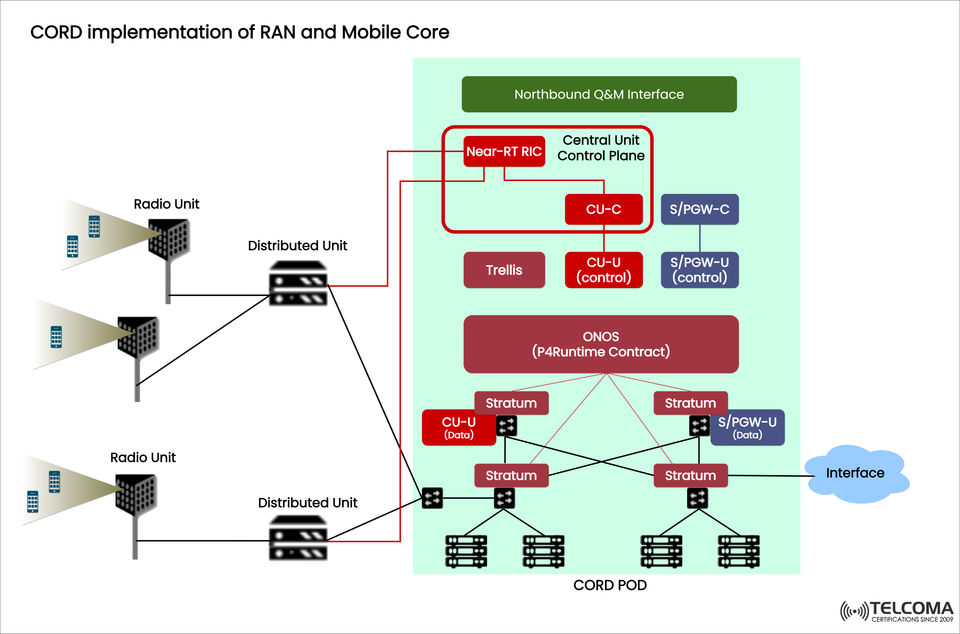
The diagram above shows how CORD combines RAN (Radio Access Network) and the mobile core, integrating distributed radio units, central units, and control functions within a single cloud-native framework.
Grasping RAN in CORD
The Radio Access Network (RAN) is the initial point of contact for user devices (UEs). In a CORD-based RAN, the layout adheres to the O-RAN Alliance principle of CU/DU/RU split:
Radio Unit (RU): Manages the conversion between analog and digital signals along with RF transmission.
Distributed Unit (DU): Takes care of real-time Layer 1 and Layer 2 functions closer to the RU.
Central Unit (CU): Handles centralized, non-real-time RAN functions (Layer 3 and higher Layer 2).
With CORD, the RUs and DUs are placed near the users, while the CU is part of the CORD POD (cloud-based datacenter) for streamlined management.
The CU/DU Split in CORD Architecture
A standout innovation in 5G RAN is the separation of CU and DU:
CU-CP (Control Plane): Manages control signaling for mobility, session setups, and policy enforcement.
CU-UP (User Plane): Deals with user data traffic to ensure efficient throughput and scalability.
In the CORD framework:
CU-C (Central Unit - Control) is cloud-based, working with the Near-RT RIC (Near-Real-Time RAN Intelligent Controller) for optimization based on policies.
CU-U (Central Unit - User Plane) is spread across Stratum switches, directing user traffic through the core.
This division leads to greater scalability, cost-effectiveness, and simpler implementation of network slices.
Mobile Core Integration in CORD
CORD is also geared to support the mobile packet core, making it easier to transition to a virtualized and cloud-native EPC/5GC.
The diagram illustrates the division of:
S/PGW-C (Serving/Packet Gateway Control): Controls mobility and session management functions.
S/PGW-U (Serving/Packet Gateway User Plane): Manages user plane traffic forwarding.
These functions tie into the CORD POD through the ONOS (Open Network Operating System) controller, which orchestrates SDN-based operations.
The Role of ONOS and Stratum in CORD
ONOS (Open Network Operating System) is the SDN controller that oversees the programmable data plane in CORD. It implements P4Runtime contracts for detailed packet control.
Stratum, which is an open-source software for switches, enables programmable forwarding within the CORD POD. Together, ONOS and Stratum deliver:
Centralized traffic management.
Dynamic bandwidth distribution.
Effective management of CU-U and S/PGW-U data flows.
This setup brings the advantages of cloud-native networking to telecom central offices.
Northbound Q&M Interface
The Northbound Q&M (Query and Management) Interface acts as a layer for higher-level orchestration and network management apps. It provides functionality for:
Tracking RAN and core components.
Configuring based on policies.
Integrating with OSS/BSS systems.
This ensures operators have a cohesive management view across the separated RAN and core functionalities.
Advantages of CORD in RAN and Mobile Core
Implementing CORD offers several perks for operators moving to 5G:
Disaggregation: Splits hardware from software, allowing easier upgrades.
Virtualization: Network functions can be deployed as VNFs or CNFs (containers).
Programmability: Thanks to ONOS and Stratum, which allow for dynamic control.
Cost-Effectiveness: Lowers dependency on pricey proprietary hardware.
Scalability: Can handle a high number of devices and rising traffic.
Network Slicing: Simplifies the integration of multi-tenant, slice-based services.
An Example Workflow in CORD RAN + Core
A user device (UE) connects through the Radio Unit (RU).
The Distributed Unit (DU) takes care of processing at lower layers.
The Central Unit (CU-CP & CU-UP), hosted in the CORD POD, manages both control and user plane data.
ONOS + Stratum flexibly oversee forwarding throughout the programmable fabric.
S/PGW-C and S/PGW-U funnel user traffic into the wider IP network via their interfaces.
This cloud-native setup guarantees high performance, adaptability, and centralized control.
Comparing CORD with Traditional Mobile Core
Aspect | Traditional Core | CORD Implementation
Hardware Dependence: Proprietary, vendor-locked hardware | Commodity hardware + virtualization
Control Plane: Closely tied to hardware | Disaggregated, software-driven
User Plane: Centralized, less flexible | Distributed, programmable
Network Evolution: Slow upgrades, costly expansions | Agile, scalable, cloud-based
SDN/NFV Integration: Limited | Native integration with ONOS/Stratum
Looking Ahead: CORD in 6G and Beyond
As CORD is making waves in the 5G space, its importance in 6G is set to grow even more. The future of networks is going to need:
- AI-Driven Networking
Integrating CORD with AI will help in predicting traffic in real time, spotting anomalies, and creating networks that can heal themselves.
Expect the Near-RT RIC to be boosted with AI-driven policy decisions for smoother automation.
- Cloud-Edge Continuum
The way CORD is built makes it a natural fit for 6G’s edge-focused design, which means processing happens closer to where users are.
This will open doors for holographic communications, tactile internet, and huge IoT applications.
- Quantum-Safe Security
With quantum computing on the way, it’s essential for CORD to adopt post-quantum cryptography in its control and data layers.
- Comprehensive Network Slicing
By the time we hit 6G, slices will go beyond just RAN and core to include MEC and application layers as well.
CORD’s CU/DU split and SDN programmability will play a crucial role in making sure there’s real slice isolation and orchestration.
- Growing Open Ecosystems
The ONF community is broadening CORD to ensure multi-vendor interoperability.
Future CORD implementations will push for open hardware, open APIs, and open-source orchestration.
Wrap-Up
The CORD approach to RAN and Mobile Core marks a significant shift in telecom architecture. By utilizing disaggregation, virtualization, and cloud-native designs, CORD helps operators upgrade their networks, save costs, and get ready for the high demands of 5G and beyond.
With ONOS, Stratum, CU/DU split, and SDN-driven orchestration, CORD brings the agility, scalability, and efficiency necessary for next-gen mobile networks, IoT, and edge computing.