
CP/UP Split of gNB in 5G | Control and User Plane Separation Explained
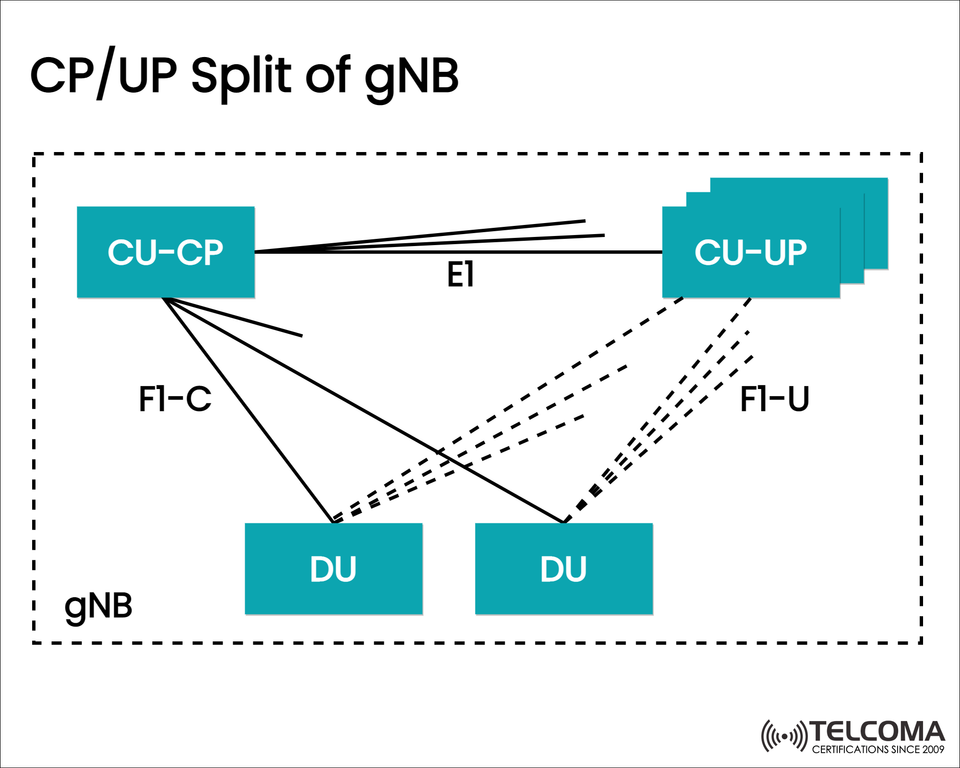

The 5G New Radio (NR) gNB architecture focuses on scalability, flexibility, and performance. A notable feature of 5G is the division between the Control Plane (CP) and User Plane (UP) functions in the gNB. This separation allows network operators to manage signaling and data traffic separately, leading to better resource use, increased scalability, and enhanced service delivery.
The diagram shared here depicts how the CU-CP (Centralized Unit - Control Plane), CU-UP (Centralized Unit - User Plane), and DU (Distributed Unit) communicate through standardized interfaces like E1, F1-C, and F1-U. In this blog, we'll break down the architecture, explore its benefits, use cases, and what it means for telecom operators.
What is gNB in 5G?
In the world of 5G, the gNB is the counterpart to the eNodeB in 4G LTE. Its responsibilities include managing the radio interface with User Equipment (UE), connecting the UE to the 5G Core (5GC), and managing both control signaling and user traffic.
To meet the scalability needs of 5G, the gNB is further divided into logical units.
CP/UP Split in gNB
The gNB is divided into three main components:
CU-CP (Centralized Unit – Control Plane)
Manages signaling, mobility, and session control.
Oversees Non-Access Stratum (NAS) signaling, radio resource control (RRC), and connection management.
CU-UP (Centralized Unit – User Plane)
Responsible for forwarding user data.
Takes care of QoS enforcement, packet routing, and encryption/decryption.
Multiple CU-UPs can link to one CU-CP to manage user traffic more effectively.
DU (Distributed Unit)
Located closer to the radio interface.
Handles lower-layer tasks like scheduling, HARQ, and real-time radio operations.
Interfaces in CP/UP Split
The diagram highlights three essential interfaces for CP/UP communication:
E1 Interface
Links the CU-CP with one or more CU-UPs.
Maintains the separation between control and user functions.
Facilitates dynamic selection and load balancing of CU-UPs.
F1-C Interface
Connects CU-CP with DUs.
Manages control-plane signaling for lower radio operations.
Enables mobility management across DUs.
F1-U Interface
Links CU-UP with DUs.
Transports user-plane data from the UE to the core network.
Guarantees that data forwarding operates independently of control signaling.
Advantages of CP/UP Split
The separation of control and user planes in the gNB architecture brings several benefits:
- Scalability
A single CU-CP can manage multiple CU-UPs, allowing user traffic to scale on its own without straining the signaling functions.
- Flexibility
Operators have the option to place CU-UPs closer to end-users (at the edge) for services that are sensitive to latency, like AR/VR or online gaming.
The CU-CP can stay centralized for easier mobility management.
- Optimized Resource Utilization
Resources can be adjusted dynamically based on traffic demands.
Services requiring high throughput can be allocated dedicated CU-UPs, while signaling remains stable.
- Improved Mobility Management
Facilitates smooth handovers between Distributed Units (DUs) since the CU-CP maintains centralized control.
CP/UP Split in Action – A Practical Example
Imagine a bustling city with tons of users streaming videos, making calls, and using IoT sensors:
The CU-CP oversees session setups, authentication, and mobility for all devices.
The CU-UPs take care of the data flow for video streams, ensuring they have high throughput and low latency.
The DUs, located near cell sites, manage real-time radio functions for smooth connectivity.
If there's a spike in video traffic in one area, new CU-UPs can be added dynamically without altering the CU-CP or signaling layer.
Comparison: CP/UP Split in 4G vs. 5G
Feature4G LTE eNodeB5G gNB with CP/UP Split Architecture Monolithic Distributed (CU-CP, CU-UP, DU) Scalability Limited High (multiple CU-UPs per CU-CP)Flexibility Fixed deployment Edge/cloud deployments are possible Mobility Handling Localized Centralized, seamless across DUs Latency Optimization Difficult Supported by CU-UP at the edge
Use Cases Enabled by CP/UP Split
Enhanced Mobile Broadband (eMBB)
Supports high-throughput applications like streaming, cloud gaming, and VR.
User plane managed by CU-UPs located closer to users.
Massive IoT (mIoT)
IoT devices need lightweight signaling with low data throughput.
CU-CP efficiently manages high volumes of signaling while CU-UPs optimize traffic flow.
Ultra-Reliable Low-Latency Communication (URLLC)
Applications like self-driving cars or remote surgery require minimal latency.
Deploy CU-UPs at the edge for ultra-fast response times.
Private 5G Networks
Businesses can allocate CU-UPs for critical services while keeping centralized CP for management.
Deployment Scenarios for Operators
Telecom operators can choose how to implement the CP/UP split based on their network needs:
Centralized Deployment: Both CU-CP and CU-UP are situated in the core network, suitable for smaller setups.
Edge Deployment: CU-UPs are installed at the edge, while CU-CP remains centralized, cutting down latency.
Hybrid Deployment: Combines centralized and edge-based CU-UPs, tailored to different service types.
This adaptability makes the CP/UP split essential for network slicing in 5G.
Challenges in CP/UP Split
While the CP/UP split has its perks, it also comes with some hurdles:
Complex Integration: Managing several CU-UPs for each CU-CP.
Synchronization: Keeping interfaces (E1, F1-C, F1-U) in sync.
Increased Signaling: Mobility events can lead to greater signaling demands on CU-CP.
Vendor Interoperability: Compatibility issues may arise in multi-vendor setups.
These challenges necessitate careful planning, monitoring, and the right orchestration tools.
Future of CP/UP Split in 6G
Looking to 6G, the CP/UP separation is set to evolve even further:
AI-Driven Control Plane: Will automate signaling and session control management.
Dynamic User Plane Allocation: Real-time deployment of CU-UPs in response to traffic spikes.
Cross-Domain Integration: Will enhance coordination across terrestrial, satellite, and other networks.
The CP/UP split will continue to be a fundamental aspect as networks progress towards hyper-connectivity and ultra-low latency.
Conclusion
The CP/UP split of gNB marks a major architectural advance in 5G, offering scalability, flexibility, and improved performance. By decoupling control signaling (CU-CP) from user data transmission (CU-UP), operators can efficiently scale services, reduce latency, and support a wide range of applications—from IoT sensors to immersive AR/VR experiences.
This split also paves the way for network slicing, edge computing, and the evolution into 6G, making it crucial knowledge for anyone in the telecom field.