
CPRI Network Explained: Architecture, Logical Connections & Role in Fronthaul

CPRI Network: How It Works and Its Role in Fronthaul
With the shift from 3G to 5G, fronthaul connectivity has become super important. At the center of this is CPRI (Common Public Radio Interface), a standard that sets the rules for how the Radio Equipment Controller (REC) talks to the Radio Equipment (RE).
This blog will break down the CPRI network structure, look at the master/slave port configuration, and highlight how logical connections make sure everything runs smoothly between the baseband unit (BBU/REC) and the remote radio units (RRU/RE).
What is CPRI?
CPRI (Common Public Radio Interface) is a standardized interface created by major telecom players to link BBUs (Baseband Units) and RRUs (Remote Radio Units) using fiber. It's designed to provide a fast, low-latency connection for sending digitized IQ samples along with control and management data between baseband and radio units.
The main goals of CPRI are:
Standardization: Making it possible for different vendors' equipment to work together.
High Capacity: Meeting the growing bandwidth needs.
Low Latency: Crucial for real-time wireless communication.
Deterministic Transport: Delivers consistent performance.
Understanding the CPRI Network Architecture
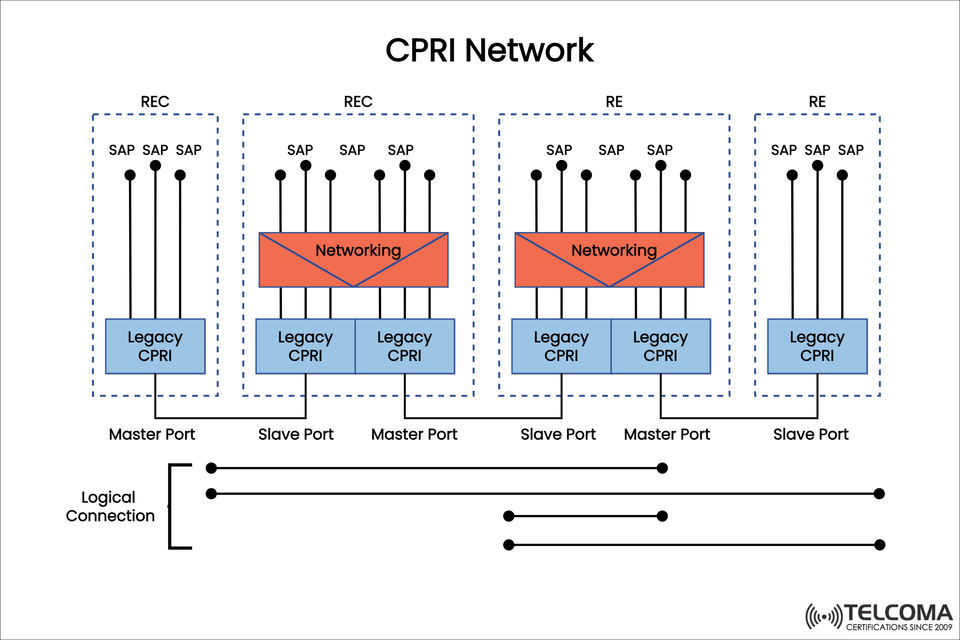
The diagram shows a CPRI network where several RECs are linked to REs through logical master-slave port connections. Here's a rundown:
REC (Radio Equipment Controller):
Also called the BBU, it's in charge of baseband processing.
It connects to multiple REs using master ports.
It might include networking gear to manage traffic across multiple CPRI links.
RE (Radio Equipment):
Commonly known as the RRU (Remote Radio Unit).
Handles RF processing, amplification, and sends signals to antennas.
Connects to the REC through slave ports.
Legacy CPRI Modules:
These are the physical interface cards that manage CPRI framing, serialization, and sync.
Networking Layer:
In today's setups, networking nodes are added to dynamically switch and route CPRI data streams, letting multiple REC–RE pairs share fronthaul resources.
Master Port and Slave Port Configuration
A key point in the diagram is the master and slave ports, which define how CPRI clocking and sync work.
Master Port:
Acts as the clock reference.
Usually found on the REC side (the BBU).
Makes sure all connected REs sync to the same clock.
Slave Port:
Gets the clock from the master port.
Located on REs to keep precise timing and frequency for RF transmission.
This setup is vital for keeping phase alignment across multiple radios, especially in advanced MIMO and Carrier Aggregation situations.
Logical Connections in a CPRI Network
The lower part of the image illustrates logical connections between master and slave ports. These links show how data streams are channeled over physical fibers:
Each line represents a logical CPRI link.
A single REC can connect to multiple REs through various logical links.
These connections route IQ data from specific sectors or carriers to the right RE for transmission.
This setup allows flexible deployment where a single REC can manage multiple RRUs spread out over a large area.
How CPRI Supports Fronthaul in RAN
CPRI is the backbone of traditional fronthaul setups. Its main jobs are:
Transporting IQ Data: Sending digitized baseband signals from REC to RE.
Synchronization: Making sure REs work in a phase-aligned way.
Management and Control: Helps with OAM (Operations, Administration, and Maintenance) messages for configuration and fault management.
Benefits of CPRI Networks
Even with new standards like eCPRI out there, CPRI is still widely used. Here are some of its perks:
Deterministic Latency: Crucial for real-time radio processing.
High Reliability: It’s proven tech that's been used in 3G, 4G, and early 5G systems.
Scalability: Can support multiple REC–RE connections in different setups like star, chain, or ring.
Vendor Interoperability: CPRI specs ensure that equipment from different vendors can work together, as long as they meet the standards.
Challenges and Limitations of Legacy CPRI
While CPRI is solid, it does have some downsides in the 5G age:
High Bandwidth Usage: CPRI takes up a lot of bandwidth since it sends raw IQ samples, which can waste fronthaul capacity.
Limited Statistical Multiplexing: Because this bandwidth is reserved, links often go underused, regardless of traffic.
High Cost: Needs dedicated dark fiber or WDM options, driving up deployment costs.
No Packetization: As a constant bit rate protocol, it doesn’t really fit into modern Ethernet-based packet networks.
CPRI vs eCPRI: The Evolution
As networks changed, eCPRI (enhanced CPRI) was developed to tackle CPRI's limitations by using Ethernet-based packet transport.
Aspect CPRI eCPRI Transport Constant Bit Rate (CBR)Packet-based (Ethernet)Bandwidth Efficiency Low High (supports IQ compression)Flexibility Limited Dynamic bandwidth allocation Cost High (dedicated fiber)Lower (shared packet networks)Scalability Moderate High, supports Cloud RAN (C-RAN)
While CPRI is still common in LTE and early 5G networks, operators are increasingly looking to move to eCPRI and packet-based fronthaul to meet the huge bandwidth demands of 5G.
Real-World Use Cases
You’ll find CPRI networks being used in:
Macro Cell Deployments: Linking centralized BBUs to distributed RRUs.
DAS (Distributed Antenna Systems): Making sure coverage is consistent in big venues.
Initial 5G NSA (Non-Standalone) Deployments: Using existing LTE fronthaul setups.
Rural Rollouts: Where fiber is accessible but bandwidth isn’t the main concern.
Conclusion
The CPRI network architecture continues to be a key part of RAN deployments, connecting RECs and REs through logical master-slave ports while ensuring precise sync and reliable IQ data transport. Even though it has challenges around scalability and bandwidth efficiency, its reliability and consistent performance make it essential in current LTE and early 5G setups.
As operators gear up for large-scale 5G rollouts, eCPRI and packet-based fronthaul will take the spotlight — but getting a grip on CPRI is still crucial for engineers working with hybrid networks that blend legacy and contemporary solutions.