
CPRI vs eCPRI: Key Differences in Fronthaul Protocols for 5G Networks
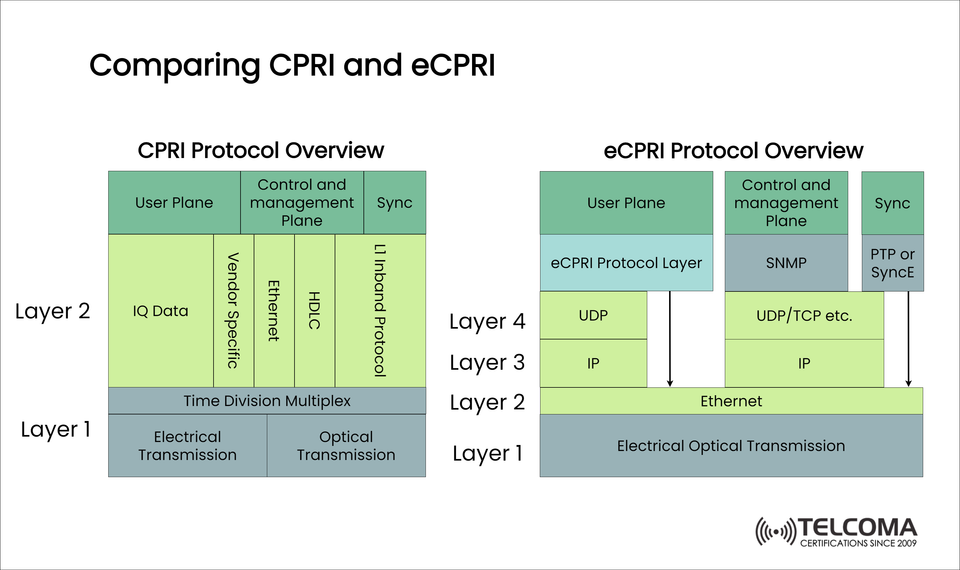

CPRI versus eCPRI: Fronthaul network protocols explained in context of modern radio access network architecture
As the mobile network ecosystem continues to evolve to accommodate 5G capabilities, it is imperative that the fronthaul—the transmission link between the radio unit (RU) and distributed unit (DU)—continues to evolve to meet growing data demands and reduce latency. CPRI (Common Public Radio Interface) and eCPRI (enhanced CPRI) have arisen as the two most widely adopted fronthaul protocols.
In this blog, using the provided image comparison of the protocols, we'll look to further discuss how CPRI and eCPRI differ in areas, such as architecture or the way they operate in terms of energy efficiency, and the relationship between the two protocols for tomorrow's 5G networks.
What is CPRI?
CPRI is a legacy standard built for 4G LTE fronthaul. It allows the carrying of I/Q (In-phase and Quadrature) data (the method of demodulating radio signals to allow them to interface with the DU) in a point-to-point optical fiber link using time-division multiplexing (TDM) to account for bandwidth and latency requirements.
Key Aspects:
Transport Type: Time Division Multiplexing
Layer 2 Payload: I/Q data (user plane), vendor-specific protocols, HDLC, Ethernet
Synchronization: In-band protocol (Layer 2)
Transmission: Optical or electrical
What is eCPRI?
eCPRI is a progressive version of CPRI that allows for more flexibility using a packet-based solution and designed to be 5G-ready. It provides an efficient means to use Ethernet over IP networks and further enhances the efficiency of using CPRI with statistical multiplexing and much better scalability for the 5G landscape.
Key Aspects:
Transport Type: Packet-based over Ethernet
Layer 2-4 Stack: eCPRI protocol layer over UDP/IP
Control & Management: Simple Network Management Protocol (SNMP) over UDP.
Comparative Overview of CPRI vs. eCPRI
Comparison CPRI eCPRI
Target Technology 3G/4G LTE 5G NR+ and enhanced LTE
Transport Mode Time Division Multiplex Packet-switched Ethernet
Data Types I/Q data, control, sync I/Q data, control, sync (as packets)
Layer Stack L1: TDM, L2: Proprietary, HDLC, Ethernet L2: Ethernet, L3: IP, and L4: UDP/TCP
User Plane Fixed-rate I/Q data Flexible eCPRI protocol over UDP
Control Plane HDLC or Ethernet-based SNMP over IP
Synchronization In-band protocol (Layer 2) PTP (IEEE 1588) or SyncE
Efficiency Low- high overhead and bandwidth High- better multiplexing and lower latency
Network Type Point-to-point, fiber only Ethernet/IP network, scalable
5G Ready Limited Fully 5G capable
Layered Protocol Comparison (Ref: sketch/image)
📘CPRI Protocol Stack
Layer 1: Electrical/Optical Transmission using TDM
Layer 2: Vendor Logic, HDLC, Ethernet, I/Q data, sync using LI Inband Protocol
Planes:
User Plane: Raw IQ data
Control & Management: HDLC/Ethernet
Sync Plane: LI in-band sync
📗eCPRI Protocol Stack
Layer 1: Electrical or Optical Ethernet
Layer 2: Ethernet
Layer 3: IP
Layer 4: UDP (user/data), TCP/UDP (control), SNMP
Planes:
User Plane: eCPRI Protocol over UDP/IP
Control Plane: SNMP over TCP/UDP
Why eCPRI Matters for 5G
The introduction of high bandwidth and ultra-low-latency capabilities for 5G means eCPRI remains a vital building block due to:
📶 Scalability: Ethernet-based transport provides support for mesh and flexible topology.
💡 Efficiency: Reduces bandwidth consumption through statistical multiplexing.
⚙️ Interoperability: Uses standard IP-based based network tools, i.e. SNMP, TCP/UDP.
🕒 Timing Accuracy: Synchronizes via IEEE 1588 PTP or SyncE.
💰 Cost Reduction: Employs commercial Ethernet hardware, reducing CAPEX.
CPRI eCPRI Use Cases
Use Case Recommended Protocol
Legacy LTE deployments CPRI
5G fronthaul with higher data requirements eCPRI
Urban macro cell densification (3D) eCPRI
Private 4G/5G campus networks eCPRI
Vendor locked installations contained by CPRI only CPRI
Conclusion
For operators retrofitting RAN infrastructure to support 5G, it is important to recognize what it means to migrate from CPRI to eCPRI. CPRI has been a useful standard for the telecom space for LTE deployments, but it is moving toward a world of death while simultaneously holding LTE deployments. CPRI has limitations in scalability and efficiency, and 5G will bring data-hungry, low-latency use cases to the forefront of our expected future.
eCPRI is the naturally created evolution based on Ethernet, packet-oriented design that leaves telecom to carry next-gen networks with additional flexibility and cost efficiency. For professionals in telecom, eCPRI is not just an uplift in technology; it is the actual measure of importance in forward-thinking the business into a world of 5G.
✔️ Infrastructure Compatibility
CPRI requires point-to-point fiber connections, which can reduce flexibility and greatly increase overall costs.
Conversely, eCPRI can leverage the existing Ethernet/IP transporte infrastructure, making it the best option for cloud-native and disaggregated RAN deployments.
✔️ Latency and timing accuracy
CPRI has deterministic latency, whereas eCPRI latency requires accurate time synchronization, possibly involving mechanisms like PTP (Precision Time Protocol) or SyncE to achieve required performance levels.
This all adds additional required configuration and testing to the network.
✔️ Vendor Interoperability
CPRI connections are often vendor-specific and typically have limited interoperability between equipment vendors.
Conversely, eCPRI is an open standarized protocol that supports multi-vendor RAN ecosystems (e.g., achieved is one of the key pillars of Open RAN (O-RAN) programming).
✔️ Bandwidth utilization
CPRI is a bandwidth hog. CPRI brings raw I/Q samples with no option to manage bandwidth use.
eCPRI can have functional split options (e.g., 7.2x) whereby fronthaul bandwidth can be significantly reduced by sending only the processing parts over the transport link.
Trends in Industry Adoption
Operator Deployment Focus eCPRI Usage
Verizon (USA) mmWave 5G NR Yes — utilizing eCPRI with vRAN
Rakuten Mobile Cloud-native RAN Yes — full O-RAN with eCPRI support
Vodafone 5G Open RAN trials Yes — vendor-neutral eCPRI networks
China Mobile Massive 5G rollout Gradual migration from CPRI to eCPRI
Future Implications
🔮 eCPRI Will Become the New Normal
With 5G continuing to mature and 6G research accelerating, eCPRI is positioned to be the fronthaul protocol of choice due to:
Cost-effective scaling via Ethernet
Open architecture compatibility
Aligning with vRAN models
🧠 AI & Network Automation
With AI-based RAN orchestration (Non-RT and Near-RT RIC in O-RAN), eCPRI's flexibility and hybrid approach make it easy to deploy intelligent and dynamic resource allocation across the fronthaul.
🚀 6G Implications
As we stand up 6G networks, which will be Ultra-dense cells, AI and intelligent edge computing are emerging in early visions.
The fronthaul will likely shift into the cloud and the protocols with them to integrate with TSN and deterministic layers in IP.
Final Thoughts
Moving from CPRI to eCPRI is much more than just a protocol swap; it is a paradigm shift with respect to how RANs are built, scaled, and managed. With telecom networks becoming more cloud-like and software interfaced, eCPRI has the power to establish a protocol that is robust and/or future-proof combining open RAN principles with the 5G principles.