
CPRI vs eCPRI: Understanding Fronthaul Evolution in 5G Networks
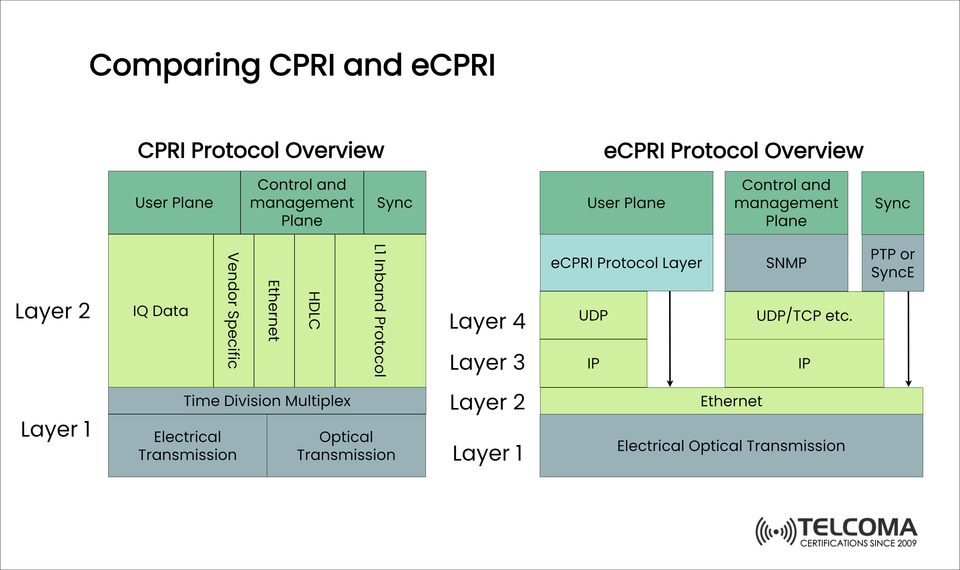

Comparing CPRI and eCPRI: The Backbone of 5G Fronthaul Communication
In today's telecom networks, fronthaul communication links the Baseband Unit (BBU) or Centralized Unit (CU) with the Remote Radio Unit (RRU). This connection is crucial for efficiently moving radio data and control info throughout the network.
Traditionally, CPRI (Common Public Radio Interface) has been the go-to standard for this link. But with the rise of 5G, the Enhanced CPRI (eCPRI) protocol has become essential in addressing the need for greater bandwidth, lower latency, and flexible deployment.
The image above does a good job of comparing CPRI and eCPRI architectures, highlighting the differences in how they are structured and function. Let’s dive into their setup and operations, and see how eCPRI is reshaping fronthaul communication for 5G.
Understanding Fronthaul in RAN Architecture
In a traditional Radio Access Network (RAN), the Baseband Unit (BBU) and Radio Unit (RU) typically sit close together. However, with the advent of Centralized RAN (C-RAN) and Open RAN, the baseband processing becomes centralized while the RUs are positioned near the antennas. The connection between these units is referred to as the fronthaul.
Fronthaul Requirements:
High data throughput for IQ samples
Low and predictable latency
Precise synchronization
Scalability to support multi-antenna (MIMO) systems
Originally, CPRI was crafted for LTE systems, but as we moved towards 5G, it became clear that a more packet-based, scalable, and flexible solution was needed, paving the way for eCPRI.
What is CPRI?
CPRI (Common Public Radio Interface) is a serial communication protocol that was standardized back in 2003 by Ericsson, Huawei, NEC, and Nokia Siemens. It was designed primarily for connecting the Radio Equipment Controller (REC) (or BBU) with the Radio Equipment (RE) (or RRU).
Key Features of CPRI:
Point-to-point interface with dedicated fiber links
Deterministic latency and high precision in synchronization
Time Division Multiplexing (TDM) structure for data transfer
Vendor-specific implementations (limited flexibility)
CPRI Architecture Overview (from the image):
Plane Function Layer User Plane Transmits IQ data between BBU and RRU Layer 2Control & Management Plane Uses Ethernet and HDLC for control signaling Layer 2Sync Plane In-band synchronization (LI protocol)Layer 2Transmission Layer TDM data over optical/electrical connections Layer 1
This setup ensures deterministic and low-latency performance, making it well-suited for LTE and 4G networks, though it has some significant drawbacks in the 5G age.
Limitations of CPRI
While it worked well for earlier network generations, CPRI struggles to meet the high-capacity and flexible fronthaul demands of 5G.
Main Drawbacks:
Bandwidth inefficiency: Transporting IQ samples takes up too much bandwidth.
High costs: Setting up and maintaining dedicated fiber links is pricey.
Inflexibility: The static TDM structure complicates scaling.
Vendor lock-in: Proprietary systems limit interoperability.
No packet network support: This restricts cloud-RAN and O-RAN integration.
These limitations led to the creation of eCPRI, which uses Ethernet and IP-based transport to create a more open and efficient fronthaul.
What is eCPRI?
eCPRI (Enhanced Common Public Radio Interface) is the next-gen fronthaul protocol, introduced by the CPRI consortium in 2017 to cater to 5G and later technologies. It moves away from the rigid TDM approach to a packet-based, Ethernet-friendly design.
Key Features of eCPRI:
Packet-based transmission utilizing Ethernet/IP/UDP
Flexible functional split between RU and DU
Reduced bandwidth needs by only sending essential data
Support for various topologies: point-to-point, point-to-multipoint, and multi-hop
Compatibility with cloud-native and O-RAN setups
eCPRI Architecture Overview (from the image):
Plane Protocol/Transport Layer User Plane eCPRI protocol layer over UDP/IPLayer 2–4Control & Management Plane SNMP over UDP/TCP/IP Layer 2–4Sync Plane PTP (Precision Time Protocol) or SyncE Layer 2–4Transmission Layer Ethernet over optical/electrical transport Layer 1
By leveraging standard Ethernet networks, eCPRI supports cost-effective, flexible, and scalable fronthaul communication.
Layer-by-Layer Comparison: CPRI vs eCPRI
Layer CPRIe CPRI Layer 1 (Physical)TDM over Fiber Ethernet over Optical/Electrical Layer 2 (Data Link)Vendor-specific or HDLC-based Ethernet-based with IP encapsulation Layer 3 (Network)N/AIP Layer 4 (Transport)N/AUDP/TCP Synchronization In-band LI protocol PTP or Sync E User Plane Raw IQ data Compressed IQ data or higher-layer info Control Plane Proprietary or HDLCSNMP over IP Scalability Limited Highly scalable (multi-hop and routing support)
Advantages of eCPRI Over CPRI
a. Bandwidth Efficiency
eCPRI sends only essential user-plane data, rather than raw IQ samples.
Cuts down fronthaul capacity needs by up to 10 times compared to CPRI.
b. Cost-Effectiveness
Takes advantage of Ethernet networks (shared infrastructure) instead of costly dedicated fiber lines.
Significantly lowers both CAPEX and OPEX.
c. Flexibility and Scalability
Offers various functional split options between DU and RU (as defined by 3GPP).
Facilitates dynamic resource allocation and cloud-based RAN implementation.
d. Multi-Vendor Interoperability
Built on open standards (Ethernet, IP, SNMP, PTP).
Eases integration with O-RAN and virtualized settings.
e. Synchronization Accuracy
Uses PTP (Precision Time Protocol) or SyncE (Synchronous Ethernet) for precise time synchronization, which is crucial for achieving 5G's sub-1 ms latency.
f. Support for Advanced Architectures
Works well with Open RAN, Cloud RAN (C-RAN), and Edge Computing frameworks.
Enables smart fronthaul management through software-defined controls.
Use Cases Enabled by eCPRI
Use CaseDescription5G New Radio (NR)Meets high bandwidth and low latency demands. Massive MIMO Handles multiple antenna streams effectively with packetized IQ transport.
**Cloud-RAN (C-RAN)Centralizes baseband pooling for better efficiency.
Network SlicingAllows flexible bandwidth allocation for different service slices.
O-RAN and vRANEases integration with open and virtualized RAN setups.
Synchronization in CPRI vs eCPRI
Getting synchronization right is vital to keep timing accuracy between distributed units in check.
CPRI: Uses Layer 1 in-band synchronization (LI protocol) tightly linked to TDM, ensuring consistent timing.
eCPRI: Employs PTP (IEEE 1588v2) or SyncE over Ethernet, providing accurate timing even in packet-based setups.
This capability allows eCPRI networks to maintain precise synchronization while taking advantage of Ethernet's scalability.
Migration from CPRI to eCPRI
As operators transition from 4G to 5G, they can move to eCPRI in stages:
Hybrid Fronthaul: Combining existing CPRI setups with new eCPRI interfaces through gateways.
Ethernet Transport Upgrade: Installing Ethernet-based switches and routers for scalable fronthaul.
Integration with O-RAN: Using eCPRI to link up with O-RU and O-DU components via open standards.
This evolutionary migration helps keep costs down and lowers risks while gearing up networks for future-proof 5G growth.
Conclusion
The transition from CPRI to eCPRI represents a significant technological advancement in RAN evolution. While CPRI served its purpose for 4G with its precise, fixed design, it just doesn’t cut it for the scalability, flexibility, and efficiency that 5G demands.
With its packetized, Ethernet-based, and open architecture, eCPRI enables telecom providers to:
Optimize fronthaul bandwidth needs
Implement cost-effective infrastructure
Gain cloud-native flexibility
Support advanced 5G applications like massive MIMO, network slicing, and O-RAN
In summary, eCPRI is shaping the future of modern, open, and intelligent 5G networks, delivering the responsiveness and efficiency that the next generation of connectivity requires.