
Cross-Carrier HARQ Retransmission in 5G NR: Enhancing Multi-Carrier Reliability

Cross-Carrier HARQ Retransmission in 5G NR: An Overview
With the rollout of 5G NR (New Radio), we've moved beyond just using a single carrier for communication. Nowadays, many networks are leveraging carrier aggregation (CA), which means they combine multiple component carriers (CCs) to boost throughput and enhance spectral efficiency.
But this change brings its own set of challenges when it comes to error handling and retransmission, especially since data can be spread over multiple carriers. That’s where Cross-Carrier HARQ Retransmission comes in — a system that allows Hybrid Automatic Repeat Request (HARQ) retransmissions to happen on a different carrier than the one that sent the original data.
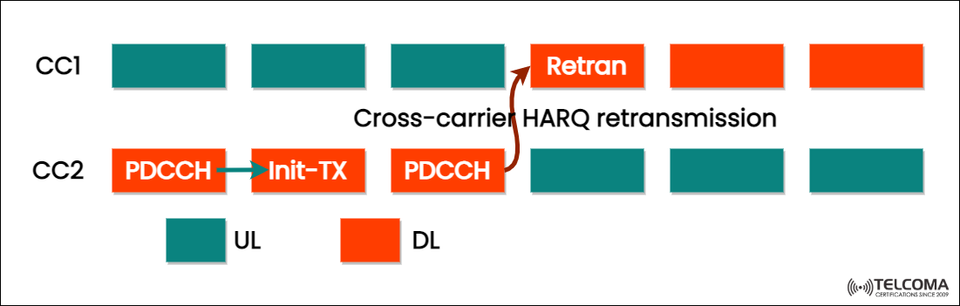
Take a look at the uploaded image; it clearly illustrates this process: there’s an initial transmission (I nit-TX) on Carrier 2 (CC2), followed by its retransmission (Ret ran) on Carrier 1 (CC1). This shows just how important cross-carrier coordination is in the 5G landscape.
Understanding the Basics: What is HARQ?
Before we dive deeper into cross-carrier operations, let’s quickly recap what HARQ actually is.
HARQ (Hybrid Automatic Repeat Request) is a fundamental part of LTE and 5G systems that ensures reliable data transmission. It pulls together two key components:
Forward Error Correction (FEC) for fixing errors.
ARQ (Automatic Repeat Request) for sending corrupted packets again.
When a User Equipment (UE) gets a data block, it checks for errors using a Cyclic Redundancy Check (CRC). If any errors pop up, the UE will send a Negative Acknowledgment (NACK) back to the gNB, asking for a retransmission. On the flip side, if everything's good, a Positive Acknowledgment (ACK) is sent instead.
This back-and-forth continues until the data is successfully delivered or the maximum number of retransmissions is reached.
Why Cross-Carrier HARQ Retransmission Is Needed
In Carrier Aggregation (CA), a UE often uses multiple component carriers (think CC1, CC2, CC3) at the same time. Each carrier can manage uplink (UL) and downlink (DL) data independently, all under the guidance of a Physical Downlink Control Channel (PDCCH).
Typically, HARQ retransmissions happen on the same carrier where the original transmission took place. But sometimes, this approach can hit performance snags:
The original carrier might get crowded.
The quality of the channel on that carrier could drop.
Scheduling or timing issues might make retransmitting on the original carrier a hassle.
With Cross-Carrier HARQ Retransmission, we can schedule retransmissions on a different carrier (like initially sending on CC2 but retrying on CC1).
This flexibility results in:
Better link reliability
More efficient resource use
Lower latency during load imbalances
Explaining the Diagram
The image from Tel coma portrays two component carriers: CC1 and CC2.
Symbol Description PDCCCH Physical Downlink Control Channel for managing transmission I nit-TX First attempt at data transmission Retran Resending the data block UL/DLU plink and Downlink time slots respectively
Sequence of Events:
The initial transmission (Init-TX) takes place on CC2, directed by the PDCCH.
The UE struggles to decode this transmission correctly.
The network’s HARQ process recognizes that a retransmission is needed.
Instead of going back to CC2, the system smartly chooses to retransmit on CC1.
The successful cross-carrier HARQ retransmission on CC1 completes the process.
This ensures that if one carrier faces issues, the system can still keep the communication strong by utilizing another carrier that's available.
How Cross-Carrier HARQ Works in 5G NR
- Control Signaling
The PDCCH specifies the HARQ process number, resource allocation, and whether it’s an initial transmission or a retransmission.
In cross-carrier HARQ, the PDCCH from one carrier can schedule data on another carrier.
This coordination requires a cross-carrier scheduling field in the DCI (Downlink Control Information).
- HARQ Process Mapping
Each UE has multiple HARQ processes (like 16 or 32). When a retransmission starts:
The scheduler can direct the retransmission to a different CC’s HARQ buffer.
The system keeps the synchronization between carriers to prevent conflicts.
- Timing and Synchronization
Retransmissions have to stick to timing guidelines between carriers. 5G NR handles this with:
Aligned subframe timing across all aggregated carriers.
Timing Advance (TA) adjustments to keep things in sync.
Advantages of Cross-Carrier HARQ Retransmission
- Enhanced Reliability
If one carrier has fading or interference, retransmitting on another carrier boosts the chances of successful reception.
- Load Balancing
This system allows for dynamic resource redistribution across carriers, ensuring a balanced load on the network and maximizing throughput.
- Reduced Latency
It helps to avoid waiting for resources on the same carrier by using free resources on a different one, thereby speeding up response times.
- Spectrum Efficiency
Operators can make smarter use of fragmented spectrum across various frequency bands.
- Seamless Multi-Band Coordination
It allows smooth transitions between low-band and mid/high-band carriers, which is crucial for broad 5G deployments.
Technical Considerations
Aspect Description Carrier Aggregation Type The type of intra-band or inter-band CA impacts how cross-carrier HARQ can work. Scheduling Mode Cross-carrier scheduling needs to be enabled. DCI Format Must include the Carrier Indicator Field (CIF) to show which carrier to use for retransmission. Timing Offset Controlled by Timing Advance and inter-carrier synchronization. UE Capability Only UEs that support multi-carrier HARQ can take advantage of this feature.
Cross-Carrier HARQ and PDCCH Coordination
The Physical Downlink Control Channel (PDCCH) is key here. In the diagram:
The first PDCCH on CC2 manages the initial transmission (I nit-TX).
Later on, another PDCCH — maybe on the same or a different carrier — prompts the retransmission (Ret ran) on CC1.
This cross-carrier control signaling allows the base station (gNB) to:
Quickly adapt to channel conditions.
Dynamically assign resources.
Keep synchronization between carriers.
Implementation Challenges
Even though it has its perks, rolling out cross-carrier HARQ retransmission can be tricky:
- HARQ Buffer Management
Each carrier has its HARQ buffers, so managing those across carriers requires some smart sharing and mapping logic.
- Timing Alignment
Different carriers, especially if they’re inter-band, might run on slightly different timing references, which calls for precise alignment.
- PDCCH Scheduling Conflicts
Multiple control channels across carriers can lead to scheduling issues that need real-time solutions.
- Increased UE Complexity
UEs need more processing power to manage multiple HARQ processes at once.
- Network Configuration Overhead
The gNB has to support adaptive cross-carrier signaling, making the control plane a bit more complex.
Real-World Use Case
Imagine a 5G smartphone using two carriers:
CC1: 3.5 GHz band (n78)
CC2: 700 MHz band (n28)
If the UE gets a packet through the higher-frequency n78 band (Init-TX) but can’t decode it due to interference, the network can send it again on the lower-frequency n28 band (Ret ran), which is less congested and has better range.
This ensures consistent service quality, especially in challenging conditions.
Comparison: Traditional vs. Cross-Carrier HARQ
Feature Traditional HARQ Cross-Carrier HARQ Retransmission Carrier Same as the initial Can be differentFlexibilityLimitedHighReliabilityMediumHighLatencyHigher (wait for the same carrier)Lower (use any available carrier)Complexity Lower Higher (requires coordination)
Benefits for Operators and Users
Operators can better manage spectrum use and balance the network.
Users enjoy smoother connections, quicker error recovery, and enhanced throughput.
For 5G networks that focus on low latency and high reliability — like URLLC (Ultra-Reliable Low-Latency Communication) or massive carrier aggregation scenarios — this function is essential.
Conclusion
Cross-Carrier HARQ Retransmission is a significant upgrade in the 5G NR multi-carrier framework. By allowing retransmissions across different carriers, it boosts reliability, optimizes resource management, and guarantees stable performance even as radio conditions change.
The diagram effectively demonstrates how an initial transmission on one carrier (CC2) can be retransmitted on another (CC1) — showcasing the adaptability and smart design that define the future of wireless communication.
As networks keep advancing with Carrier Aggregation, Dual Connectivity, and 5G-Advanced (5G-A), cross-carrier HARQ retransmission will continue to be a vital part of efficient and resilient radio operation.