
CRS, USS-1, and USS-2 Transmission in BF-PDCCH: Beamforming for Next-Gen Networks

As mobile networks are being upgraded to handle higher data speeds, lower latency, and more connections, the importance of control channels is really coming to the forefront. The Physical Downlink Control Channel (PDCCH) plays a key role in LTE and 5G, managing tasks like scheduling, power control, and HARQ signaling. But traditional broadcast methods for PDCCH end up creating some inefficiencies, especially in crowded or beamformed environments.
To tackle this issue, researchers have come up with a Beamforming-based PDCCH (BF-PDCCH) design. This method uses beam-specific transmissions for reference signals (CRS) and user-specific search spaces (USS), which boosts coverage and efficiency.
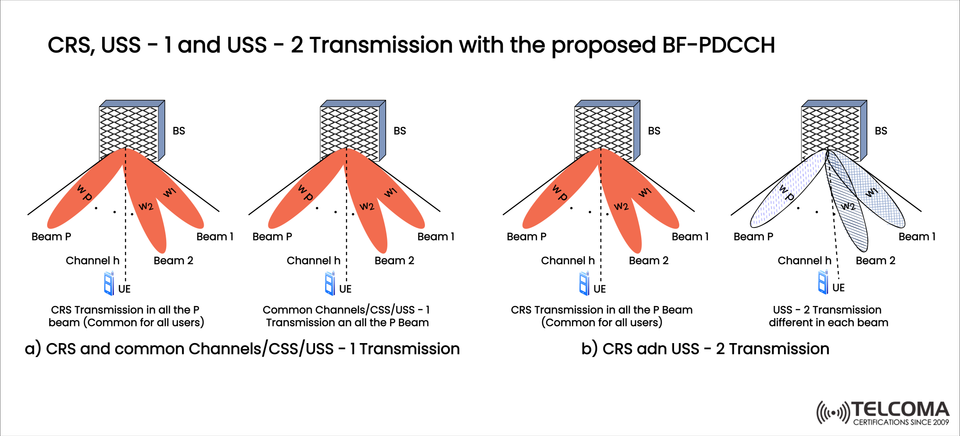
The diagram provided gives a clear view of how CRS, USS-1, and USS-2 transmissions operate within the BF-PDCCH framework. In this blog, we’ll break down each type of transmission, what it does, and how beamforming enhances PDCCH effectiveness in LTE and beyond.
Key Terminologies
Before we dive deeper, let’s clarify a few terms:
CRS (Cell-specific Reference Signal): These are reference signals available to all users, used for channel estimation.
CSS (Common Search Space): This part of PDCCH resources is where control messages for multiple users are sent.
USS (User-specific Search Space): A section of PDCCH resources dedicated to an individual user’s control signaling.
BF-PDCCH: A beamforming-based PDCCH that utilizes directional beams for improved efficiency and less interference.
Conventional CRS and PDCCH Transmission
In older LTE systems:
CRS is sent out across the entire cell, no matter where users are.
PDCCH is transmitted in all directions, which leads to a lot of overhead and less efficient use of the spectrum.
With massive MIMO and beamforming, this setup just doesn't work as well anymore because users are served through specific beams instead of blanket broadcasts.
This highlights the need for beam-centric CRS and PDCCH designs, aligning control resources with the data transmission.
CRS, USS-1, and USS-2 in BF-PDCCH
The image shows two main scenarios for control signaling under BF-PDCCH:
a) CRS and Common Channels / CSS / USS-1 Transmission
CRS Transmission: Occurs in all P-beams (pilot beams) and is available to all users for channel estimation.
Common Channels (CSS): Sent in the P-beam direction so all UEs can access system info and common scheduling grants.
USS-1 Transmission: Transmitted on the same P-beam as CRS, offers initial user-specific control but still depends on broad beam coverage.
👉 Implication:
This method ensures backward compatibility with LTE CRS/PDCCH design, while also introducing beam-awareness in USS-1 transmissions, maintaining a good balance between coverage and efficiency.
b) CRS and USS-2 Transmission
CRS Transmission: Stays common across all P-beams, ensuring global reference availability.
USS-2 Transmission: Is now beam-specific; every beam carries different USS-2 signaling. This is different from USS-1, where user-specific control relied on the common P-beam. With USS-2, each beam can independently handle user-specific control data.
👉 Implication:
Here, we see a shift toward beam-level granularity in PDCCH signaling. Users get improved reliability, reduced interference, and better alignment with beamformed data.
Comparing USS-1 vs USS-2 Transmission
AspectUSS-1 TransmissionUSS-2 Transmission Beam Association Uses P-beam (same as CRS)Beam-specific (varies across beams)Efficiency Moderate (shared beam leads to overhead)High (optimized per beam)Interference Higher, since multiple users share CRS beam Lower, as beams are separated Coverage Broad coverage across CRS beams Narrow, precise coverage per user beam Adaptability Legacy-compatible with LTE CRS/PDCCH Advanced, optimized for BF-PDCCH architecture
Benefits of BF-PDCCH with CRS, USS-1, and USS-2
Better Spectral Efficiency: Reducing unnecessary overhead by sending USS-2 only within user-specific beams.
Improved Beamforming Gains: Aligning control signaling more closely with beamformed data, which enhances SINR (Signal-to-Interference-plus-Noise Ratio).
Backward Compatibility: CRS and USS-1 modes make sure that older LTE users can still be supported as new systems come online.
Scalable Control Signaling: This supports massive MIMO and dense deployments by reusing beams more effectively.
Less Interference: The beam-specific USS-2 reduces cross-user interference that often happens with omnidirectional PDCCH transmission.
Technical Challenges
Despite its benefits, BF-PDCCH does come with its own challenges:
Beam Management Overhead: Keeping beams aligned with UE positions means needing advanced tracking algorithms.
UE Complexity: Devices have to manage beam-specific CRS and USS, which ups the complexity at the receiver end.
Inter-Beam Coordination: Needs careful management of USS-2 to prevent inter-beam interference in scenarios with multiple users.
Transitioning from Legacy LTE: Finding ways to support both CRS-based legacy control and BF-PDCCH beam-based control needs hybrid deployment strategies.
Relevance to 5G NR
The ideas shown in this image are very relevant to 5G New Radio (NR):
In 5G, CORESETs (Control Resource Sets) take the place of traditional CCEs, enabling flexible beam-specific control signaling.
Similar to USS-2, beam-level control resource mapping is crucial for 5G’s effective design.
Beamformed CRS-like reference signals in 5G (CSI-RS, SSB) reflect the shift from omnidirectional to beam-specific signaling.
So, BF-PDCCH can really be seen as a bridge between LTE’s CRS/PDCCH and 5G NR’s CORESET-based beamformed design.
Practical Use Cases
Massive MIMO Deployments: BF-PDCCH helps optimize signaling when a lot of antennas are creating narrow beams.
Dense Urban Environments: Beam-specific USS-2 gets rid of interference, improving user experience in crowded areas.
Cell-edge Users: Aligning USS transmissions with beams boosts reliability and coverage for users on the fringes.
5G Evolution Path: It serves as an evolutionary model for operators transitioning from LTE PDCCH to 5G NR CORESET.
Conclusion
The proposed BF-PDCCH design along with CRS, USS-1, and USS-2 transmission marks an important move toward more effective and beam-aware control signaling in LTE and beyond.
CRS continues to be common across beams, ensuring broad support for channel estimation.
USS-1 gives backward-compatible signaling for users that connects back to P-beams.
USS-2 introduces full beam-level granularity, perfectly aligning with advanced beamforming systems.
For telecom pros, grasping these mechanisms is key to understanding the shift from LTE’s omnidirectional PDCCH to 5G’s beam-centric CORESETs. By leveraging beamforming in control channels, networks can achieve better spectral efficiency, less interference, and greater reliability, setting the stage for the next generation of wireless communication.