
CU and DU Placement Options in 5G Networks: Centralized vs Distributed Architectures

CU and DU Placement Options in 5G Networks: Centralized vs. Distributed Architectures
As 5G keeps developing, network flexibility and performance optimization are becoming key priorities for operators. A crucial aspect of deploying the 5G Radio Access Network (RAN) is figuring out where to place the Centralized Units (CU), Distributed Units (DU), and Radio Units (RU).
The decision regarding CU/DU/RU placement affects several factors:
Cost-effectiveness of the network
Latency performance
Benefits of centralization and resource pooling
Backhaul and fronthaul needs
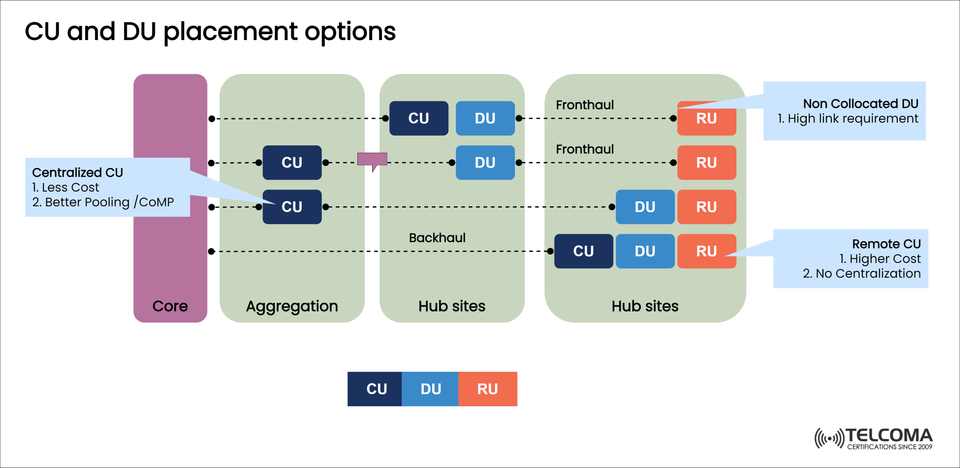
The diagram above shows various CU and DU placement strategies. Let's dive into the details, explore the trade-offs, and see how operators can make the most of these options in real-world 5G setups.
Getting to Know CU, DU, and RU in 5G RAN
5G brings a disaggregated RAN architecture, splitting the traditional baseband unit (BBU) into three parts:
CU (Centralized Unit): Handles higher-layer functions like RRC and PDCP. It can be centralized, which helps save costs and pool resources.
DU (Distributed Unit): Manages lower-layer functions (RLC, MAC, parts of PHY). Typically, it's placed closer to the RU to reduce latency.
RU (Radio Unit): Takes care of RF processing and connects to antennas. It’s always situated at the cell site for direct transmission.
This division of functions gives operators flexibility in network design, enabling them to optimize performance according to local needs.
Centralized CU Placement
In a centralized setup, the CU is positioned nearer to the core or aggregation layer, serving multiple DUs and RUs.
Benefits of Centralized CU:
Cost savings through resource pooling.
Improved performance for Coordinated Multi-Point (CoMP) operations.
Easier scalability when additional DUs/RUs are needed.
Use Cases:
Urban areas where several cell sites can share a central hub.
Operators aiming to cut operational expenses by consolidating CU resources.
Trade-offs:
Needs high-capacity backhaul to link with DUs.
Possible latency issues if it's not optimized.
DU Placement: Non-Collocated vs. Collocated
The placement of the DU determines how close the distributed processing is to the RU:
A. Non-Collocated DU
DU is separate from the RU (connected via fronthaul).
Pros: Flexible deployment and supports centralization benefits.
Cons: High fronthaul link requirement (low latency and high bandwidth).
Best for: Urban areas with plenty of fiber backhaul.
B. Collocated DU
DU is co-located with the RU.
Pros: Lower fronthaul needs and a simpler design for rural or suburban scenarios.
Cons: Reduced pooling efficiency and a larger hardware footprint across sites.
Best for: Rural or remote areas with minimal fiber backhaul.
Remote CU Deployment
Sometimes, operators decide to place the CU remotely at hub sites rather than at centralized aggregation points.
Characteristics of Remote CU:
Placed directly closer to DU/RU.
Reduces reliance on centralized pooling.
Benefits:
Cuts down latency for specific applications.
Enhances user experience for edge-driven services.
Drawbacks:
Higher costs due to the lack of pooling.
No centralization, leading to less efficient resource use.
Best for: Deployments focused on edge applications (e.g., industrial private 5G networks or ultra-low-latency scenarios).
Placement Trade-Offs: Cost, Latency, and Centralization
Here’s a summary table of CU/DU placement options:
Placement Option Pros Cons Best Fit Centralized CU Lower costs, pooling, Co MP benefits High-capacity backhaul needed Urban & metro locations Non-Collocated DU Flexibility, centralization High fronthaul requirements Fiber-rich urban areas Collocated DU Lower fronthaul needs Less pooling, more site hardware Rural/remote regions Remote CU Lower latency, edge benefits Higher costs, no pooling Private/edge 5G networks
The Importance of Fronthaul, Mid haul, and Backhaul
To really grasp CU/DU placement, you’ve got to think about the transport requirements:
Fronthaul: Connects DU to RU and is sensitive to latency and bandwidth.
Midhaul/Backhaul: Links CU to DU or CU to Core. It's more adaptable but needs scaling for a centralized CU.
When deciding between centralized and distributed CU/DU, availability and cost of fronthaul often play a big role. Operators with dense fiber infrastructure can benefit from non-collocated DU, while rural deployments often go for collocated DU.
Strategic Deployment Scenarios
Urban 5G Networks
Centralized CU + non-collocated DU for efficiency and pooling.
Relies on high-speed fiber backhaul.
Suburban Deployments
Combination of centralized CU and collocated DU.
Aims to strike a balance between cost and fronthaul limitations.
Rural Rollouts
Collocated DU with RU due to limited fiber infrastructure.
Simpler, less centralized setup, but requires more hardware spread out.
Private 5G / Industrial Networks
Remote CU placement at the edge.
Facilitates ultra-low-latency applications, such as automation and AR/VR.
Future Outlook: Moving Towards Cloud-Native RAN
The trend in CU and DU placement is heading toward Cloud RAN (C-RAN) and Open RAN architectures, where:
CU and DU functions become virtualized, running on standard off-the-shelf (COTS) servers.
Operators can place CU/DU functions more flexibly in centralized data centers, edge sites, or on-premise enterprise networks.
AI/ML-driven RAN orchestration will dynamically determine the best CU/DU placements based on traffic demand and latency.
Conclusion
Choosing the right CU and DU placement is a vital decision in 5G network design, significantly affecting cost, latency, scalability, and service quality.
Centralized CU provides pooling and efficiency, which works well for urban areas.
Non-collocated DU offers flexibility but relies on robust fronthaul.
Collocated DU is easier for rural rollouts.
Remote CU fits edge-centric applications even though it's pricier.
As 5G evolves towards cloud-native and open RAN, the strategies for placement will become more dynamic and responsive, meeting the diverse needs of IoT, enterprise 5G, and consumer broadband.
In the end, the ideal CU/DU strategy hinges on geography, infrastructure availability, and operator objectives—finding the right balance between cost, performance, and scalability in the 5G age.