
CU and DU Virtualization in Open RAN: Cloud-Native Infrastructure for Scalable 5G Networks

Introduction: Transitioning to Cloud-Native 5G
As telecommunication networks adapt to increasingly demanding ultra-fast, low-latency scalable 5G services, cloud-native architectures will be vital. At the heart of this transition is the virtualization of Centralized Units (CU) and Distributed Units (DU) - the decoupling of software from hardware to deploy in flexible, software-driven environments using Open RAN standards.
This blog post will review the critical elements of CU/DU virtualization; how to integrate with the cloud; and how Open RAN interfaces are changing how we will design our radio access networks for 5G and beyond.
🧱 Introduction CU-CP, CU-UP and DU Virtualization
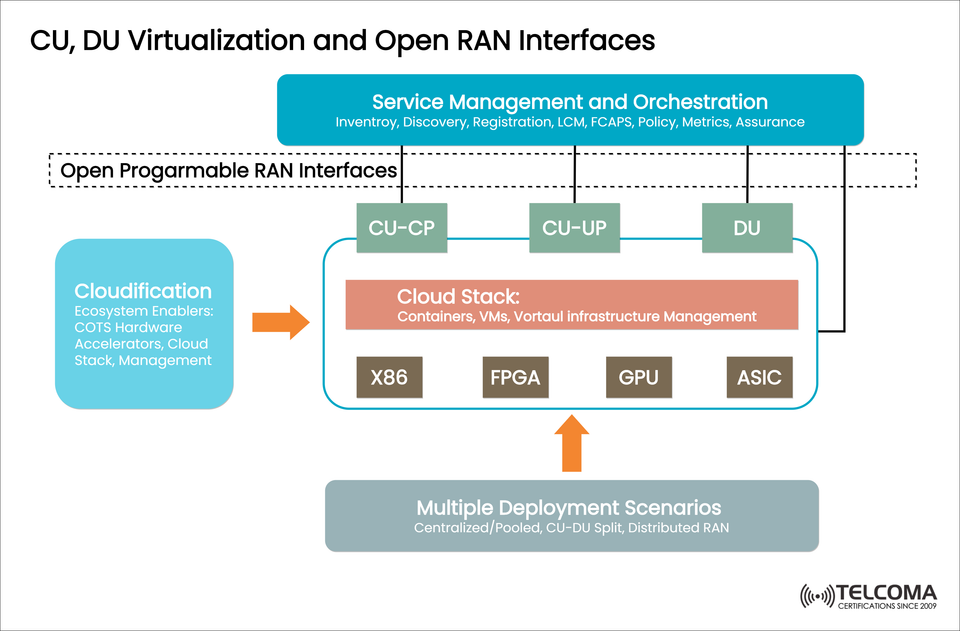
In a disaggregated RAN 5G solution, we see a separation of functions into:
CU-CP (Centralized Unit-Control Plane): Completes RRC and all signaling proceedings.
CU-UP (Centralized Unit - User Plane): Completes all user data traffic.
DU (Distributed Unit): Completes lower layer functions (RLC/MAC/PHY).
These units can then be virtualized, with the ability to host in cloud environments, either on general-purpose, or specialized hardware platforms including:
🖥️ x86 - Very economical and used broadly,
🚀 GPU - Accelerated or AI/ML driven functions.
⚙️ FPGA - Reconfigurable, and optimized for low-latency workloads.
🧠 ASIC - High-performance, custom-designed hardware.
☁️ Clouding RAN: Building a Virtual Infrastructure Stack
The virtualization of functions like the CU/DU is enabled through a cloud stack that consists of the following:
Containers and VMs
Virtual Infrastructure Management (VIM)
Orchestration platform for lifecycle management and resource
Cloudification enables network functions to be deployed, scaled and managed as cloud applications - bringing agility and resource efficiency.
🔑 Ecosystem Enablers
COTS Hardware
Network Function Virtualization (NFV)
Kubernetes and OpenStack
Automation and AI/ML integration
🔌 Open RAN Interfaces: Enabling Interoperability
The graphic demonstrates Open Programmable RAN Interfaces which are critical to enabling multi-vendor interoperability and modularity of architecture. Open RAN Interfaces standardize communications capabilities between RAN components, thus ensuring:
🧩 Vendor-neutral integration of CU, DU and RIC
🔍 More visibility through service analytics
🧠 Intelligent Control at the RIC level
📊 Service Management & Orchestration (SMO)
The service management and orchestration (SMO) layer is responsible for end-to-end orchestration across the disaggregated RAN and provides:
✅ Inventory and Discovery
✅ Lifecycle management (LCM)
✅ Enforcement of policies and ending FCAPS (Fault, Configuration, Accounting, Performance, Security)
✅ Metrics and assurance of SLA
This is critical to providing consistent service performance across distributed RAN deployments.
Deployment Scenarios for Virtualized RAN
Virtualized CU and DU components can enable different deployment models according to operator requirements:
Deployment Model Description
Centralized CU-DU CU and DU are co-located at centralized sites
Split CU-DU CU hosted in core cloud, DU at the edge sites
Distributed RAN All components are distributed at the edge nodes (DU at the edge)
Pooled CU Shared CU functions for multiple DUs
The flexibility of the virtualized architecture allows for network slicing, multi-access edge computing integration and scaling based on demand.
Conclusion
The virtualization of CU and DU using cloud-native approaches, COTS hardware and Open RAN interfaces is changing how 5G networks are constructed and operated. It enables agility, reduced operational costs, and the opportunity to deploy a truly multi-vendor, scalable, and intelligent RAN.
As telecom operators, globally, are getting ready for 6G and densified 5G services, moving to a cloudified Open RAN architecture is more than just an option, it's a necessity.
Summary Table
Component Function Virtualized On
CU-CP Control Plane (RRC, signaling) x86, GPU, FPGA, ASIC
CU-UP User Plane (GTP-U, packet forwarding) x86, GPU, FPGA, ASIC
DU RLC, MAC, PHY Layer 1 x86, GPU, FPGA, ASIC
SMO Lifecycle & Performance Management Cloud-native platforms
Interfaces Open and Programmable APIs for RAN O-RAN, based on 3GPP alignment.
🌍 The Importance of CU/DU Virtualization in a Changing Industry
The industry surrounding telecommunications, or telecom, is experiencing a shift from proprietary hardware-defined networks, to open software defined infrastructure. CU and DU virtualization are a crucial right now for multiple reasons:
📈 Industry Drivers:
- 5G Scalability: High user density, throughput, ultra low latency.
- Cost: Decreased CAPEX/OPEX by buying commercial off the shelf COTS instead of custom hardware.
- Agility / Automation: Time to market with accelerating containers and CI/CD pipelines.
- Vendor Diversity: Open RAN interfaces decrease vendor lock-in and establish good competition.
- Edge Awareness: This supports Mobile Edge Computing (MEC) and low latency apps for AR/VR, autonomous vehicles and smart cities.
🧪 Use Cases and Deployments
Many Tier-1 telecom operators and vendors are already implementing CU/DU virtualization with Open RAN principles. Here is how its being deployed:
📍 Use Case 1: Rakuten Mobile (Japan)
- Fully virtualized RAN with full cloud-native architecture.
Overlaying CU / DU split with open RAN interfaces for scale and multi vendor integration.
📍 Use Case 2: Dish Wireless (USA)
- Deployed a 5G standalone core using CU/DU virtualization on AWS cloud.
- Uses open RAN interfaces on each of the multiples layers in DAN.
🔍 Use Case 3: Telefonica & Vodafone (Europe)
Looking at Open RAN in the context of pilot projects under rural and urban deployments.
Focuses on cost savings, network diversity, and network intelligence.
🧠 AI / ML into the Cloudified RAN
Virtualised centralised units (CUs) and distributed units (DUs), allow for an environment where AI/ML-optimized networks can be deployed, expect:
🔍 Self-Organizing Networks (SON)
📊 Predictive maintenance
🔄 Automated scaling of resources
🧠 Dynamic traffic steering
AI capabilities can be integrated through RAN Intelligent Controller (RIC) capabilities, that are accessible through Open Interfaces exposing RAN KPIs and knobs for control.
🛠️ Challenges/Considerations
The advantages of Deploying Open RAN are immense but operators should consider:
Latency considerations: Especially for Layer 1 functions on generic hardware.
Interoperability: Supporting multi-vendor one network and making it seamless.
Security: More attack surface with more vendors, especially in virtualized environments.
Skillshift: Need for upskilling telecom engineers to support migration to cloud-native environments.
🔚 Final Remarks
CU/DU virtualization and Open RAN interfaces are not only an improvement in a delivery model, it is a re-thinking of building, deploying, and evolving networks. And as 5G is established and plans for 6G are being drawn, these technologies will allow operators to build a programmable, intelligent, autonomous radio access infrastructure.