
CU Virtualization Architecture in 5G: Control and User Plane Separation Using Containers

🧠 CU Virtualization Architecture in 5G Networks
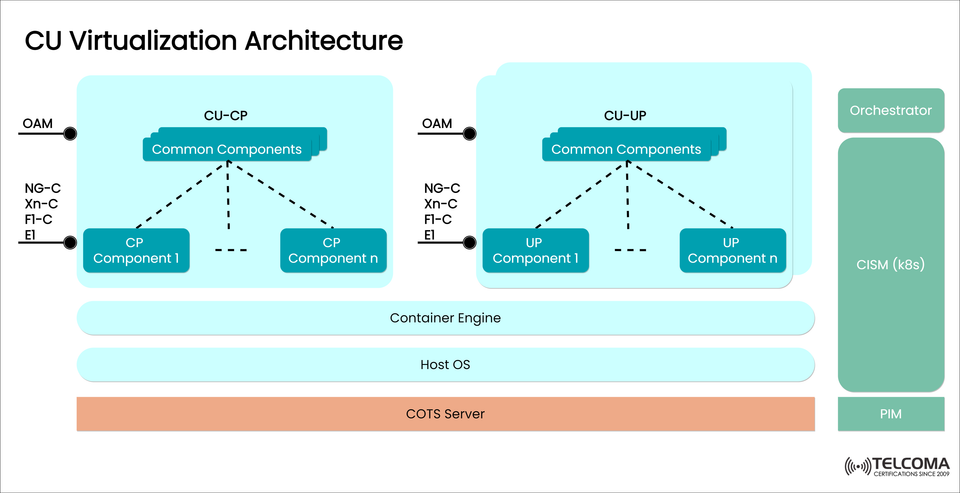
The CU (Central Unit) virtualization is significant to cloud-native 5G networks as it provides the flexibility in deployment, horizontal scaling, and multi-vendor support. The virtualized architecture separates the Control Plane (CU-CP) and User Plane (CU-UP) components so that they run on standard COTS (Commercial Off-The-Shelf) hardware based on containerized platforms like Kubernetes (K8s).
🧩 The Components of CU Virtualization Architecture
In the architecture diagram above, the virtualized CU components are segregated into CU-CP and CU-UP blocks, whereby each is deployed as separate containerized workloads.
🔹 CU-CP (Centralized Control Plane)
Common Components: Microservices that are shared such as configuration mgmt, state DB, etc.
CP Components 1 to n: Control Plane functionality for managing significant signaling protocols including NG-C, Xn-C, F1-C, and E1.
Interfaces:
NG-C: To connect to the 5G Core (AMF)
Xn-C: Handle control communication with intra/inter-gNB (gNB signalling)
F1-C: Control signalling interface to DU
E1: For the CU-CP to CU-UP split
🔹 CU-UP (Centralized User Plane)
Common Components: User data processing resources and management services.
UP Components 1 to n: Stateless data plane components handling the user traffic.
Interfaces:
NG-C: Indirect interface through CU-CP to 5GC
Xn-C, F1-C, E1: For interworking and split operations with DU and CU-CP
⚙️ Infrastructure Stack Overview
Layer Description
COTS Server Commodity x86 hardware with virtualization capabilities
Host OS Base OS supporting container runtime/ infrastructure (Linux flavours)
Container Engine to manage workloads in a container (Docker, CRI-O)
CISM (K8s) Cloud Infrastructure Service Manager (orchestrator), such as Kubernetes
Orchestrator Automates deployment, scaling, and lifecycle management
PIM Performance and Infrastructure Management Infrastructure
🛰️ Why CU Virtualization is Relevant in 5G
🔑 Key Benefits:
✅ Flexible Scaling: allows control and user plane components to scale independently .
✅ Resource Optimization: gets down to container level resource allocation.
✅ Multi-tenancy: allows network slicing and separation per use case.
✅ Vendor Independence: openness provides freedom to be disaggregated.
✅ Cloud Native: enables deployment in Private/Public edge cloud locations.
📐 Deployment Considerations
Latency Impact: UP components should be close to users to get low latency.
Security: separating containers, controls, user makes the network and applications more resilient.
Lifecycle Management: CI/CD process and monitoring relationships promote stability.
Interoperability: interfaces need to conform for smooth integration with DUs and Core.
🔚 Conclusion
CU Virtualization Architecture is a foundation for scalable, flexible networks. Separating control and user plane functions is essential to creating a 5G, edge cloud agnostic approach.
🚀 CU Virtualization Deployment Models
CU virtualization can take on many forms based on scale, topology, and use cases; the main deployment models are:
- Centralized Deployment.
CU-CP and CU-UP instances exist in the cloud and cloud data center is centralized.
Best for networks with stable backhaul and don't have high an latency requirements.
Streamlined for operations and orchestration.
- Distributed Deployment
CU-UP is deployed closer to the edge (e.g., MEC sites) and CU-CP is still centralized.
Best for ultra-low latency use cases (e.g., autonomous driving, AR/VR, industrial IoT use cases, etc.).
- Hybrid Deployment
CU-UP instances can be deployed selectively across edge as well as central sites.
CU-CP is shared across many UPs with Kubernetes-based orchestration.
Provides better balance of cost and performance across different geographies.
⚖️ Orchestration and Lifecycle Management
Cloud-native orchestration frameworks are required for telecom operators to run CU lifecycle management efficiently.
🧩 Kubernetes (K8s) as the Core Orchestrator
Responsible for managing containerized workloads from CU instances.
Auto-scaling, self-healing, and rolling upgrades are all supported.
Utilizes Cloud Infrastructure Service Managers (CISM) to schedule resource utilization.
🧠 Orchestrator Layer Functions:
Provisioning - Deployment on demand automatically.
Scaling - CU resources are dynamically adjusted per traffic.
Monitoring - Continuous health-checks of respective CP/UP instances.
Healing - Recovering from faults by restarting respective containers.
📊 Real-World Use Cases of CU Virtualization
Use Case CU Virtualization Role
Private 5G Networks Supports CU-UP running on-premises for secure enterprise traffic
Massive IoT Deployments Lightweight CU-CP allows management of a large volume of devices
Fixed Wireless Access Low-cost rollout of a centralized CU-CP and CU-UP edge
Network Slicing Isolated at the CU layer for differentiated services
🛠️ Challenges and Optimizing Solutions
While CU virtualization provides agility in implementation and benefits to several architectures, it does come with a few challenges:
⚠️ Typical Challenges
Performance Overhead: The net performance can vary with added containerization abstractions.
Complex Debugging: A distributed component make debug/troubleshooting more difficult.
Interoperability: Vendor neutral interfaces may also make validation more complex.
✅ Optimizing Suggestions
DPDK (Data Plane Development Kit) - Up performance.
Leverage light weight OS layers alpine Linux in containers.
Use observability tools like Prometheus and Grafana to monitor performance.
🧭 Conclusion
CU Virtualization is not just an architectural design choice, it effectively represents a conscious decision to move toward building resilient, programmable and scalable 5G Networks. We are creating a more rational split of CU-CP and CU-UP and by incorporating containerization, orchestration to enable logical layers of infrastructure function of the telecom networks to run so we can meet:
🔮 Predictions for CU Virtualization in 6G and Beyond
As networks advance toward 6G, CU virtualization will continue to evolve:
🧠 AI-Native CU Functions
CU-CP could directly embed AI/ML models for intelligent mobility management and beamforming decisions.
☁️ Full Cloud-Native RAN (CN-RAN)
Function-as-a-Service (FaaS) models leveraging serverless computing that go beyond containers.
Enhanced dynamic scaling per-user-session.
🌍 Edge Convergence
CU-UP instances will tightly couple with Edge Computing based environments, thus enabling real-time local content delivery and AR/VR use cases.
An Emerging Necessity for CU Virtualization
Benefit Description
Scaling Cloud and container-based elastic deployments on COTS hardware
Modularity Independent lifecylce of CP and UP functions
Automation & Orchestration Automation & orchestration can be managed via tools such as Kubernetes and CI/CD pipelines associated with cloud native tool chains
Vendor Agnostic & Flexible Enablement of open interfaces which foster multi-vendor interoperability
5G Ready Complements URLLC, mMTC and eMBB service types
📌 Takeaway
CU Virtualization is not simply a migration to the cloud; it is the process of transforming the radio network into a programmable, intelligent, and agile digital fabric. Whether 5G rollouts are planned or bleeding-edge innovations equivalent to 6G are being planned, undergoing CU virtualization is a fundamental step towards building resilient, future-proof networks.