
CUPS Architecture in EPC: Enabling Scalable and Flexible LTE Core Networks

CUPS Architecture in EPC: A Key Enabler of Future Mobile Networks
The landscape of mobile networks is rapidly shifting to 5G, and mobile operators are compelled to provide improved data throughput, reduced latency, and faster service onboarding. CUPS - Control and User Plane Separation, is one architectural shift to address these requirements in LTE EPC (Evolved Packet Core).
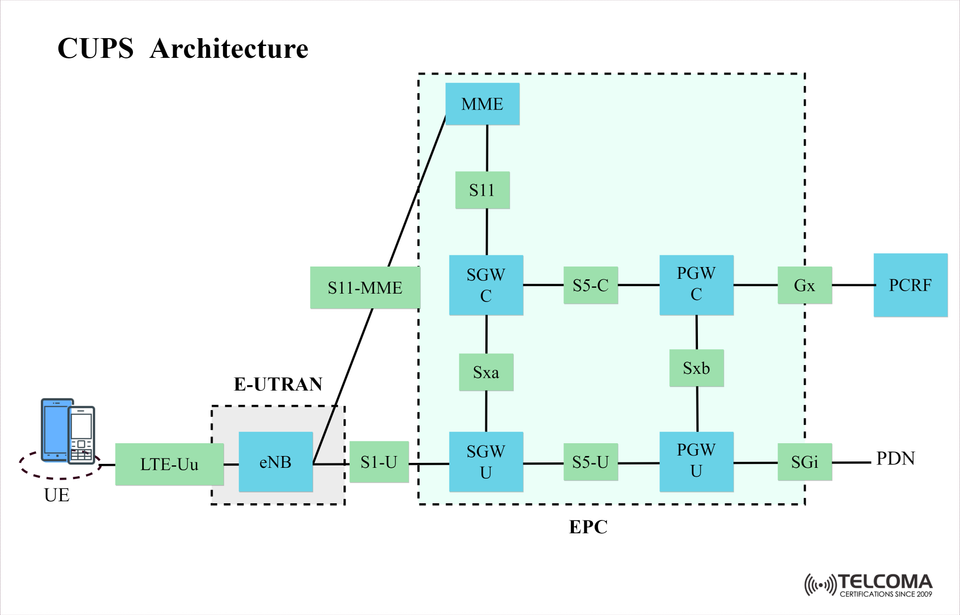
The attached drawing illustrates a simplified, but technically accurate depiction of CUPS architecture, and shows how CUPS implementation must be structured as part of an argument for network performance and flexibility in LTE networks, and a stepping stone to a 5G migration.
This guide is intended for the complete EPC evolution learners include telecom engineers, architects, and hobbyists.
What exactly is CUPS (Control and User Plane Separation)?
CUPS is an architectural enhancement to the Evolved Packet Core (EPC) introduced by 3GPP in Release 14. CUPS establishes separation of the control plane (C-plane) from the user plane (U-plane) in the network functions of the EPC:
Serving Gateway (SGW) → SGW-C and SGW-U
PDN Gateway (PGW) → PGW-C and PGW-U
Separating these functions enables independent scaling, flexible deployments, and lower latency.
CUPS Architecture: Components Described
The following provides a description of how the major network components will be described in the CUPS-enabled EPC:
CUPS Architecture: Component Overview
Here are the primary network components and their associations in a CUPS-enabled EPC:
🟦 UE (User Equipment)
Provides connectivity over the LTE-Uu interface to the eNodeB (eNB) in the E-UTRAN.
🟦 E-UTRAN (Evolved UTRAN)
The eNB interconnects the UE to the EPC via:
S1-U: User plane traffic to the SGW-U.
S11-MME: Control signaling to the MME.
🟦 Control Plane Functions
MME (Mobility Management Entity): Responsible for all signaling control and session control.
SGW-C (Serving Gateway – Control): Responsible for the bearer signaling and mobility.
PGW-C (PDN Gateway – Control): Responsible for IP session policies and IP session connections.
PCRF (Policy and Charging Rules Function): Communicates with PGW-C via the Gx interface to apply QoS and charging rules.
🟦 User Plane Functions
SGW-U (Serving Gateway – User): Forwards user traffic to destination, toward the PGW-U.
PGW-U (PDN Gateway – User): Routes traffic to/from the public data network (PDN).
🟩 Important Interfaces
Interface Description
S11-MME MME ↔ SGW-C
S1-U eNB ↔ SGW-U (User data path)
S5-C SGW-C ↔ PGW-C (Control signaling)
S5-U SGW-U ↔ PGW-U (User data transfer)
Sxa SGW-C ↔ SGW-U
Sxb PGW-C ↔ PGW-U
Gx PGW-C ↔ PCRF
SGi PGW-U ↔ the Internet/PDN
Value of CUPS in EPC
The implementation of CUPS provides a variety of operational and performance benefits in EPC.
✅ Independent Scale: The control and user planes can scale based on need.
✅ Edge Deployment: The user plane (SGW-U/PGW-U) can be located closer to the user to allow for ultra-low latency.
✅ Streamlined Upgrades: The control logic can evolve separately from the data plane.
✅ Resource Efficient: CUPS provides central nodes with reduced load and increased throughput.
✅ Future-proof: The architecture moves further toward 5G SBA (Service-Based Architecture).
CUPS vs Traditional EPC Architecture
Feature Traditional EPC CUPS-EPC
Plane Coupling Control & User tightly coupled Separate
Flexibility Limited High
Latency Higher Lower (because of edge user plane)
Scale Vertical Horizontal, scalable independently
5G Compatibility Legacy supported Aligned with evolution of 5G Core
Example use cases
📶 Network Slicing Support
CUPS allows user plane functions to be allocated per network slice to improve customized QoS for enterprise or IoT use cases.
🛜 Edge Computing Enablement
The deployment of PGW-U at the edge reduces the distance to the content and services, and allows for the future use of MEC (Multi-access Edge Computing).
🚦Traffic Offload
Operators can offload heavy user traffic with edge PGW-U nodes bypassing the central control planes.
Conclusion
The launch of CUPS in EPC means a fundamental shift to flexible, scalable, and low-latency mobile core networks, enabling operators to quickly respond to data demands, incorporate edge services, and seamlessly get ready for 5G Core (5GC).
For telecom professionals, knowledge of CUPS should be critical for delivering future-proof LTE networks and maintaining operational excellence as the mobile landscape evolves.
Deployment Considerations for CUPS
To take full advantage of CUPS, service providers must strategically plan deployment methodology with consideration for resources. Here are three important considerations:
🔧 1. User Plane Location (PGW-U, SGW-U)
Edge Deployment: For latency sensitive applications such as gaming or AR/VR, an edge deployment of user plane functions improves response time.
Centralized Deployment: if low traffic regions exist, centralized user plane nodes may be more cost-effective.
📡 2. Control Plane Centralization
Maintaining SGW-C and PGW-C as centralized provides simplicity in management, orchestration, and policy. This is especially crucial in pan-network large scale deployments.
🔐 3. Interface Security
There are various interfaces involved in CUPS, like Sxa, Sxb, S5-U, and S1-U - all of which carry user data along the user plane. Operators must protect interfaces with either IPsec tunneling or through a trusted core design.
☁️ 4. Virtualized and NFV Readiness
CUPS is ideally suited for Network Function Virtualization (NFV). This enables operators to deploy vSGW and vPGW in cloud-native orchestration platforms (OpenStack, Kubernetes, etc.).
Live Operators: How Some Operators Are Using CUPS Today
Some leading global telecom operators have already engaged CUPS to modernize their LTE networks and to bridge them to 5G:
AT&T: Uses CUPS to handle traffic offload and to create MEC use cases in stadiums and urban areas.
NTT DOCOMO: Deployed CUPS in its metro nodes to relieve core congestion and to enhance voice and video delivery.
Reliance Jio: Implements CUPS in order to independently scale LTE user plane across India's agglomerated high density mobile market.
Final Observations and Next Steps
CUPS is not just a feature - it's a strategic enabler of flexible, high-performance, and future enabled mobile core networks. Decoupled control and user planes can deliver capabilities such as:
🔁 On demand scaling based on traffic trends.
🌐 Service agility across many distributed edge and centralized cores.
📉 Reduced latency through user plane distribution.
🛠️ Simplified upgrades that follow 5G core design concepts.