
Deep Dive into the 5G User Plane Protocol Stack: Architecture, Layers, and Data Flow Explained
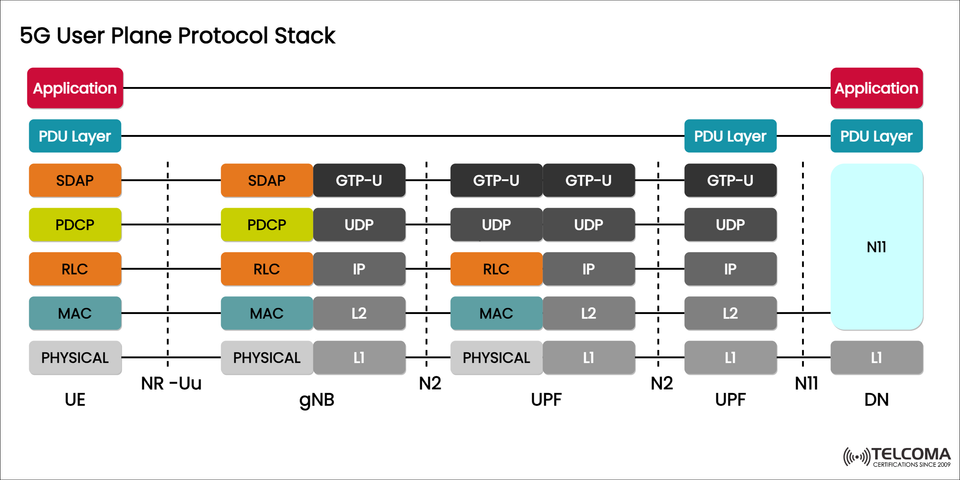

Getting to Know the 5G User Plane Protocol Stack
In the 5G world, how fast and efficiently data is transmitted really shapes the network's performance. The 5G User Plane Protocol Stack is crucial because it ensures swift, dependable delivery of user data—whether it’s being sent from smartphones to the cloud.
The diagram above shows how data travels from User Equipment (UE) to the Data Network (DN), passing through multiple layers and interfaces like NR-Uu, N2, and N11.
What’s the 5G User Plane?
The User Plane (U-plane) in 5G is all about transporting user data—this is where the actual content lives, like video streams, file downloads, or sensor data.
While it works in tandem with the Control Plane (C-plane) that manages signaling and session tasks, its primary focus is on making data transfer as efficient as possible while ensuring Quality of Service (QoS).
Main Goals of the 5G User Plane:
Secure and effective transport of user data.
Minimal latency with high reliability.
Managing QoS for different kinds of services.
Encrypting, compressing, and routing data.
Supporting seamless handover and mobility.
A Quick Look at the 5G User Plane Protocol Stack
The 5G User Plane Protocol Stack defines the journey of data as it moves through the network, from the user’s device to the data network.
It consists of several network nodes:
Node Role Interface UE (User Equipment)Source or destination of user data.NR-UugNB (Next Generation Node B)5G base station managing radio and PDCP layers.N2, N3UPF (User Plane Function)Routes data between RAN and the core network.N3, N9, N6DN (Data Network)The endpoint (like the Internet or a private cloud).N6
Each node has specific layers that work together through established interfaces, making sure data flows smoothly and reliably.
Layer-by-Layer Dive into the 5G User Plane
The protocol stack includes various layers, each with a distinct role in data transfer. Let’s explore them from the top down.
a. Application Layer
On both the UE and DN sides, the Application Layer deals with user-level data—think web browsing, streaming, or IoT telemetry.
This application data gets passed to the PDU layer for further handling and transmission.
b. PDU Layer
The PDU (Protocol Data Unit) Layer lays out how user data packets are structured during transmission. In 5G, these can be IP PDUs or Ethernet PDUs, depending on what kind of session it is.
It ensures that user data is properly encapsulated and manages QoS flows—which is super important for keeping service quality consistent across various applications.
c. SDAP (Service Data Adaptation Protocol)
The SDAP is special to 5G NR and plays a significant role in QoS management. It sits between the PDU layer and the PDCP.
Key Roles:
Maps QoS Flows to Data Radio Bearers (DRBs).
Ensures services have the right QoS differentiation.
Adds or removes SDAP headers as needed.
SDAP makes sure that apps like HD video, online gaming, and IoT sensors get the attention and reliability they need.
d. PDCP (Packet Data Convergence Protocol)
The PDCP layer takes care of data encryption, integrity protection, and header compression.
PDCP Duties:
Ciphering/deciphering user plane data for security.
Header compression (ROHC) to cut down on overhead.
Reordering and duplicate detection.
In-sequence delivery of data packets.
PDCP operates in both the UE and gNB, ensuring that data is handled securely and effectively over the air interface.
e. RLC (Radio Link Control)
The RLC layer ensures error correction and segmentation/reassembly of data packets.
Operating Modes:
Acknowledged Mode (AM): Reliable delivery with retransmission.
Unacknowledged Mode (UM): For low-latency, real-time applications.
Transparent Mode (TM): Used mainly for control signaling.
RLC makes sure that if packets get lost or corrupted over the air, they’re either fixed or resent before reaching the higher layers.
f. MAC (Medium Access Control)
The MAC layer is responsible for resource scheduling, multiplexing, and error detection at the radio interface.
This layer is key to managing the air interface efficiently.
Main Functions of the MAC:
Scheduling both uplink and downlink traffic.
Detecting errors with HARQ (Hybrid Automatic Repeat Request).
Prioritizing traffic according to QoS.
Mapping logical channels to physical transport channels.
Once Data Hits the gNB: Core Network Protocols
After user data reaches the gNB, it moves into the 5G Core Network (5GC) through N3 and N9 interfaces, using transport protocols such as GTP-U, UDP, and IP.
a. GTP-U (GPRS Tunneling Protocol - User Plane)
Responsible for tunneling user data between the gNB and UPF.
Ensures session continuity and mobility.
Encapsulates PDUs for core network transit.
b. UDP (User Datagram Protocol)
A connectionless transport protocol that provides low latency.
Carries GTP-U packets.
c. IP (Internet Protocol)
Deals with addressing and routing within the 5G core and external data networks.
Supports both IPv4 and IPv6 addressing.
These layers make sure user data gets delivered efficiently from the radio network to the data network.
Data Flow in the 5G User Plane
Here’s a step-by-step look at how user data flows:
User data starts at the Application Layer in the UE.
It moves through SDAP → PDCP → RLC → MAC → PHY and is sent over NR-Uu.
The gNB processes the data and uses GTP-U to tunnel it to the UPF.
The UPF then routes the packet to the Data Network (DN) through N6.
The response data takes the same route back to the UE.
This flow is designed for fast, secure, and low-latency transmission.
Benefits of the 5G User Plane Structure
The new design of the 5G User Plane brings several advantages over LTE:
A QoS flow-based design thanks to SDAP.
A clear separation of user and control planes for more flexibility.
A cloud-native UPF that supports scalability and network slicing.
Low-latency GTP-U tunneling to enable real-time services.
Support for multi-access edge computing (MEC).
These enhancements make 5G particularly suited for applications like autonomous vehicles, smart factories, and immersive AR/VR experiences.
Conclusion
The 5G User Plane Protocol Stack is fundamental to enabling the high-speed, reliable data transmission that 5G offers. Each layer—from SDAP to PHY—has a unique role in optimizing data handling, security, and QoS.
By getting a grip on these layers and interfaces, telecom professionals can better design, optimize, and troubleshoot 5G networks.
As 5G continues to grow and merge with AI, edge computing, and IoT, the user plane’s flexible and software-defined design will keep shaping the future of global connectivity.