
Demystifying the O-RAN Fronthaul: Understanding CU-plane, S-plane, and M-plane in 5G RAN

Introduction: The Foundation of Open RAN Connectivity
The Open Radio Access Network (O-RAN) is shaking things up in the telecom world by separating hardware from software in mobile networks. This shift allows for greater openness, interoperability, and flexibility.
At the core of this change is the O-RAN Fronthaul Interface, which acts as the link between the O-DU (O-RAN Distributed Unit) and the O-RU (O-RAN Radio Unit).
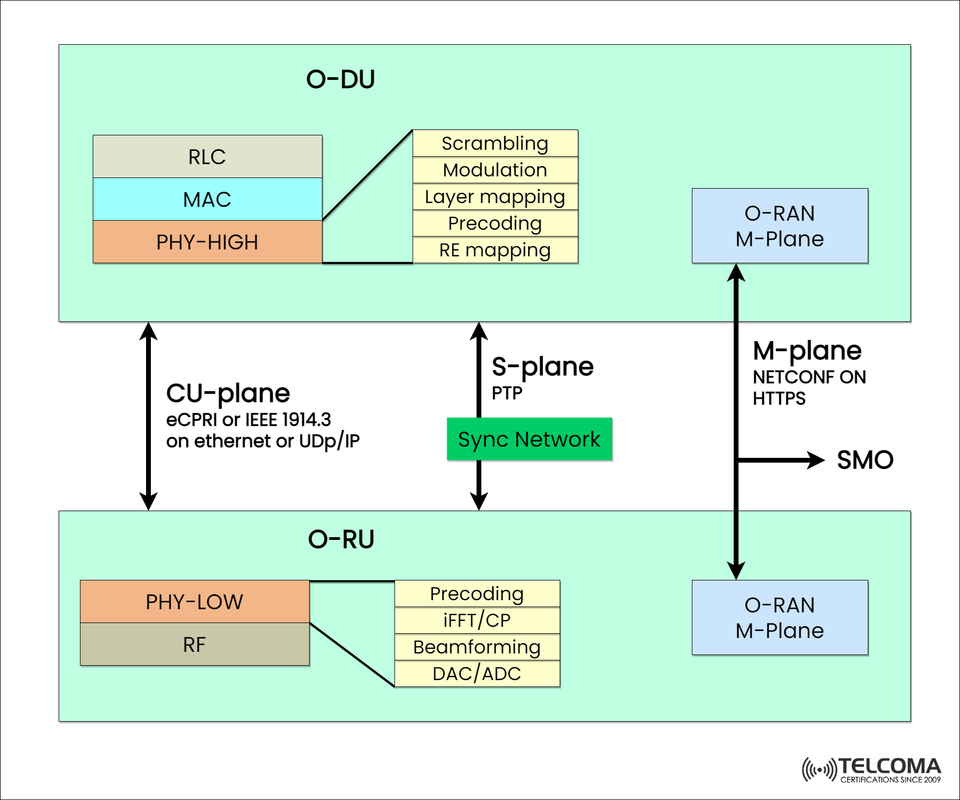
This interface, illustrated in the diagram, works through three main logical planes:
CU-plane (Control/User Plane) – Handles data and control traffic.
S-plane (Synchronization Plane) – Keeps timing and synchronization spot on.
M-plane (Management Plane) – Takes care of configuration, monitoring, and fixing faults.
All these planes work together to ensure smooth communication, synchronization, and management of RAN components, which is crucial for solid 5G network performance.
The O-RAN Fronthaul Architecture at a Glance
The fronthaul architecture breaks down the baseband and radio functions into two separate logical units:
O-DU (Distributed Unit) — takes on the higher-layer baseband tasks.
O-RU (Radio Unit) — deals with lower PHY and RF processing.
Thanks to the open fronthaul interface, communication between these units is standardized, enabling interoperability among different vendors. This modular setup allows for flexible network scaling and sparks innovation.
Here’s how it works:
The O-DU manages higher-layer protocols like RLC, MAC, and PHY-High.
The O-RU is in charge of PHY-Low and RF functions for the actual radio transmission.
Key Features of the CU-plane:
Low-latency, high-throughput transport for I/Q samples and control data.
Bidirectional data flow between O-DU and O-RU.
Dynamic bandwidth allocation and QoS management.
Example Functions:
Sending I/Q data streams.
Managing scheduling commands and link adaptation messages.
Facilitating uplink (UL) and downlink (DL) signaling.
Overall, this plane serves as the data lifeline between O-DU and O-RU, ensuring that radio functionalities are executed without delay.
S-plane: Precision Synchronization Network
Synchronization is essential in 5G, especially for technologies like Massive MIMO and TDD (Time Division Duplexing).
The S-plane (Synchronization Plane) makes sure that both O-DU and O-RU are perfectly aligned in time, preventing interference and ensuring smooth multi-cell coordination.
S-plane Protocol:
Utilizes PTP (Precision Time Protocol) based on IEEE 1588v2 for syncing time.
S-plane Responsibilities:
Clock distribution and synchronization among network elements.
Keeping frequency, phase, and time aligned.
Supporting frame timing for both uplink and downlink operations.
The Sync Network, shown in the image, offers a shared timing reference to O-DU and O-RU, keeping radio transmissions phase-aligned across various locations.
Without accurate synchronization, advanced features like beamforming, handover, and inter-cell coordination wouldn't function effectively.
M-plane: Secure Management and Configuration
The M-plane (Management Plane) is responsible for all configuration, monitoring, and fault management tasks.
It operates through NETCONF (Network Configuration Protocol) over HTTPS, ensuring secure communication between network elements and the Service Management and Orchestration (SMO) system.
Key Functions of the M-plane:
Configuration Management: Setup, software updates, and tuning operational parameters.
Fault Management: Spotting and resolving hardware or communication issues.
Performance Monitoring: Gathering KPIs like throughput, delay, and error rates.
Security: Ensuring that control messages are authenticated and encrypted.
Integration with SMO:
The Service Management and Orchestration (SMO) layer employs the M-plane to manage and optimize O-RU and O-DU functions from afar, enabling centralized and automated RAN management.
This feature is vital for cloud-native RAN deployments and supports zero-touch provisioning, boosting operational efficiency.
The Role of Functional Split (7-2x Split)
O-RAN embraces the 7-2x functional split, partitioning PHY layer duties between the O-DU and O-RU.
O-DU (PHY-High)O-RU (PHY-Low)
Scrambling Precoding
Modulation iFFT/CP
Layer Mapping Beamforming
Resource Element Mapping DAC/ADC Conversion
Advantages of the 7-2x Split:
Reduced Fronthaul Bandwidth: Less data moves between O-DU and O-RU.
Improved Flexibility: Enables different vendors to supply DUs and RUs.
Optimized Processing: Centralized computation in the O-DU, distributed radio control in the O-RU.
This split strikes a good balance between network performance and deployment flexibility.
Inter-Plane Communication Flow
The communication across the planes happens simultaneously, with each one tackling its own set of tasks:
Plane Protocol Primary Function
CU-plane eCPRI or IEEE 1914.3 Transmits user and control data.
S-plane PTP (IEEE 1588v2) Synchronizes timing and frequency.
M-plane NETCONF/HTTPS Manages configuration and operations.
This structured communication setup guarantees smooth interoperability between O-DU and O-RU, enhancing reliability and scalability.
Integration with the O-RAN M-Plane and SMO
As seen in the image, both the O-DU and O-RU are equipped with an O-RAN M-Plane linked to the SMO (Service Management and Orchestration).
This connection allows network operators to:
Monitor device health and performance in real-time.
Conduct remote software updates and troubleshoot issues.
Automate network provisioning and scaling.
Through the O-RAN Alliance-defined O1 interface, the SMO interacts with RAN components, facilitating full lifecycle management — from setup to optimization.
Benefits of O-RAN Fronthaul Architecture
Benefit Description
Open and Interoperable Enables multi-vendor integration for flexibility.
Cost Efficiency Ethernet-based fronthaul cuts down on reliance on proprietary hardware.
Centralized Intelligence AI/ML-driven control in the O-DU or RIC boosts performance.
Enhanced Synchronization PTP-based timing secures precise operation across cells.
Secure Management NETCONF/HTTPS allows for encrypted control and monitoring.
Scalability and Automation SMO and M-plane integration enables dynamic scaling.
These benefits make the O-RAN architecture a great fit for next-gen networks aiming for agility, efficiency, and openness.
Real-World Application: Coordinated Beamforming
One practical example of O-RAN fronthaul is coordinated beamforming, where several RUs collaborate to direct radio signals toward specific users:
The O-DU computes the optimal beamforming weights based on channel conditions.
These weights are transmitted to the O-RU via the CU-plane.
The O-RU uses these weights during transmission, enhancing coverage and capacity.
This process heavily relies on S-plane synchronization and fast CU-plane communication, showcasing how each plane plays a role in advanced 5G capabilities.
Conclusion: Building the Foundation for Open 5G Networks
The O-RAN Fronthaul Interface — made up of the CU-plane, S-plane, and M-plane — is essential for open, intelligent, and programmable RAN systems.
By distributing tasks across these planes, O-RAN guarantees efficient data transport, precise synchronization, and centralized management.
This open framework not only improves interoperability and cost efficiency, but also paves the way for AI-driven automation and cloud-native RAN deployments.
As we look toward the evolution of 5G into 6G, getting a handle on the O-RAN fronthaul architecture will be vital for operators and engineers aiming to build flexible, future-ready networks.