
Deployment Models of Edge Computing: Fog, MEC, and Cloudlets Explained

🌐 Familiarizing Yourself With Edge Computing Deployment Models: Fog, MEC, and Cloudlets
Edge computing is technology is critical in driving the research and development of 5G, IoT, and autonomous systems, allowing for low-latency processing at geographic proximity to the sources generating the data. However, edge deployment/the use of edge technology itself is not a "one-size-fits-all" case. In this article, we dive deep into the three edge computing deployment models — understanding the principles, outline, requirements, differences, capabilities, and eventual use cases.
🧩 What Are the Major Deployment Models of Edge Computing?
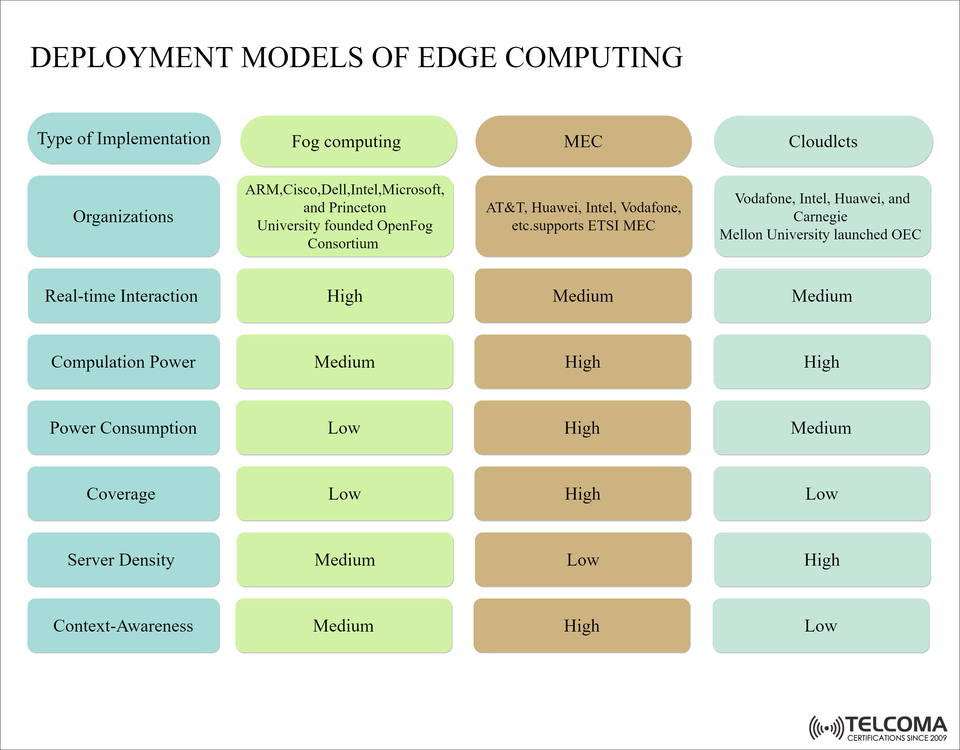
The below image collates and highlights the three major models:
Attribute Fog Computing MEC Cloudlets
Organizations ARM, Cisco, Intel, Microsoft (OpenFog) AT&T, Huawei, Intel, Vodafone (ETSI MEC) Intel, Vodafone, Carnegie Mellon (OEC)
Real-time Interaction High Medium Medium
Computation Power Medium High High
Power Consumption Low High Medium
Coverage Low High Low
Server Density Medium Low High
Context-Awareness Medium High Low
🚀 Fog Computing: Real-Time Intelligence in Edge Computing
Fog Computing is perfect for time constrained apps, such as connected vehicles, industrial automation, and real-time robotics. It is more of an extension of cloud-like capability down to local networks.
✅ Key Takeaways:
- High degree of real-time inteaction
- Low power usage can be suitable for remote, or battery recreation.
- Medium level computing power and server density
📌 Best Suited For:
Smart cities
Manufacturing automation
Industrial IoT (IIoT)
🏗️ Multi-Access Edge Computing (MEC) - Telco-Grade Intelligence at the Network Edge
MEC is an ETSI-defined framework that brings edge capabilities directly into telecommunication networks. MEC is defined as the de facto model for all 5G use cases with its ultra-low latency and context-awareness.
✅ Key Highlights:
High compute
More geographic coverage due to telco integration
Supported by AT&T, Intel, Huawei, Vodafone, etc.
Context-aware and location-based
📌 Best Suited For:
5G networks
Augmented reality/virtual reality (AR/VR)
Autonomous vehicles
Content aware optimization
💻 Cloudlets - Mini Data Centers at the Edge
Cloudlets are small-scale cloud data centers, localized to their users. They are purpose-built for high-bandwidth, low-latency applications with fast computation offload capability.
✅ Key Highlights:
High-density compute
Medium power use
Limited coverage but high efficiency at local zones
Launched by Intel, Vodafone, and Carnegie Mellon University
📌 Best Suited For:
Mobile cloud gaming
Smart healthcare systems
University campus networks
Edge AI applications
⚖️ The Right Deployment Model - Considerations
Use Case Recommended Model
Latency-critical apps Fog Computing
Telco operators MEC
High-density campus compute Cloudlets
Low-powered, decentralized IoT Fog Computing
AR/VR and immersive media
🔚 CONCLUSION: STRATEGIC PLANNING FOR EDGE MODELS AND REAL-WORLD REQUIREMENTS
Edge computing continues to evolve and presents a variety of models to meet different network topologies, power requirements, and latency needs. Fog Computing is best where real-time interaction and low power requirements must coexist. MEC is best for scalability and telco-grade resiliency, as well as cloudlet computing, which combines very localized and resource-intensive computing.
Being aware of these models is important for telecom engineers, network architects, and edge AI developers seeking to optimize their performance and scalability while reducing unnecessary costs in their deployment decisions.
🌎 INDUSTRY AND TRENDS
Edge computing deployment models are evolving quickly with the advent of 6G and AI at the edge. These systems will be demanding faster, contextually relevant and decentralized methods of processing. Here are some areas the industry appears to be leaning:
🏭 Fog Computing
Adoption: Industrial IoT, smart factories, and remote monitoring systems are growing in use.
Trend: Additional and integration with AI/ML for initial predictive analytics at the edge.
📡 MEC (Multi-Access Edge Computing)
Adoption: Well established with telecom operators and part of plans for delivering 5G services.
Trend: Emerging as a centerpiece in network slicing and private 5G deployments in the enterprise sector.
🖥️ Cloudlets
Adoption: Particularly suited for campus networks, certain university R&D, and mobile game development.
Trend: Being incorporated in edge federations and utilized in academic networking for experimentation and agile prototyping.
🧠 Expert Tip: Design Edge Architecture Around Application Layer Considerations
When selecting an edge computing model, you should:
Use Fog when your requirements call for low latency and when power availability is constrained.
Use MEC for telecommunications native applications and for wide-area delivery.
Use Cloudlets where high densities of low-latency computational power are needed in localized areas.
📣 Connect to Edge Ecosystem
Are you an organization developing or working towards edge deployments? Here are some tips to keep your edge focus front of mind:
Participate and join in consortia like the OpenFog Consortium, ETSI MEC, or Open Edge Computing Initiative.
You should also explore open source platforms like EdgeX Foundry, Akraino, and LF Edge.
You can also attend conferences like Edge Computing World and Mobile World Congress.
🔚 Summing it Up
Edge computing is not a monolith but rather a continuum of deployment models optimized to be used in deployments for specific applications, contexts, stakeholder industries, and user requirements. By understanding how Fog, MEC, and Cloudlets differ, telecommunications professionals and developers can design edge solutions that are scalable, adaptable, and future-fit.
In a world of 6G, AI, and intelligent automation as a reality, your ability to define what to choose and how to deploy models of edge computing is going to be a key differentiator in the digital infrastructure landscape.
📌 Recommended Key Words:
Edge Computing Deployment Models
Fog vs MEC vs Cloudlets
Edge Computing for 5G and IoT
MEC in Telecom Networks
OpenFog and OEC
Edge Computing
🧩 Optional Extensions for Further Content
You could add to this blog post even more by:
📘 Creating Companion Content
Infographic: A visual side-by-side comparison of Fog, MEC and Cloudlets.
White Paper: "Design Considerations for Edge Computing in 6G Networks."
Case Study: A real-world deployment of Cloudlets on university campuses.
🎥 Multimedia
Short Video: An explanation of Edge Models in 2-minutes or less.
Podcast: An interview with a telecom architect or an OpenFog contributor.
🛠️ Developer Focus
Code Sample: Running an edge AI model on a Cloudlet.
Tutorial: Setting up MEC with open source tools.