
Designing Scalable 5G Systems for High-Quality Content Delivery

Building Scalable 5G Systems for High-Quality Content Delivery
As people start consuming more media in immersive formats like 360° videos, VR (Virtual Reality), and UHD streaming, networks really need to step up their game to meet these demands efficiently. 5G broadcast technology paired with unicast services like eMBMS (Evolved Multimedia Broadcast Multicast Service) gives us the scalability and flexibility we need for seamless high-quality content delivery.
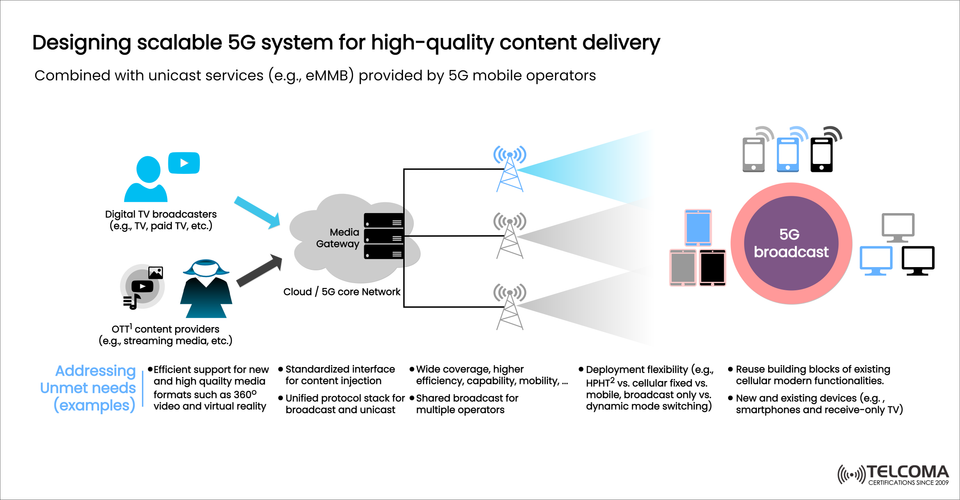
The diagram we've uploaded shows how digital TV broadcasters and OTT content providers connect to a 5G core network via a media gateway, which allows for scalable 5G broadcasting that can reach smartphones, tablets, smart TVs, and other connected devices.
This setup is crucial for the next phase of content delivery, combining broadcast efficiency with personalized unicast services.
Why Scalable 5G Content Delivery is Important
Telecom operators and content providers are facing a lot of challenges:
Increasing demand for streaming services (think Netflix, YouTube, Disney+).
A massive rise in mobile video consumption, especially with short clips and live events.
New immersive formats (like VR, AR, and 360° videos).
The need for simultaneous delivery to millions of devices.
If we don’t have scalable solutions, traditional unicast delivery can really struggle during peak times, leading to congestion, buffering, and a not-so-great user experience. 5G broadcast tackles this by sending the same content to multiple devices at once, which saves on spectrum and resources.
How Scalable 5G Content Delivery Works
The diagram lays out a straightforward workflow of 5G broadcast and unicast integration:
Content Sources * Digital TV broadcasters (like paid TV, linear TV, live sports). * OTT content providers (streaming media, VoD platforms).
Media Gateway / Cloud / 5G Core * Standardized interfaces for bringing in content. * Unified protocol stacks for both broadcast and unicast. * This acts as the distribution brain of the whole system.
5G Radio Network * Broadcast transmission using multiple base stations. * Shared broadcast resources among various operators.
End Devices * Devices like smartphones, tablets, smart TVs, and receive-only TVs. * They can easily switch between broadcast and unicast modes based on coverage and what services they need.
Tackling Unmet Needs with 5G Broadcast
The image shows how 5G systems fill in the gaps left by older delivery methods.
- Support for New Media Formats
360° videos and VR need high bandwidth and low latency.
5G broadcast makes sure there's consistent quality even when millions are watching at the same time.
- Standardized Interfaces
Content providers can use a standardized injection interface, which makes integration much easier.
This reduces fragmentation between broadcasters, OTT platforms, and operators.
- Efficiency and Coverage
5G broadcast offers broad coverage, high efficiency, and mobility support.
Shared broadcast channels among operators help cut down on duplication.
- Flexible Deployment Models
It can be set up for HPHT (High Power High Tower) or traditional cellular networks.
Dynamic switching between broadcast-only and hybrid modes.
- Compatibility and Reusability
It reuses existing cellular building blocks, which helps with lowering deployment costs.
Works with both new and old devices (like smartphones, receive-only TVs).
Broadcast vs. Unicast in 5G: A Balanced Method
5G content delivery merges broadcast and unicast methods for top efficiency.
Feature5G Broadcast5G Unicast (eMBMS)Efficiency One-to-many delivery, saves bandwidth One-to-one, uses a lot of resources Scalability Perfect for live events and popular content Great for personalized streams Coverage Wide, accommodates multiple operators Depends on unicast traffic loads Use Cases Live sports, TV, public safety updates Personalized videos, targeted ads Device Support Compatible with enabled smartphones & TVs Works on any 5G device utilizing eMBMS
By blending the two, operators can provide mass-market broadcasts while also creating personalized unicast experiences.
Benefits for Stakeholders
For Telecom Operators
Spectrum efficiency: Cuts down on duplicated streams.
Cost savings: Shared infrastructure helps multiple operators.
New revenue streams: Opportunities in premium content delivery, advertising, and partnerships.
For Content Providers
Unified distribution: A single channel for both broadcast and unicast.
Scalable reach: Millions of users can be reached at once.
Flexibility: Standardized protocols make integration smoother.
For Consumers
Better QoE (Quality of Experience): Streaming becomes smoother, with no buffering even during peak times.
Access to immersive content: Enjoy VR, 360° videos, and UHD streaming on mobile devices.
Device compatibility: Works across smartphones, tablets, and smart TVs.
Flexible Deployment in 5G Broadcast
The image highlights deployment flexibility, showcasing how adaptable 5G broadcast can be:
HPHT (High Power High Tower) versus cellular fixed networks.
Mobile vs. broadcast-only setups.
Dynamic mode switching – smooth transitions between broadcast and unicast depending on demand.
This adaptability allows operators to adjust deployments to suit urban, rural, and event-driven settings.
Real-World Uses of Scalable 5G Content Delivery
Live sports streaming for millions without buffering.
Emergency broadcast alerts sent to all devices at the same time.
Interactive VR concerts and events.
Next-gen TV services that combine traditional TV with streaming.
Smart education platforms offering 360° classroom experiences.
Looking Ahead: 5G Broadcast and Beyond
The future of 5G broadcast is closely tied to 6G research and beyond, focusing on:
Edge computing integration for quicker response times.
AI-driven content distribution for smarter resource sharing.
Satellite-5G convergence for worldwide coverage.
Ultra-immersive formats like holographic streaming.
These advancements will not only enhance entertainment but also support public safety, education, and enterprise applications.
Key Takeaways
5G broadcast works with unicast services to deliver scalable, high-quality content.
It addresses needs like VR/360° support, standardized interfaces, and efficient coverage.
Offers deployment flexibility and device compatibility, making adoption easier.
Benefits stakeholders like operators, content providers, and consumers.
Future developments will push scalability further into AI, edge computing, and holographic content.
Wrap-Up
Creating scalable 5G systems is crucial for delivering high-quality, future-ready content. The blend of broadcast and unicast in 5G networks enables operators to find the right balance between efficiency and personalization. Digital TV broadcasters, OTT providers, and telecom operators can collaborate using standardized interfaces, unified protocol stacks, and shared infrastructure to cater to billions of users.
With its ability to recycle existing cellular infrastructure, support fresh formats like VR, and cater to both old and new devices, 5G broadcast is gearing up to reshape the media landscape.
As we move forward with 5G and its intersections with emerging technologies, scalable systems will become the backbone of immersive, reliable, and universally accessible content delivery.